Bachelor studies
The School of Engineering offers ten different Bachelor’s degree programmes. Teaching is practice-oriented and provides opportunities to connect with potential future employers while you are still studying.
We contribute to most of these degree programmes, which can be completed either full-time or part-time, and are particularly involved in the following two:
Building on the foundational studies, you will gain in-depth knowledge of algorithms, machine learning, data mining and artificial intelligence, as well as a wide range of specialised topics within the areas of expertise of the Centre for Artificial Intelligence.
We place great importance on developing our students' scientific and research skills, as these are essential for practical engineering work in the field of AI. Our lecturers at the CAI are not only highly qualified academically but also bring extensive professional experience and a broad network of contacts.
As part of these degree programmes, they offer a limited number of opportunities to undertake a research project during the final year of study. These projects are characterised by their clear research focus and higher level of academic rigour. This gives you a competitive advantage in successfully completing your studies and subsequently entering the professional world.
Student Theses
You can find the complete list of student projects supervised by experts at the CAI here. Below is an example of a successful Bachelor's thesis that won numerous awards and was also published in a scientific journal.
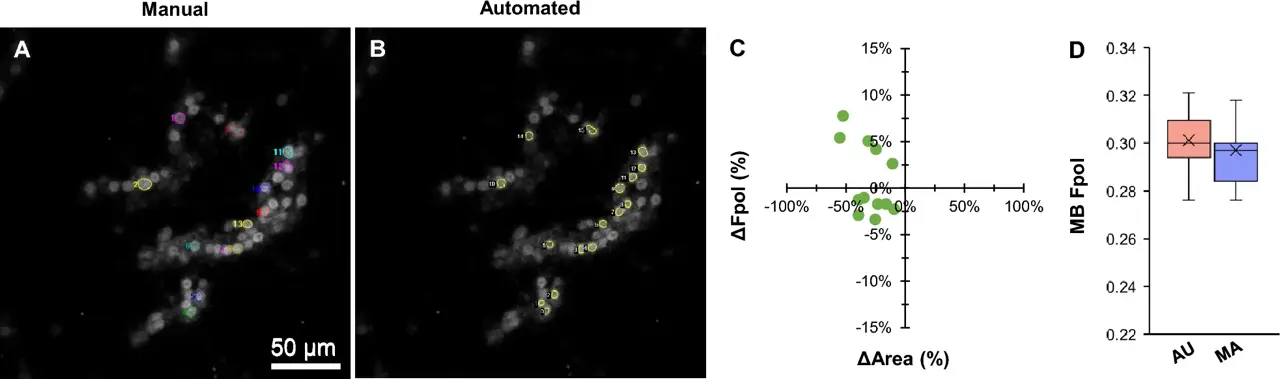
Deep learning-based cell segmentation for rapid optical cytopathology of thyroid cancer
Bachelor Thesis (Computer Science)
Fluorescence polarization (Fpol) imaging of methylene blue (MB) is a promising quantitative approach to thyroid cancer detection. Clinical translation of MB Fpol technology requires reduction of the data analysis time that can be achieved via deep learning-based automated cell segmentation with a 2D U-Net convolutional neural network. Time required for auto-processing was reduced to 10 s versus one hour required for manual data processing. https://www.nature.com/articles/s41598-024-64855-2