Curriculum design
Combining theory and practice
The Master of Science in Engineering comprises a total of 90 ECTS points, which is equivalent to a time expenditure totalling 2700 hours. You will earn 30 credits by attending the theory modules. Another 30 ECTS poins are based on practical application of the knowledge acquired at the institutes and centres with which you are affiliated. Passing the Master's thesis will earn you 30 additional credits. The Master of Science in Engineering therefore offers a particularly high level of practical relevance.
Select an institute or centre
Select one of our institutes and centres that offers your chosen profile. Deepen your knowledge through practice-oriented research and development projects, and tailor the programme to your individual interests and career goals.

You can also see on the profile pages at which institute or centre you can study.
Full-time curriculum design
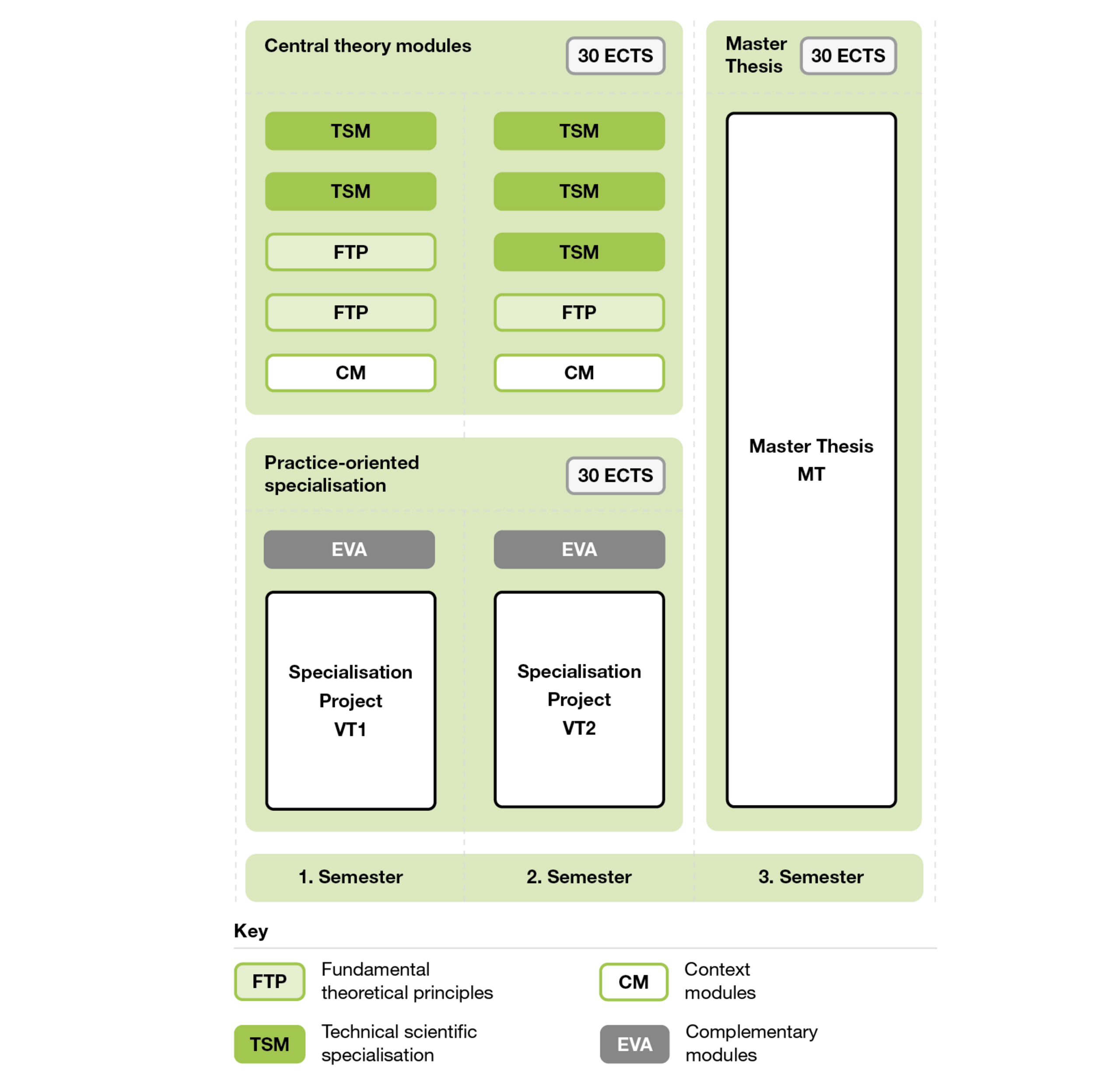
The full-time curriculum lasts three semesters and comprises 90 ECTS credits. In the first two semesters, students complete central theory modules as well as practice-oriented specialisation modules. These include modules in the areas of Fundamental Theoretical Principles, Technical Scientific Specialisation, Context Modules and Complementary Modules. In addition, students work on one specialisation project in each of the first and second semesters. The third semester is dedicated to the Master’s thesis.
Part-time curriculum design
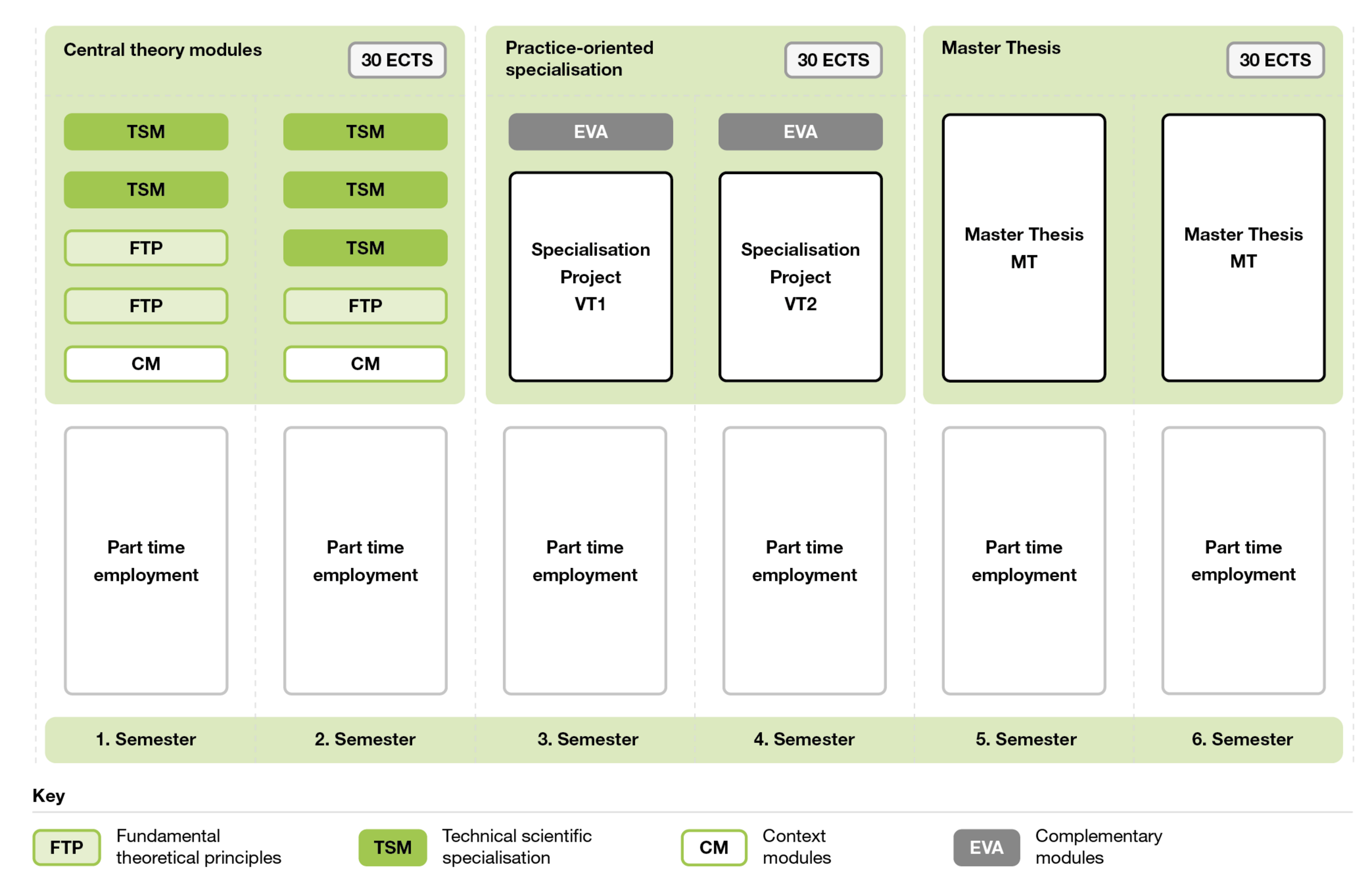
The part-time curriculum lasts six semesters and comprises 90 ECTS credits. It is designed to be combined with part-time employment throughout the programme. In the first two semesters, students complete central theory modules in the areas of Fundamental Theoretical Principles, Technical Scientific Specialisation and Context Modules. In the third and fourth semesters, they complete practice-oriented specialisation modules, including Complementary Modules and one specialisation project per semester. The fifth and sixth semesters are dedicated to the Master’s thesis.
Theory modules
The theoretical training with 30 credits comprises around one third of the Master's degree programme. There is a variety of modules to chose from.
At least ten modules must be selected from the full range: three FTP-modules (fundamental theoretical principles), five TSM-modules (technical scientific specilisation) and two contextual modules. Selection takes place on the basis of an agreement with your advisor. This results in a study plan optimised to suit your individual study objectives. The planning software MSE-Tools serves as an aid in this process.
Fundamental theoretical principles (FTP)
Foundation modules extend your basic mathematical-scientific knowledge. Depending on the profile and the chosen field of expertise, a model plan of study is recommended. For each field of expertise, three mandatory modules are defined which you must take in all cases. Deviations in the study programme are permitted.
Technical scientific specialisation(TSM)
The modules for the technical focus promote the degree of specialisation. You must take at least five modules. Depending on the profile, the profile commission makes recommendations which facilitate the selection process. The institutes and centres can declare individual modules as mandatory.
Context modules (CM modules)
Contextual modules serve the purpose of interdisciplinary broadening of knowledge. These modules convey important non-technical themes from the fields of management, quality assurance and jurisprudence. You must take at least two of these modules.

Practice-oriented in-depth specialisation
Practice-oriented in-depth specialisation accounts for one third of the course of study. This enables you to acquire targeted practical know-how in an environment characterised by real industrial research and development projects. You will normally work on two projects. In the first, you will act as a team member of a development group. You will be allocated a specific task and expertly supported by lecturers or experienced scientific staff. During the second project, you will be allocated additional conceptual tasks and greater development responsibility.
The supplementary events (EVA), from which you earn at least six credits, are also part of the in-depth specialisation block. EVA events are special theory modules designed to help promote development of your specialism. These modules are always organised by the institute/centre where you are studying. However, you can also take suitable modules offered by other universities.
Overview Complementary Events:
- AI for Anomaly Detection in Complex Systems: a Hands-On Tutorial (PDF 144 kB) (rEVA_AnDet)
- Aircraft Structural Integrity (PDF 154 kB) (rEVA_AcStruct)
- Advanced Software Production Seminar (PDF 133 kB) (rEVA_SoftPro)
- Artificial Intelligence for Healthcare (PDF 212 kB) (rEVA _AIHC)
- Computer Systems Performance (PDF 154 kB) (rEVA_SysPerf)
- Computational science and engineering for air conditioning systems (PDF 195 kB) (rEVA_CE4AC)
- Computational science and engineering for intelligent energy buildings (PDF 225 kB) (rEVA_CE4IB)
- Cost management in product development (PDF 165 kB) (rEVA_CMPD)
- Current Topics in Blockchains and Distributed Ledger Technology (PDF 102 kB) (rEVA_BDL)
- Engineering Practice within Asian and Swiss Culture (MSE Asia Module) (PDF 137 kB) (mEVA_Asia)
- Ethical Hacking (PDF 142 kB) (rEVA_CTF)
- Future Networks and Security (PDF 170 kB) (rEVA_FutNWSec)
- Future oriented technology analysis (PDF 180 kB) (rEVA_FOTA)
- Hands-on Experiences in Spectroscopy, Interferometry, and Light Emission (PDF 156 kB) (rEVA_PhotLab)
- HealthTech Summer School (PDF 162 kB) (rEVA_HealthTech)
- Information Security Seminar (PDF 223 kB) (rEVA_InfoSecSeminar)
- Innovathon: The Digitalization of Mobility (PDF 151 kB) (rEVA_DoM)
- Introductory optics for photonics (PDF 162 kB) (rEVA_IntroOpt)
- Methodology seminar: Quantitative methods from the fields of business engineering and data science (PDF 249 kB) (rEVA_MethSem)
- Quantum Machine Learning (PDF 222 kB) (mEVA_QML)
- Realtime DAQ and Control using LabVIEW (PDF 146 kB) (rEVA_LabVIEW)
- Safety and Dependability (PDF 163 kB) (rEVA_SaD)
- Seminar on Recent Scientific Publications in Data Science (PDF 134 kB) (rEVA_SciPub)
- Supply Chain Master Simulation (PDF 179 kB) (rEVA_SCMS)
- System Dynamics Simulation of Socio-Technical Transitions (PDF 158 kB) (rEVA_SimTech)
- Thermo Fluid Dynamic Model Development (PDF 171 kB) (rEVA_OpenFOAM1)
- Thermo Fluid Dynamic Model Development (PDF 168 kB) (rEVA_OpenFOAM2)
Complementary modules for external MSE students
External MSE students (i.e. students not enrolled at the ZHAW) wishing to attend complementary modules offered by the School of Engineering must have their attendance confirmed by their home university.
Please ask your degree course director or degree course secretariat to confirm your attendance by sending an e-mail to mse.engineering@zhaw.ch.
If you have any questions regarding complementary modules or would like to reserve a spot in one, please contact the School of Engineering’s programme director at mse-pd.engineering@zhaw.ch.
Master's thesis
You will use the Master’s thesis to prove your ability to independently complete a comprehensive piece of work which meets demanding methodological, conceptual, and scientific criteria. You will also be able to present the results in both written and spoken form.
The Master's thesis is carried out as far as possible as a third-party-financed project in collaboration with an industrial partner. Ideally, you will assume the role of a project manager. You will be largely responsible for the conceptual development of the project. Within the scope of the thesis, you will often lead a small team – generally as co-supervisor of a project or Bachelor's thesis – covering some of the subject areas of your Master's project.
Annual schedule
The study programme is geared to the academic calendar, with some adjustment possible due to individual project situations. By contrast, the teaching times and examination sessions are fixed. It is possible to start your studies in either the spring or autumn semester.
Additional information
Information for MSE students
Information for students of the Master of Science in Engineering at the ZHAW School of Engineering.
All set for starting your MSE
All the important information and dates you need to know relating to the start of your studies.
MSE tool
Information for MSE students
All set for starting your MSE
An individualised timetable can be designed using the MSE Tool.
Information for students of the Master of Science in Engineering at the ZHAW School of Engineering.
All the important information and dates you need to know relating to the start of your studies.