Explainable AI

"The future belongs to the AI we can understand, trust, and work alongside — AI that makes sense of complex, multimodal data, explains its decisions, and engages seamlessly with the humans who use it. That is how we unlock its true potential to transform industries and benefit humanity."
Expertise and Services
Expertise
- Machine Learning
- Deep Learning
- Generative AI
- Explainable/trustworthy AI
- Multimodal AI
- Healthcare
The research focus of the Explainable AI (XAI) group is on machine learning and deep learning methodologies, with a particular emphasis on explainable, trustworthy, generative and multimodal AI, to address complex decision-making and knowledge-discovery challenges across different application domains.
We are driven by an ambitious vision: AI systems that seamlessly integrate multimodal data, communicate their reasoning in human-understandable terms and become true partners in addressing real-world challenges – succeeding not only in scientific publications but also in real products developed and validated in close collaboration with the domain experts and users who will rely on them.
Reinforcement learning and causal inference are two additional areas of interest that are particularly relevant to sequential decision-making and knowledge discovery involving humans in the loop (Human-in-the-Loop).
While we welcome challenging problems across a variety of application domains, we are particularly interested in advancing, improving and digitalising healthcare. We pursue this vision by developing explainable AI-powered products for disease diagnosis and treatment, as well as transparent AI-driven approaches to deepen our understanding of health and disease – always working closely with healthcare professionals and patients, and always prioritising safety and responsibility.
Services
- Insight: keynotes, trainings
- AI consultancy: workshops, expert support, advise, technology assessment
- Research and development: small to large-scale research projects, third party-funded research, student projects, commercially applicable prototypes
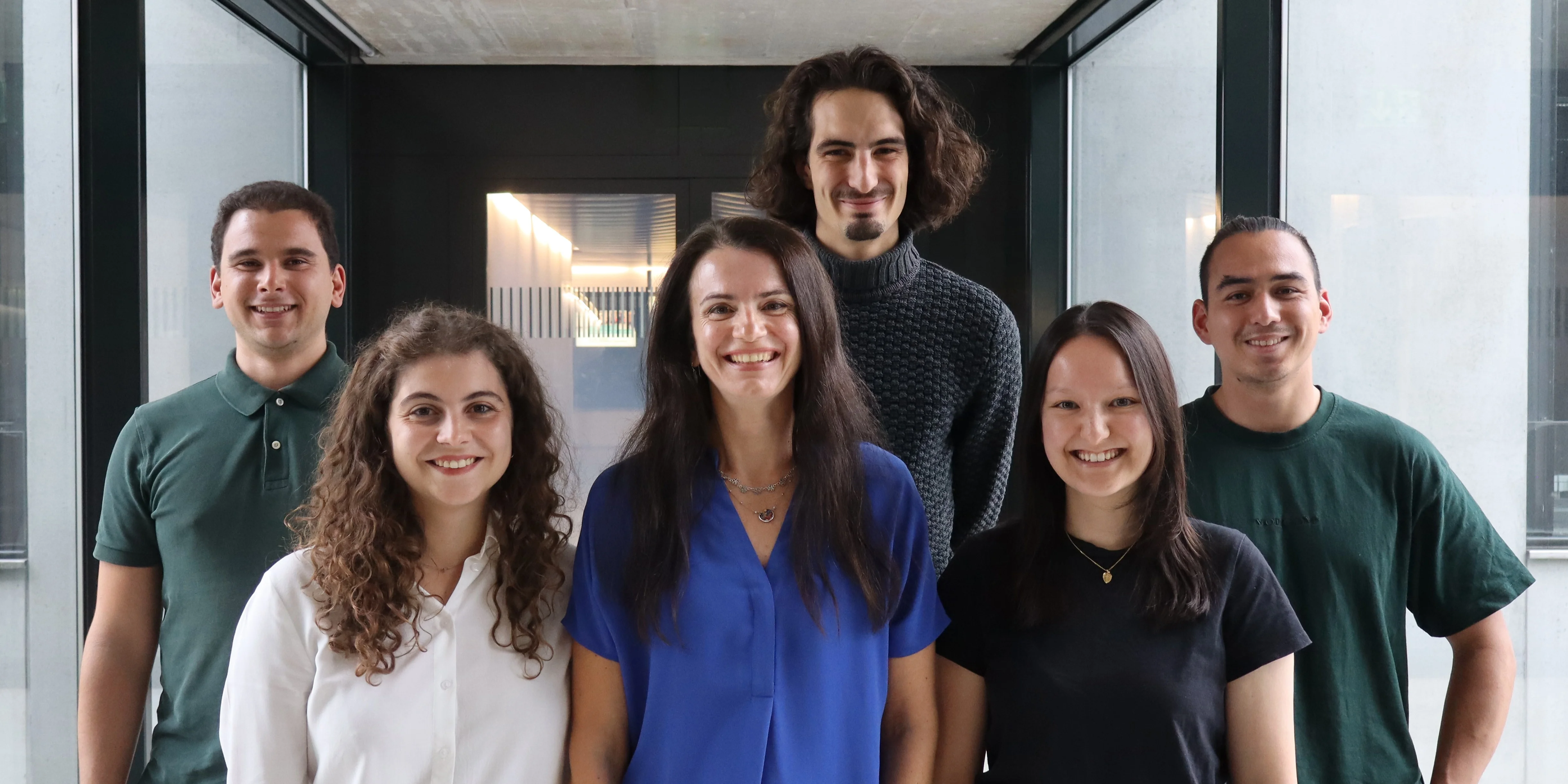
Our team as of September 2026
Additional Information
We look forward to collaborating with industry partners, hospitals and research institutions to translate the latest advances in AI research into practical applications and achieve tangible impact through joint research and innovation projects. Please feel free to contact us to explore opportunities for collaboration.
We also welcome motivated students who share our vision and are interested in completing their Master's thesis under our supervision. All vacancies within our research group, including doctoral positions, are advertised on our institution's website as they become available.
Team
Head of Research Group







Projects
-
Antimicrobial Resistance Tracker (AMR)
The goal of the project is to strengthen surveillance of antimicrobial resistance in animals and food products, with a focus on international travelers. The project will explore (and quantify the uncertainty of) using AI-based text and image mining techniques to extract data on the prevalence of…
current, 08/2025 - 07/2028
-
Reliable Conversational Domain-Specific Data Exploration and Analysis (ARMADA)
The ARMADA doctoral network aims at training 15 versatile and interconnected Early-Stage Researchers (ESRs) to specialise in the overarching area of Conversational Artificial Intelligence (Conversational AI).
current, 03/2025 - 02/2029
-
Development of a Machine Learning program for Injury Surveillance in Children and Adolescents (BfU2.0)
Background: Injuries in the age group of children and adolescents are a major public health concern and cause individual suffering and costs for the healthcare system and society. Evidence-based, targeted and effective injury prevention must be based on reliable data. Currently, this is not…
expired, 07/2023 - 11/2025
-
LINA: Shared Large-scale Infrastructure for the Development and Safe Testing of Autonomous Systems
The goal of the LINA consortium is to create a basis for the largest European (real and virtual) infrastructure for research, development and safe testing of autonomous systems / UAS (Unmanned Aircraft System) for commercial products in the canton of Zurich.
current, 08/2022 - 12/2027
Publications
-
Feer, Sonja; Saaro, Felix Matthias; Zysset, Annina; Bächli, Mirjam; Nieman, Steffen; Meier, Delphine; Seiler, Michelle; Bogojeska, Jasmina; Dratva, Julia,
2026.
International Journal of Public Health.
71(1609472).
Available from: https://doi.org/10.21256/zhaw-37587
-
Bolck, Hella; Vollenweider, Janik; Merkli, Fabian; Barden, Alexander; Jajcay, Martin; Trempeck, Peter; Rafailović, Boško; Fraefel, Robert; Lenhart, Peter M.; Chavarriaga, Ricardo; Renold, Manuel; Bogojeska, Jasmina; Stadelmann, Thilo; Guillaume, Michel,
2026.
LINA’s testing infrastructure enables AI to take-off in unmanned aerial vehicles (UAVs).
Frontiers in Robotics and AI.
13(1764248).
Available from: https://doi.org/10.21256/zhaw-36280
-
Sîrbu, Iustin; Sîrbu, Iulia-Renata; Bogojeska, Jasmina; Rebedea, Traian,
2025.
GIT-CXR : end-to-end transformer for chest X-ray report generation.
Information.
16(7), pp. 524.
Available from: https://doi.org/10.21256/zhaw-33688
-
Amer-Yahia, Sihem; Bogojeska, Jasmina; Facchinetti, Roberta; Franceschi, Valeria; Gionis, Aristides; Hose, Katja; Koutrika, Georgia; Kouyos, Roger; Lissandrini, Matteo; Maniu, Silviu; Mirylenka, Katsiaryna; Mottin, Davide; Palpanas, Themis; Rigotti, Mattia; Velegrakis, Yannis,
2025.
Towards reliable conversational data analytics[paper].
In:
Proceedings of EDBT 2025.
28th International Conference on Extending Database Technology (EDBT), Barcelona, Spain, 25-28 March 2025.
Open Proceedings.
pp. 962-969.
Available from: https://doi.org/10.21256/zhaw-32833
-
Burger, Manuel; Sergeev, Fedor; Londschien, Malte; Chopard, Daphné; Yèche, Hugo; Gerdes, Eike Christian; Leshetkina, Polina; Morgenroth, Alexander; Babür, Zeynep; Bogojeska, Jasmina; Faltys, Martin; Kuznetsova, Rita; Rätsch, Gunnar,
2024.
Towards large-scale clinical multi-variate time-series datasets[paper].
In:
NeurIPS Workshop on Time Series in the Age of Large Models.
38th Conference on Neural Information Processing Systems (NeurIPS), Vancouver, Canada, 10-15 December 2024.
OpenReview.
Available from: https://doi.org/10.21256/zhaw-32746