Master Studies

"Working as a research assistant at the CAI during my MSE studies allowed me to apply the concepts I learned to impactful projects and to shape the future of AI together with experts in the field."
Pascal Sager, CAI MSc Alum 2023
The next step in your career
We look for curious, professional, and action-driven individuals with a recent bachelor's degree in computer science, engineering or a related technical field interested in using AI to solve real-world challenges with state-of-the-art research methodology. During your MSc studies you will join an international, interdisciplinary team that includes computer scientists, engineers, neuroscientists, physicists, among others. This will give you direct exposure to the latest AI methods at the highest scientific level. Activities at the CAI are centred around four main research topics.
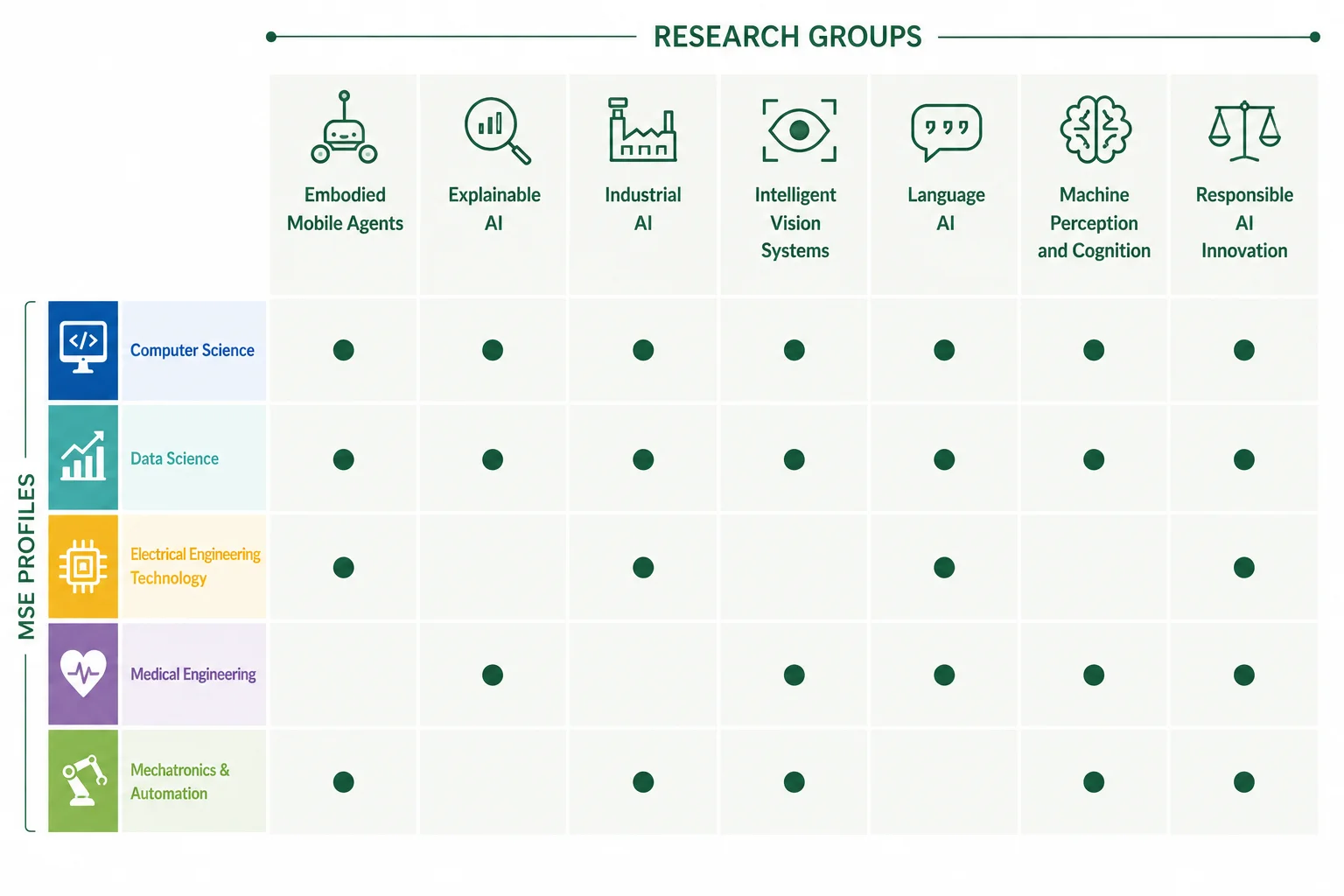
MSE students at CAI are embedded in one of our research groups: Embodied Mobile Agents, Explainable AI, Industrial AI, Intelligent Vision Systems, Machine Perception and Cognition, Language AI, Responsible AI Innovation. This provides you the opportunity to complement the theoretical modules with applied research projects, familiarize with academic research and generate practical benefit side by side with our industry partners.
In addition to high-quality training on technical skills, CAI offers multiple opportunities for improving additional skills crucial for advancing your professional career. They include invited talks and colloquia, courses on scientific communication, workshops on soft skills, and social and cultural activities.
MSc students at the CAI also have the possibility of working as research assistants in combination with their studies. This gives the additional opportunity of getting involved in collaborative research projects on AI-based innovation.
MSE Profiles at the CAI
The Centre for Artificial Intelligence offers a program of Master’s in Engineering with profile specializations on Computer Science, Data Science, Electrical Engineering, Medical Engineering and Mechatronics and Automation. These programmes focus on the applied research on machine learning and deep learning in multiple application domains.
The various profiles and how each research group is connected to those profiles are shown in the following diagram.
Master Theses
One key success factor for an exceptional master’s project or thesis is the right research question, that is, the right question at the right time, combined with a good idea, might lead to unimagined progress in both research and practice. Our researchers keep lists of such good ideas that often lead to the publication of original papers and to industry solutions when combined with the skills of our master’s students. Sometimes, they even win awards.
Examples of recent student theses can be found below.
Quis metietur ipsos metitores? Automated Metrics for Natural Language Generation in Theory and Practice
Master Thesis (Computer Science)
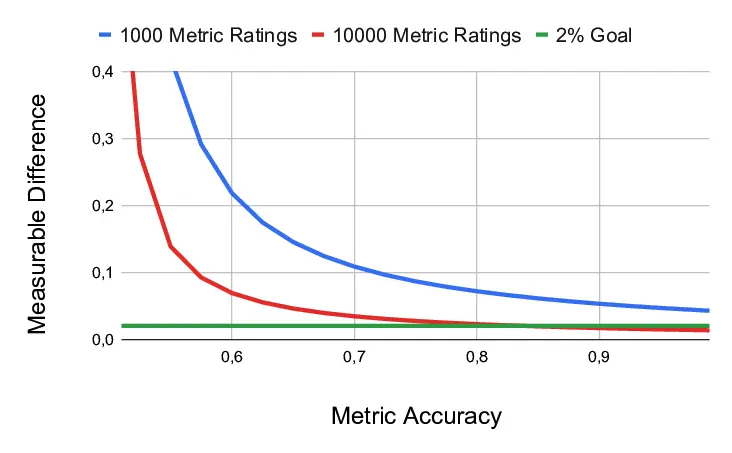
Automated metrics are commonly used to quickly and efficiently evaluate text generation systems, such as those used in machine translation. However, these metrics can sometimes incorrectly assess certain outputs, leading to skewed results when evaluating the overall quality of these systems. This thesis introduces a hybrid evaluation model that combines straightforward binary ratings from human experts and automated metrics to provide more accurate performance estimates.
There is also a peer-reviewed publication associated with this thesis: https://aclanthology.org/2022.findings-emnlp.108/
Distinguishing Traumatic from Degenerative Rotator Cuff Tears Using a Multimodal AI Model
Master Thesis (Data Science)
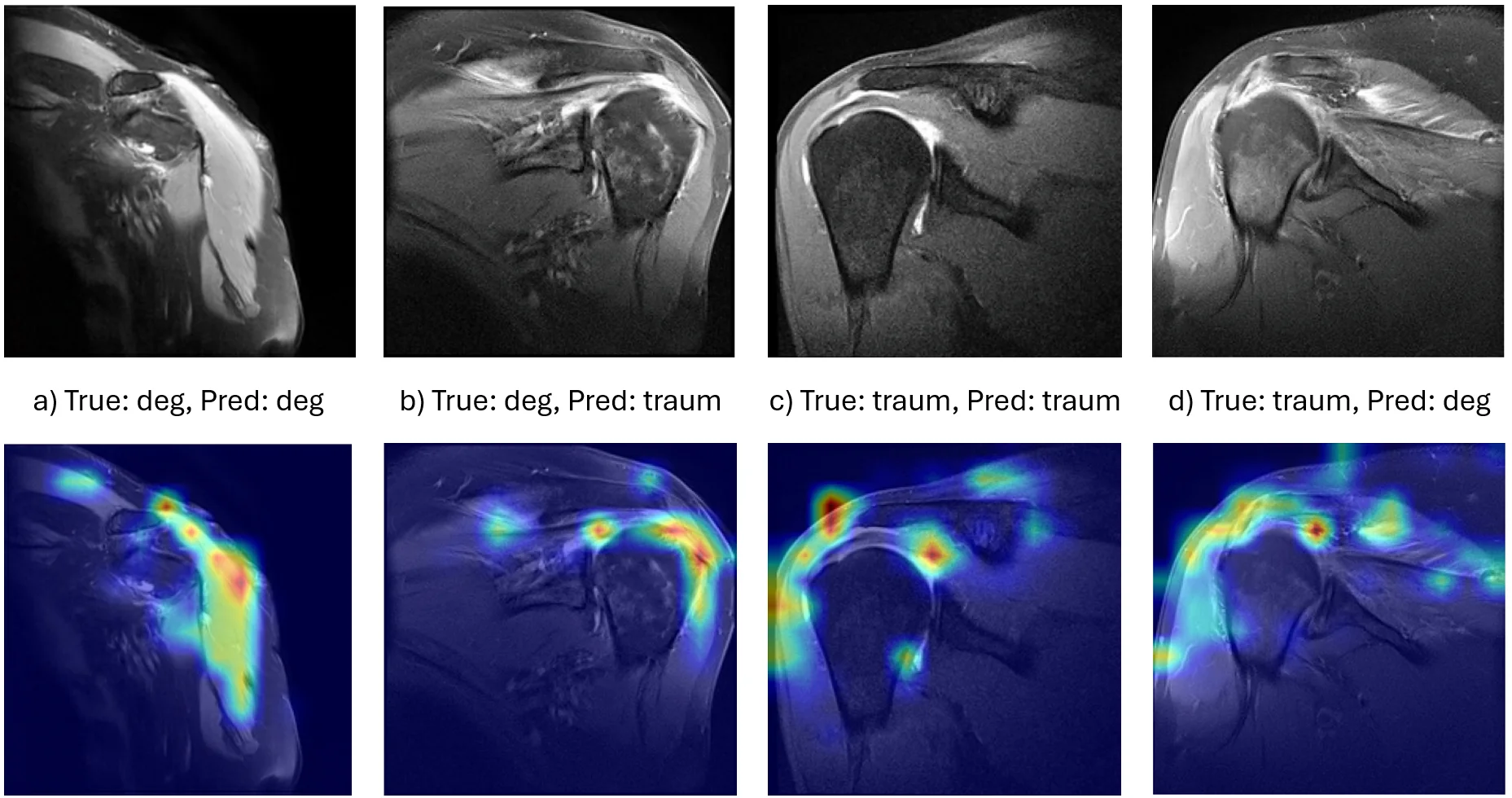
In this Master's thesis, a multimodal model capable of distinguishing between traumatic and degenerative rotator cuff tears was developed in collaboration with Balgrist University Hospital. The architecture integrates magnetic resonance imaging with structured clinical data. To address the issue of data scarcity, a class-dependent latent diffusion model was implemented in order to generate high-resolution MRI samples for the purpose of training augmentation. The multimodal architecture employs a Vision Transformer and TabNet architecture, utilising advanced fusion strategies to combine visual and tabular inputs. The integration of explainable AI techniques, including Grad-CAM++ and saliency maps, into the workflow was undertaken to ensure clinical interpretability.
Thesis Link: Not available - confidential
Self-Organisation in a Biologically Inspired Learning Framework Based on Bernoulli Neurons
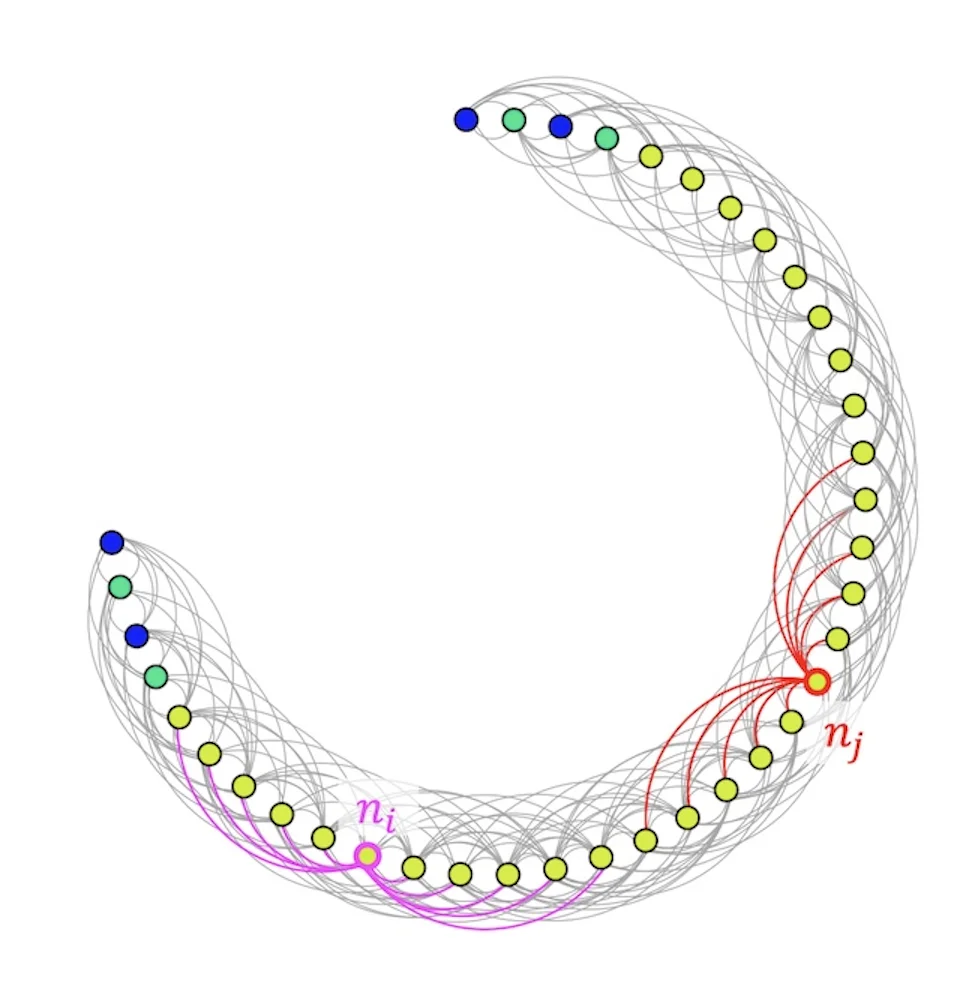
Master Thesis (Computer Science)
Deep learning in automatic image analysis suffers from vulnerability to noise and high data reliance. A novel brain inspired framework overcomes these limitations using lateral connections and local Hebbian learning to establish mutual cell support. Experimental results demonstrate that this architecture deactivates 91.7% of unwanted noise activity and successfully restores visual interruptions up to 20 pixels.
Thesis Link: https://www.zhaw.ch/storage/engineering/institute-zentren/cai/studentische_arbeiten/Herbst_2023/MSc_PascalSager.pdf
The complete list of all the student works, which were supervised by an expert at CAI, can be found here.
Applying for a Masters at the ZHAW CAI
To apply for one of the Master's study places, please officially register for the MSE. Indicate the "Centre for Artificial Intelligence (CAI)" as the institute and enclose a cover letter in which you indicate, among other things, which research group(s) at the CAI you are particularly interested in (and why, ideally referring to the group’s prior work).
If you want to apply for an assistant position at the CAI at the same time, please also note this in the cover letter and contact the MSE-Advisor to the CAI, Ricardo Chavarriaga (ricardo.chavariaga@zhaw.ch).
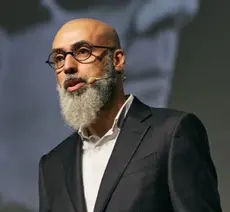
"Do not hesitate in reaching out to me. As MSE-Advisor to the CAI I will be happy to answer your questions and explain the selection process."
Ricardo Chavarriaga, CAI MSE-Advisor