Safe aircraft engines powered by sustainable fuels
Sustainable aviation fuels (SAF) differ from conventional kerosene in terms of their vaporization and combustion. Researchers at the IEFE at the ZHAW are investigating the interaction between spray droplets, flames and sound to predict combustion instabilities and ensure the safe operation of engines.
On the path to net zero by 2050, the decarbonization of aviation is particularly challenging. One reason for this is the very high energy density of kerosene. Batteries and fuel cells cannot come close to matching this and are therefore unlikely to provide a solution for transcontinental flights in the foreseeable future.
Sustainable aviation fuels (SAFs) offer a promising way of reducing CO₂ emissions from aviation. They have similar properties to conventional kerosene but are produced from renewable raw materials or synthetic sources. When considered over their entire life cycle, SAFs can reduce CO₂ emissions by up to 80 per cent compared with fossil kerosene.
SAF burns differently from conventional kerosene
SAF can be produced from a variety of biogenic and synthetic feedstocks. Its physical properties, such as density, surface tension and viscosity, are comparable to those of conventional kerosene. However, there are differences in its vapourization and combustion behavior within the combustion chamber of an aircraft engine.
In the combustion chamber, the liquid fuel is injected as a fine spray of droplets. The droplets vaporize and the fuel burns. Flames usually generate sound waves which are acoustic pressure oscillations. These acoustic waves, in turn, can affect the spray pattern and the flame. Under unfavourable conditions, these interactions reinforce one another. This gives rise to what are known as thermoacoustic combustion instabilities. They can impair the engine’s performance and, in extreme cases, damage components.
Understanding the interaction between spray droplets, flame and sound
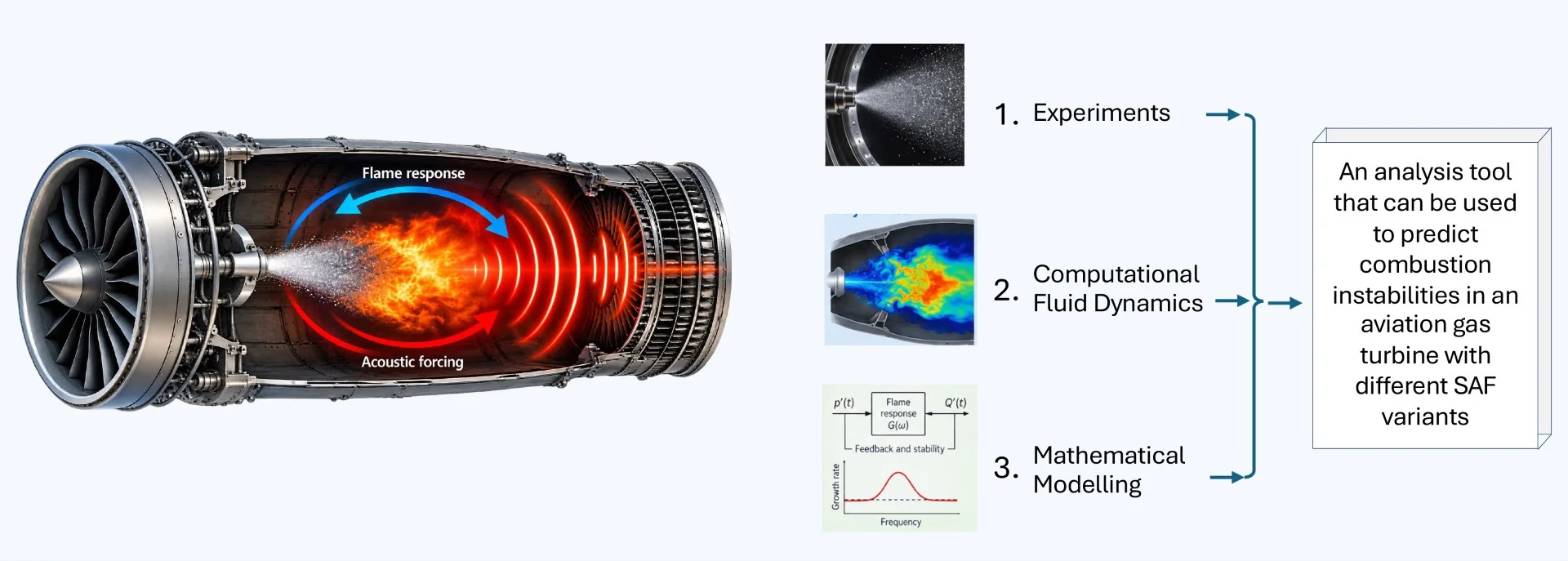
In a new research project, the Thermoacoustics and Sustainable Combustion research group at the Institute for Energy Systems and Fluid Engineering (IEFE) at the ZHAW is investigating how such combustion instabilities arise when using SAF and how they can be predicted. The focus is on the complex interaction between spray droplets, flame and sound. To this end, the researchers are combining experiments with numerical simulations, data-driven techniques and mathematical models.
The focus is on three questions:
• How do sound waves affect the injected spray droplets?
• How do spray flames react to acoustic pressure oscillations?
• How can the interaction between spray droplets, flame and sound be described mathematically to predict potential instabilities at an early stage?
Another key area of focus is the composition of sustainable aviation fuels. The researchers are investigating how different SAFs influence combustion behavior and the occurence of thermoacoustic instabilities. To this end, they have access to the extensive experimental infrastructure and measurement technology of the Thermoacoustics and Sustainable Combustion research group. This includes, amongst other things, acoustic test benches, condenser microphones and Phase Doppler Particle Analysers (PDPA) for the non-contact measurement of flow fields.
Predicting combustion instabilities at an early stage
The aim of the research project is to develop a physically sound and data-driven analysis tool. This should enable thermoacoustic combustion instabilities in systems using liquid fuels to be predicted reliably and with reasonable effort.
The findings can be incorporated into the development and optimization of aircraft engines. For example, the geometry of the combustion chamber can be specifically adapted to prevent unwanted vibrations. The project thus lays important foundations for the safe and efficient use of sustainable liquid aviation fuels.
The research project is funded by the Swiss National Science Foundation (SNSF) under the Ambizione funding scheme.
Project name
Towards quieter and cleaner skies: unravelling spray—flame—acoustic coupling in aircraft engines operated on sustainable aviation fuels
Funding body
Swiss National Science Foundation (SNSF) - Ambizione
Participants
Project leader: Harish Gopalakrishnan, ZHAW
Duration
December 2026 to November 2030