SWEET EDGE - Studies on the Decentralized Feed-in of Renewable Energy
The BFE’s SWEET EDGE project supports the integration of decentralized renewable energy sources (PV, wind, biomass) into the Swiss energy system in order to achieve climate goals. Our research focuses on regional energy balancing (cities, midlands, the Alps) and pilot projects in the midlands aimed at decarbonization through the use of storage and smart grids.

Challenge
To achieve Switzerland’s climate goals, it is essential to integrate large amounts of renewable energy decentrally into the Swiss energy system. To this end, the Swiss Federal Office of Energy has launched a call for proposals for new research programs (SWEET call for proposals). The focus is on decentralized, renewable energy sources such as photovoltaics, wind, and biomass from local sources in combination with existing hydropower and new storage options. The aim is to investigate how these decentralized renewable energy sources can be optimally installed, operated, and integrated into the overall system in conjunction with European grid interconnection. The primary focus will be on electricity, while also taking into account the interactions with electric mobility, heat generation, a wide variety of storage technologies, and synthetic fuels.
Technological advances will be examined alongside effective ways to promote investment, develop new business models, shape markets (including decentralized markets), create new policy instruments and regulations, and address the social acceptance of these new instruments and regulations.
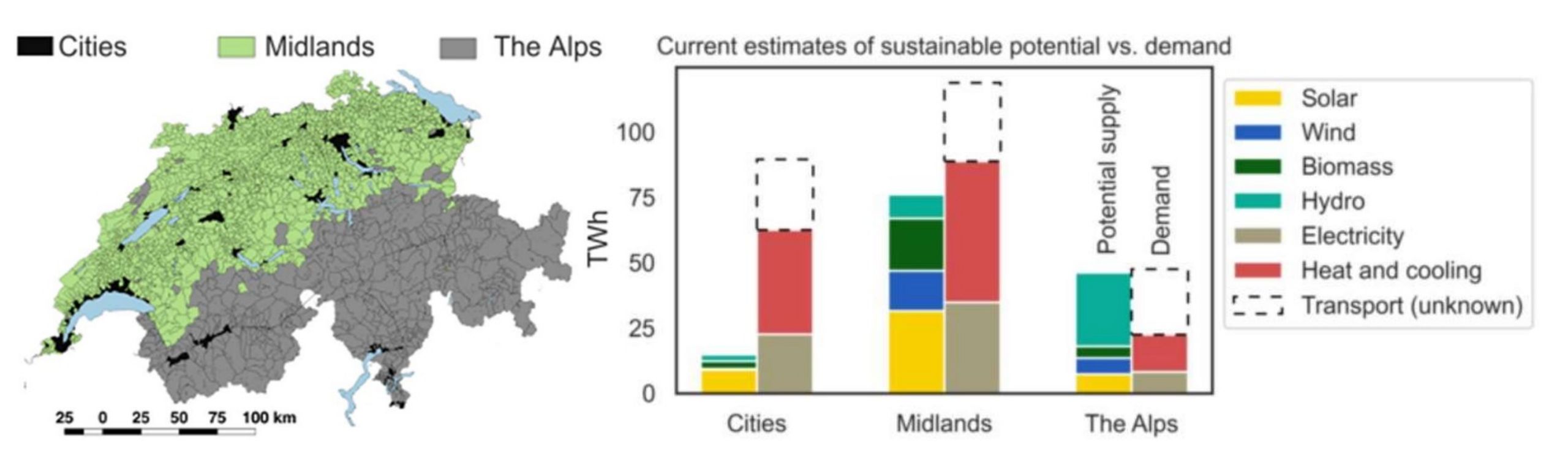
The SWEET EDGE project will also pay particular attention to sociotechnical characteristics, which vary greatly across Swiss cities, midlands, and the Alps. Cities, for example, are characterized by a higher density of energy consumers, a higher proportion of anthropogenic biomass, significant potential for building-integrated PV systems, and a well-developed public transportation system. The midlands are rich in agricultural biomass and PV resources, but are less densely populated and have a relatively large number of agricultural vehicles that must be converted to renewable energy. The Alpine regions offer highly efficient PV, a wind power potential that is still largely untapped, and large but often difficult-to-harvest timber resources. The mountainous regions could supplement the existing supply of hydropower to cities and the midlands with new renewable energy sources. Figure 1 illustrates the various available energy potentials and the energy demand for the three regions under study.
Goals
The SWEET EDGE project aims to accelerate the growth of decentralized renewable energy in Switzerland and facilitate its integration into the Swiss energy system. The goal is to ensure that, by 2035 and 2050 - when the planned shares of renewable energy are achieved - the Swiss energy system is designed and operated in an optimal manner, both technically and economically, and is well-positioned in European markets. Between 2021 and 2027, EDGE will therefore develop regional scenarios and strategies to achieve an energy sector in Switzerland that is as fully renewable as possible by 2050. The EDGE research activities will also be complemented by three pilot and demonstration projects in urban areas, the midlands, and the Alps.
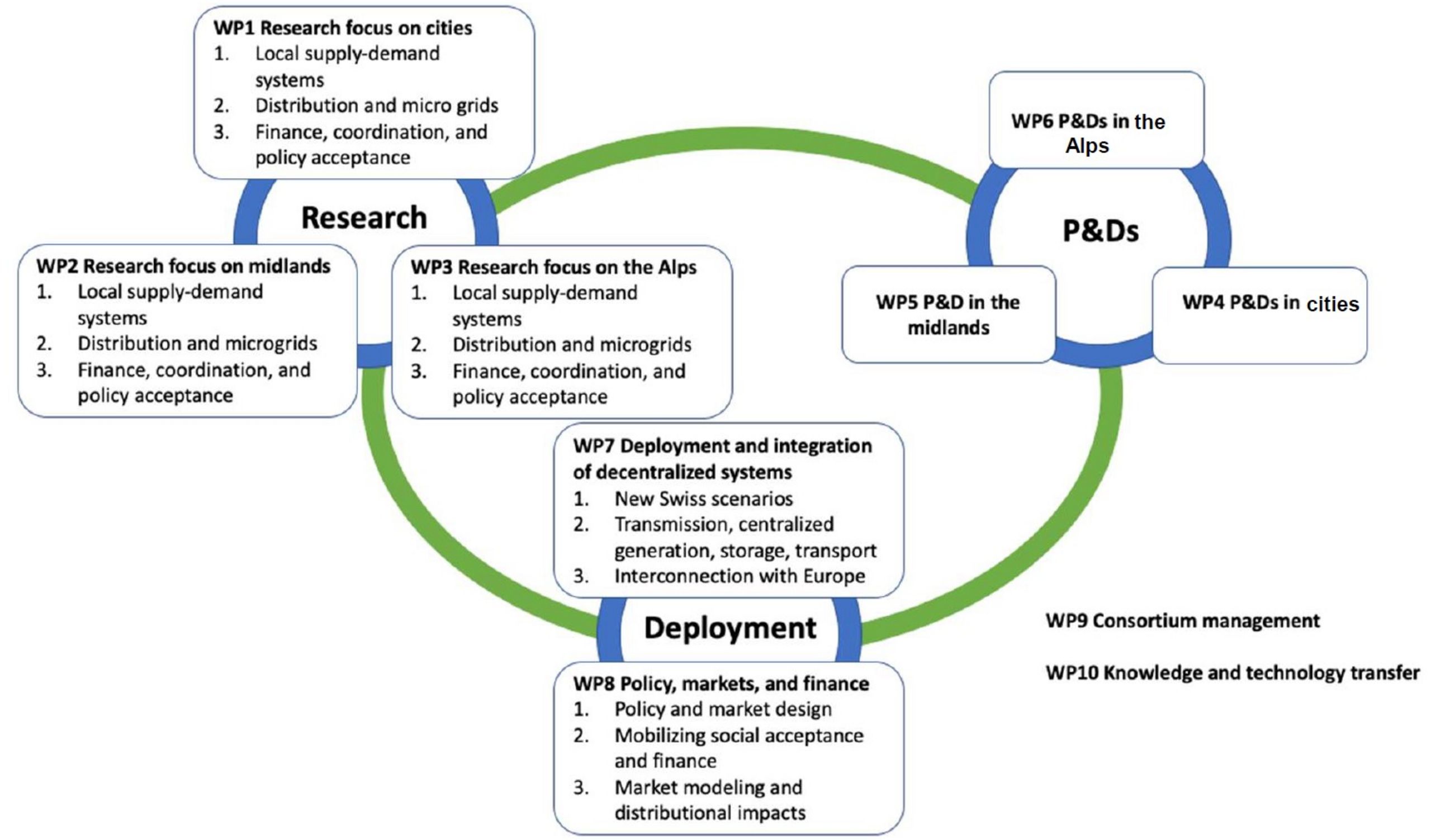
The EDGE consortium aims in particular to go beyond the generic design of decentralized renewable systems and markets and to conduct a regionalized analysis that is specifically tailored to Switzerland. Figure 2 provides an overview of the work to be carried out, broken down into the respective work packages.
Responsibilities of the Renewable Energy Research Group
The EDGE project is investigating the integration of a high proportion of decentralized renewable energy into the Swiss energy system, taking into account the different conditions in cities, midlands, and Alpine regions. The Renewable Energy Research Group focuses on analyzing the energy balance of municipalities in different types of regions that must be met. It specifically addresses the differences in decentralized production across these regions and analyzes how a decentralized, renewable Swiss energy system - incorporating storage, power-to-X, and demand-side management (DSM) - can be enabled.
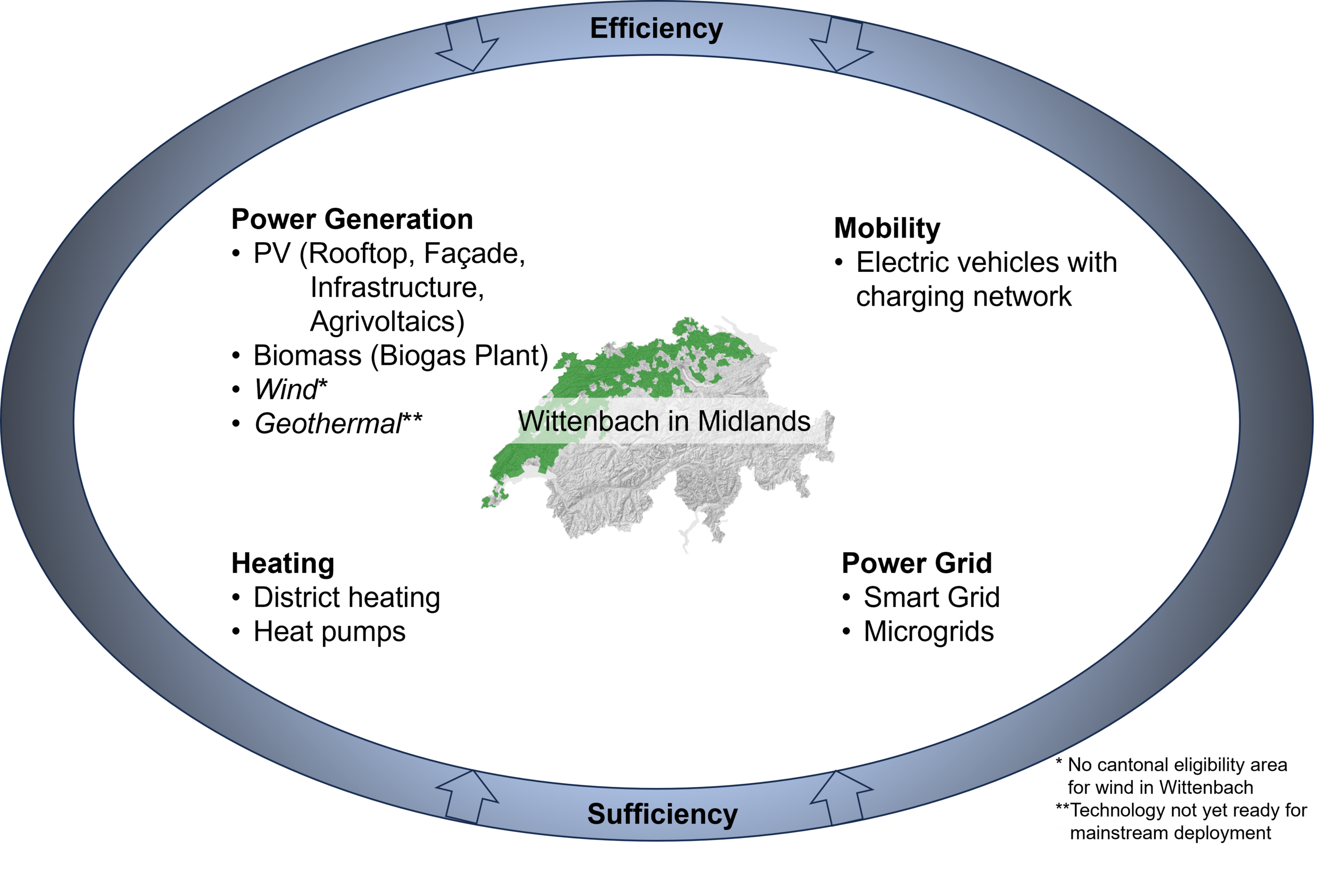
In addition, as part of a pilot and demonstration project, the research group is working on measures to more quickly achieve a 100% decarbonized energy supply for a typical municipality in the midlands (see Figure 3). The goal is to demonstrate how the integration of various proven technologies as well as efficiency and sufficiency measures can be implemented on a large scale to optimize this municipality’s energy supply. The project is examining the integration of a biogas plant, including CO2 capture and heat recovery. In addition, the focus is on the expansion of photovoltaics (including agri-PV), e-mobility, and grid integration. Furthermore, the project is analyzing the role that microgrids and smart grids could play in the energy transition in Swiss municipalities (see also Difference between Microgrids and Smart Grids).
Project Participants
The EDGE Consortium brings together a broad spectrum of interdisciplinary expertise in the fields of technology development and analysis, energy system modeling, political science, economics, and sustainability sciences. It consists of 14 colleges and universities and numerous industry partners:
- University of Geneva, Renewable Energy Systems, Prof. Evelina Trutnevyte
- École Polytechnique Fédérale de Lausanne (EPFL), Laboratory of Cryospheric Sciences
- École Polytechnique Fédérale de Lausanne (EPFL), Human-Environment Relations in Urban Systems, Prof. Claudia Binder
- WSL Institute for Snow and Avalanche Research (SLF), Prof. Michael Lehning
- Swiss Federal Institute of Technology Zurich (ETH), Power System Laboratory, Prof. Gabriela Hug
- Swiss Federal Institute of Technology Zurich (ETH), Risk and Reliability Engineering, Prof. Giovanni Sansavini
- Swiss Federal Institute of Technology Zurich (ETH), Energy Politics, Prof. Tobias Schmidt
- University of Bern, Chair of Comparative Politics, Prof. Isabelle Stadelmann-Steffen
- University of St. Gallen, Chair for Management of Renewable Energies, Prof. Rolf Wüstenhagen, Prof. Merla Kubli
- Lucerne University of Applied Sciences and Arts, Institute of Mechanical Engineering and Energy Technology, Prof. Jörg Worlitschek
- Zurich University of Applied Sciences (ZHAW), Renewable Energy, Prof. Jürg Rohrer
- Bern University of Applied Sciences (BFH), Laboratory for Photovoltaic Systems, Dr. Christof Bucher
- Paul Scherrer Institute (PSI), Bioenergy and Catalysis Laboratory, Prof. Oliver Kröcher
- Swiss Federal Research Institute for Forest, Snow, and Landscape Research, Sustainable Forestry (WSL), Dr. Vanessa Burg
- Spin-off SUNWELL, Dr. Annelen Kahl
- Basler & Hofmann AG, Peter Toggweiler
Publications
- Facilitation of decentralized renewable Swiss energy systems with batteries, power-to-X, and demand-side management (2025)
- Utilization or Permanent Storage of CO2 from Biogas Plants (2024)
- A Sustainable Energy Concept for Biogas Plants: The Wittenbach Case Study (2024)
- Assessing the Potential for Agri-PV in Swiss Agriculture (2024)