Master of Science in Life Sciences - Chemistry for the Life Sciences
In the life sciences, competencies from the fields of chemistry, biochemistry, (bio)analysis, green chemistry, materials science, and nanotechnology are required. This is where you, as a specialist, can bring your expertise to bear.
Why pursue a Master’s degree in Chemistry for the Life Sciences?
Symbiosis of chemistry, biochemistry and nanotechnology
After completing your Master's degree, you will have the best career opportunities and find yourself in a leading position on the job market thanks to both your broad and specialized knowledge.
Areas of application include not only the traditional sectors represented by the chemical and pharmaceutical industry, but also the food industry and biotechnology companies.
Career: Holding a Master's degree in Life Sciences in Chemistry for the Life Sciences will allow you to...
- make a valuable contribution to socially relevant challenges in the fields of medicine, nutrition, ecology and environmental technology, applied energy research, green chemistry.
- actively help shape the future of chemistry by expanding your scientific skills and making relevant contributions to our society.
- combine creative and sustainable approaches to solving upcoming social problems with your entrepreneurial and scientific thinking.
- plan, implement, evaluate and present research and development projects.
- contribute to the success of sophisticated research projects with your professional, social, and self-management skills.
- continue your studies in cooperation with foreign research institutions to pursue a doctorate degree.
- you are well-equipped for interesting and varied managerial tasks in typical chemical industries and potentials interfaces such as energy research, product development, production and quality assurance, in the fields of regenerative medicine, specialty chemistry, green chemistry, ecology, production of vaccines and active substances or functional materials, in diagnostics, sensor and nanotechnology, as well as positions at universities and authorities.

«My Master‘s studies allowed me to deepen my understanding of Chemistry and expand my knowledge by attending lectures beyond the traditional scope of a Chemistry programme» Read more (PDF 193 kB)
Vanessa Galati, Brand and Product Manager, Martec Handels AG

"Thanks to my Master’s studies, I found a very exciting and multi-faceted job in a great working environment." Read more (PDF 431 kB)
Mathias Schilling, Systems Engineer, Metrohm AG
Good reasons for a Master’s study in Wädenswil
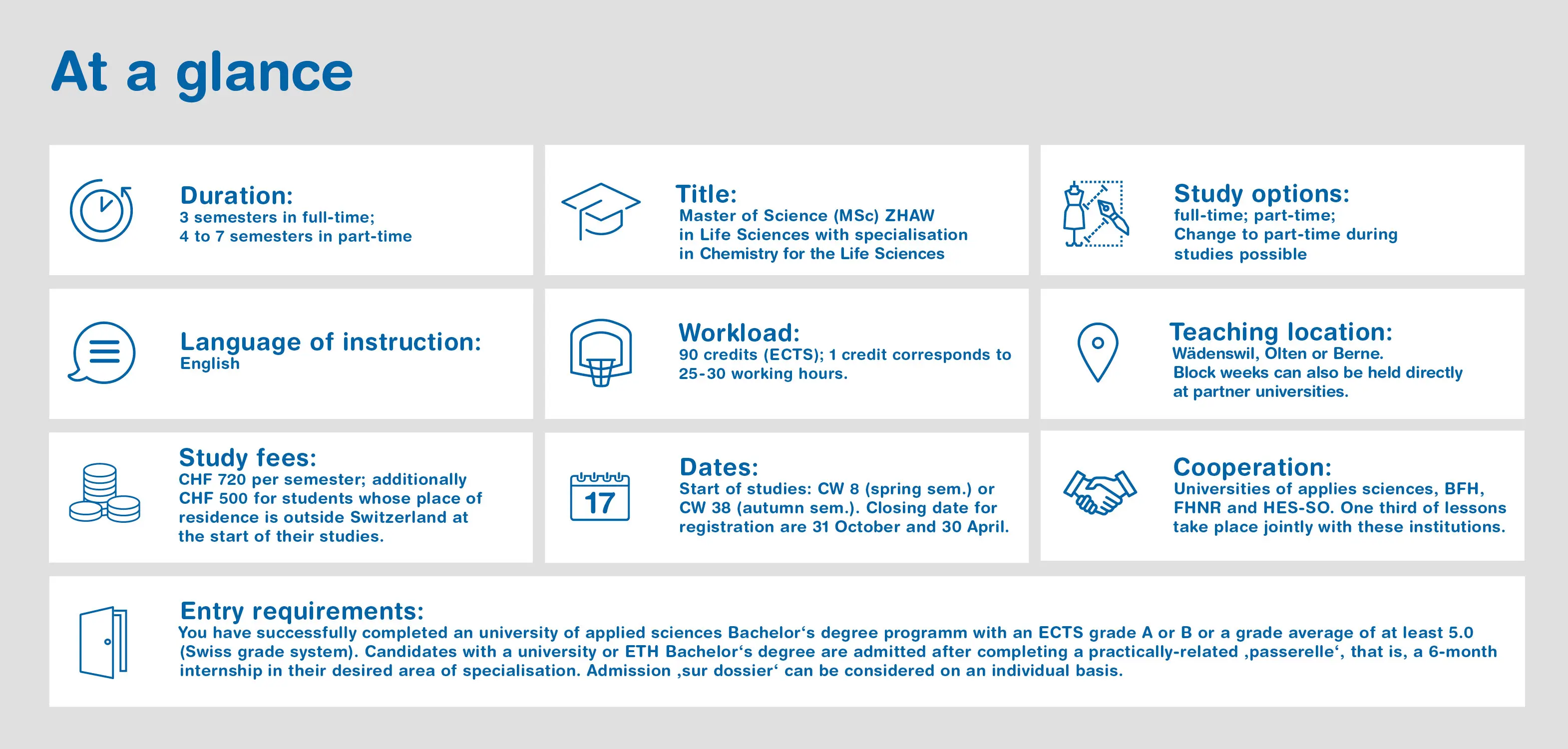
- We offer a customisable Master's programme which you can complete in 3 (full-time), 4 or more (part-time) semesters.
- The programme offers an attractive mix of research, science, practice and business modules.
- You will have the opportunity to grow both as a professional and as a person, and to evolve into a sought-after specialist with leadership skills.
- We offer exciting research projects for your Master's thesis in a research group of the institute.
- You will be able to join a research group, where you can practice skills such as teamwork, initiative and critical thinking.
- You will benefit from laboratories equipped with state-of-the-art research infrastructure.
- You will benefit from small class sizes in the advanced modules, which offer interactive learning activities that will allow you to take charge.
Study programme and course content
Your studies include three areas of competence plus a Master's thesis, with a total of 90 credits (ETCS).
Based on your interests, before starting your studies you will work out your own personal learning objectives with your specialisation director and your supervisor. You will define the topic for your Master's thesis and design your own personal study path from the range of available modules.
Based on the topic of your Master's thesis, you will be assigned to a corresponding specialisation module that will fully prepare you for your Master's thesis. While working on your Master's thesis, you will be part of a research group that is working closely with our business partners or doing research at one of our institutes.
- Online study planner Your individual study plan.
- Master's thesis specialised fields Before starting your studies, you choose the field in which you want to write your research paper.
- Annual planning / timetables Important dates in the academic year.

"Chemistry is an essential interface between biology and physics. Consequently, it has many potential areas of application, ranging from product and device development to the analysis of substances or active processes or quality control. Without chemistry, there would be no life; and without you, there will be no innovative chemical research and development."
Dr. Susanne Kern, specialisation director at the Institute for Chemistry and Biotechnology

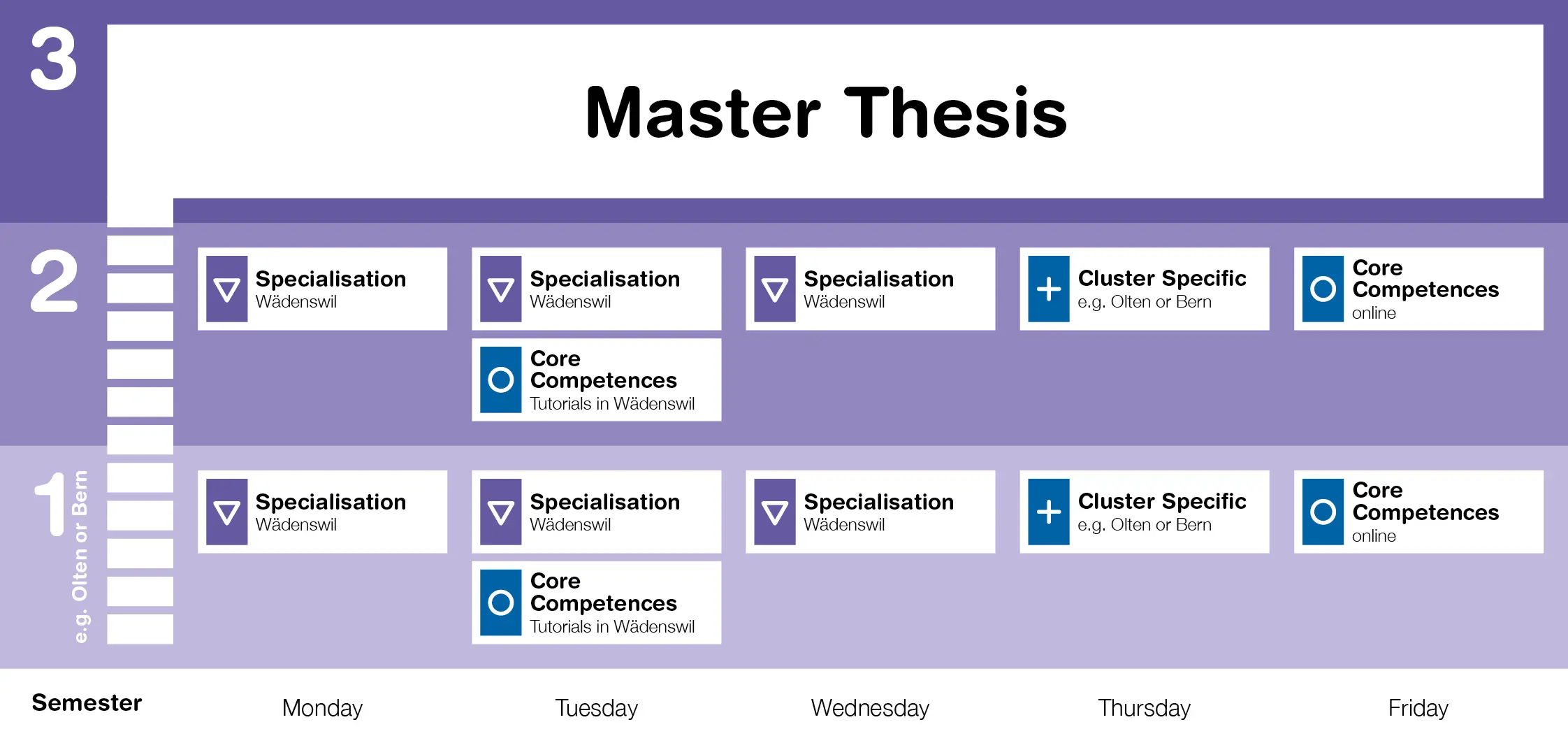
The picture above shows the general structure of a full-time Master's programme. Students design their own study paths and choose their own focal points.
Together with your supervisor, you design your own individual study plan from the range of compulsory and elective modules. The selected modules are recorded in your individual study agreement (planning).
In addition, elective modules from the specialisations of Pharmaceutical Biotechnology, Food and Beverage Innovation or Applied Computational Life Sciences can be taken.
Researching for practice
During your studies, you will expand your personal skillset not only in terms of technical expertise and methodology, but also in terms of self-management. The practice-oriented focus of the Master's thesis encourages creative problem solving, a reevaluation of perspectives and a combination of entrepreneurial and scientific thinking.
The work in your research group will not only help you develop your initiative and critical thinking abilities, but also your teamwork and leadership skills. We promote inductive, inquiry-based learning in small classes with interactive learning activities such as group work and presentations.
Theses
Interesting research questions are created with partners from industry and retail. Our graduates have already developed interesting, relevant and viable answers and solutions in their work.
Ready for the next step?
Do you have any questions?
Fields marked with an asterisk are mandatory fields.
This might also interest you
MSLS Community Centre
The Moodle learning platform for modules taught jointly with other universities of applied sciences!
Registration Master's programme
Organise your studies
MSLS Community Centre
Ready for a new chapter in your life? Apply now.
Fees, important dates, timetables and the Study App at a glance.
The Moodle learning platform for modules taught jointly with other universities of applied sciences!