Research Group Workplace Management
How we understand our work
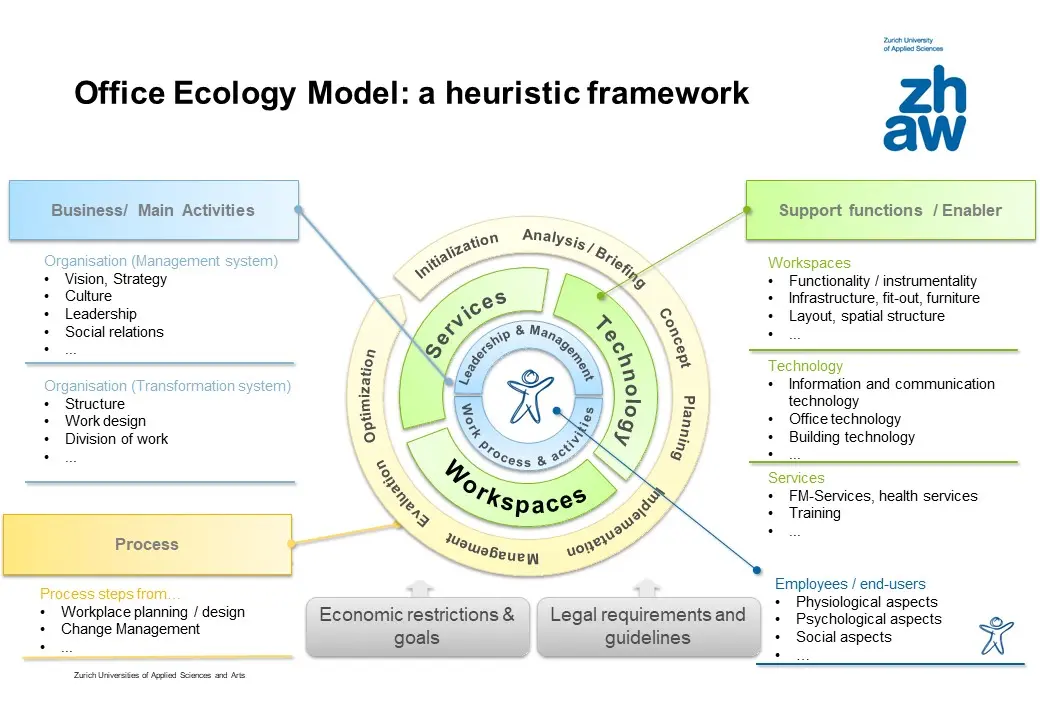
Our work is based on a holistic understanding of the human-workplace environment system: the Office Ecology Model. This describes office environments as a system in which spatial-material factors interact with work processes, organisational culture, employees, social relationships, and information and communication technologies (see Figure: Office Ecology Model). According to our understanding, the overall office system can only function optimally if the various elements are coordinated with each other. Thus the design of office environments alone does not guarantee success or failure, nor does solely management, strategy, employees or the change management process; the interaction makes the music. As a result, the overall system has an effect on people's experiences and actions, which can influence target parameters such as health, performance and employee satisfaction.
On the basis of the Office Ecology framework model developed at the ZHAW Institute of Facility Management, special attention is paid to the interaction between the office environment, information and communication technologies, services, work tasks as well as culture and superordinate strategies in the various steps of our consultancy and/or research projects. For example, in our consultancy we attach particular importance to the fact that the office space not only supports the functionality and processing of core tasks, but also the health and satisfaction of the employees.
Publications
-
Jin, Quan; Windlinger Inversini, Lukas; Hofmann, Thomas; Janser, Marcel; Wallbaum, Holger; Leiblein, Thomas,
2016.
In:
14th International Conference on Indoor Air Quality and Climate (INDOOR AIR 2016).
14th International Conference on Indoor Air Quality and Climate, Ghent, Belgium, 3-8 July 2016.
International Society of Indoor Air Quality and Climate.
pp. 868-876.
-
Windlinger Inversini, Lukas; Konkol, Jennifer; Sterner, Cornelia; Zurkinden, Rudolf,
2016.
Bedeutung der Büroumgebung im BGM : Gestaltung von Büros und der begleitende Veränderungsprozess.
In:
Mehlich, Harald; Pfannstiel, Mario, A., eds.,
Betriebliches Gesundheitsmanagement : Konzepte, Maßnahmen, Evaluation.
Wiesbaden:
Springer.
pp. 229-245.
-
Windlinger Inversini, Lukas; Konkol, Jennifer; Janser, Marcel; Schanné, Fabienne; Lange, Stefanie; Schäfer-Cui, Ying Ying,
2016.
Die 20 hartnäckigsten Missverständnisse und Irrtümer zu Büroarbeitswelten[paper].
In:
Windlinger Inversini, Lukas; Hofer, Susanne; Keller Foletti, Barbara; Schlegel, Ronald; Arnold Moos, Irene, eds.,
Tagungsband zum Symposium FM – here we go! , Standortbestimmung einer Milliardenbranche.
Symposium Facility Management - here we go! Standortbestimmung einer Milliardenbranche, Zürich, 11. November 2016.
Wädenswil:
ZHAW Zürcher Hochschule für Angewandte Wissenschaften.
pp. 258-275.
Available from: https://doi.org/10.21256/zhaw-5033
-
Windlinger Inversini, Lukas,
2016.
Effective workplaces : it's time to rethink workplace strategies.
In:
Symposium - Workplace Strategy Expo, Zürich, 12. April 2016.
-
Konkol, Jennifer; Dill, Saskia; Windlinger Inversini, Lukas,
2016.
Persorama: Magazin der Schweizerischen Gesellschaft für Human Resources Management.
2016(1), pp. 2-3.