Research Group Workplace Management
Spaces and locations as an effective tool: Work, learning and living environments have a direct impact on well-being, productivity and sustainability. We conduct research and teach how organisations can design these spaces in a way that is user-centred, usage-oriented and evidence-based.

From space to place to impact
The worlds of work, learning and living are undergoing fundamental change. Autonomy, flexibility and economic demands characterise the modern world of work. This gives rise to new ways of working, new channels of communication and complex questions: How do we design spaces for this reality?
Organisations are navigating a balance between economic efficiency and rising expectations regarding quality, wellbeing and user satisfaction. Society’s demand for health-promoting and inclusive working environments is growing. Data- and evidence-based workplace management provides transparency regarding usage efficiency and potential savings, without compromising quality for employees.

«How will we work in the future? Our team and I combine research and practical experience to develop working environments that are flexible, sustainable and tailored to people’s needs. Working environments do not come about by chance. They are deliberately designed.»
Prof. Dr. Lukas Windlinger, Head of Workplace Management
What we mean by workplace management
Workplaces are strategic factors: user- and usage-oriented conception, planning, design, management and optimisation of functional physical working environments at strategic, tactical and operational levels. This principle applies across all sectors, wherever people use spaces: in offices, in teaching and learning spaces, and in healthcare settings.
The three levels of analysis
Because spaces have an impact on so many things at once, workplace management delivers benefits for a range of roles:
- Management level: Executive Board, CFO/COO, Head of HR
Control and cost-effectiveness: Workplace Management provides visibility into actual space utilisation, transformations and specific potential savings. This enables well-informed decisions that balance cost-effectiveness with employee engagement. - Functional area: Corporate Real Estate, Facility Management and IT
Data rather than assumptions: Workplace Management provides an in-depth understanding of actual space utilisation through sensor-based analytics and smart solutions. This enables flexible, cost-optimised portfolios, continuous optimisation and forward-looking decisions. - Development and Change: Organisational Development, People & Culture, Innovation & Transformation
Spaces and places as design tools: Workplace management consciously shapes hybrid working models and collaboration. Spaces, culture and leadership are intertwined. Employees feel a sense of belonging. The physical space becomes a visible expression of organisational identity.
Our approach
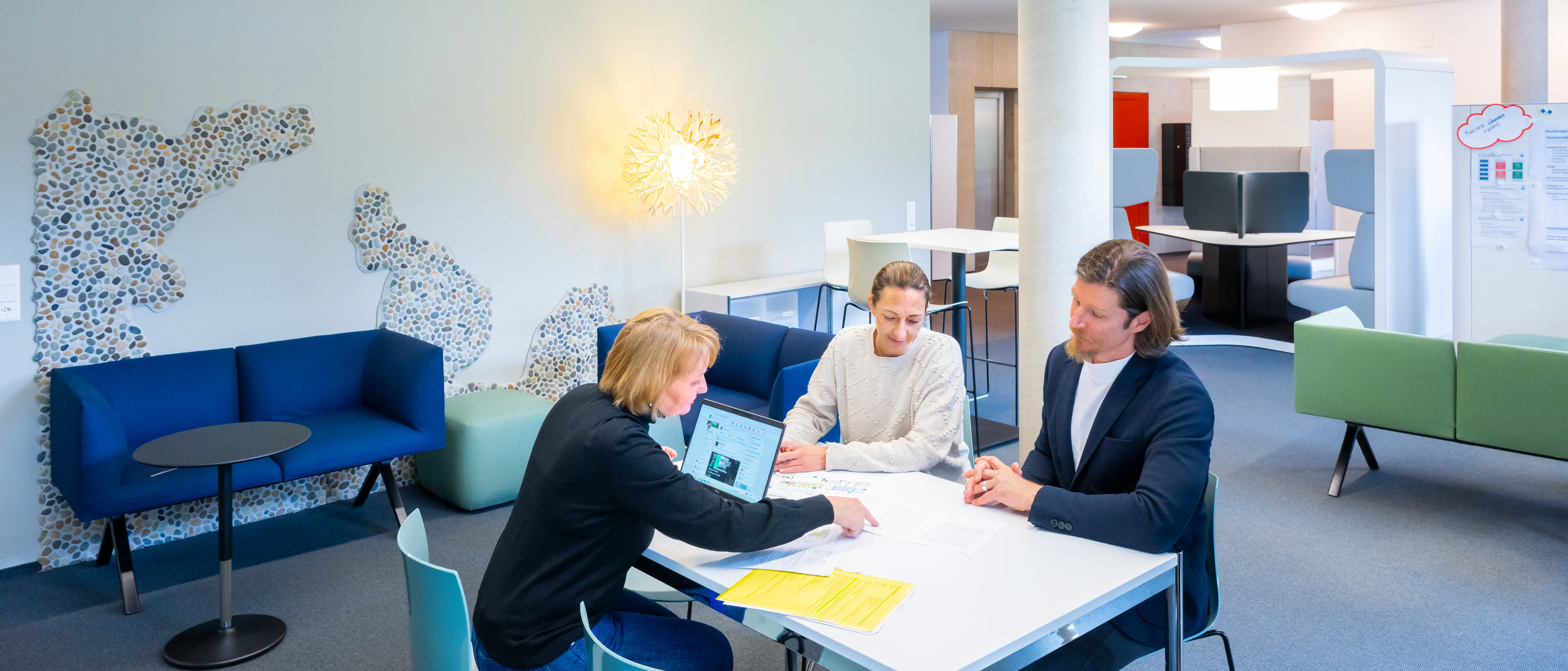
As the Institute of Facility Management at the ZHAW, we conduct research, teach and provide support in a user- and usage-oriented manner, grounded in scientific principles and directly applicable in practice. We bridge the gap between academic knowledge and practical design.
- We work in a transdisciplinary manner. Workplace and CREM managers, HR, senior management: we bring these perspectives together and equip every role with the scientific foundations needed to make well-informed decisions.
- We provide methodologically sound support. Data, analyses and evidence-based insights, rather than assumptions based on experience, ensure confidence in investments.
- We think in terms of life cycles. From design through to operation and optimisation, we identify where spaces, services and sustainability are genuine levers for change.
This is our contribution: workplace management that effectively interweaves users, space, costs, culture and sustainability.
Offers of collaboration
Your challenges in workplace and workspace management are our starting points. We work with you as partners to develop solutions.
In the field of workplace management, we support you with:
- Strategy development and procurement expertise
- Space optimisation
- Transformation processes
- Performance analyses
- ESG consultancy
- Teaching and learning environments
Our services:
- Contract research and development
- Analyses, measurements, evaluations and expert reports
- Consultancy and coaching
- Workplace Round Table for those responsible for workplace management within organisations
Can’t find what you’re looking for? Please get in touch: stefanie.lange@zhaw.ch
Past events
- 02.-05.09.2026 V. Transdisciplinary Workplace Research Conference
Research & Development: Application-oriented research into key economic and societal challenges.
Teaching: Through placements and student projects, students develop concrete proposals for solutions to the challenges they face.
Continuing Professional Development: CAS Workplace Management and continuing professional development programmes for specialists and managers.
International Research Conference
Transdisciplinary Workplace Research Conference 2026 (5. TWR)
Shape the Future of Work: Join the TWR2026 Conference in Zurich!
We are delighted to be hosting the fifth Transdisciplinary Workplace Research (TWR) Conference, from 2-5 September 2026 in Zurich, Switzerland. There will be a mix of keynotes, short paper presentations, and abstract-only presentations as well as a conference dinner. All academics, researchers, students and professionals interested in workplace matters are welcome.

Workplace optimisation for a financial services provider
The aim: to ensure that staff are provided with workspaces that support their actual work activities and mobility requirements. The framework developed was based on work-related and organisational requirements. We compiled forward-looking mobility and activity profiles. This enabled us to highlight how people actually work. At the same time, the relevant stakeholders helped shape the future use and redesign of the premises within a predefined scope of action. In this way, those affected became co-designers.
After the spaces were occupied, we carried out a scientific evaluation (post-occupancy evaluation) to assess how effectively the solution had achieved the objectives. The insights were immediately fed back into the process: detailed spatial adjustments, new ways of using the space, and continuous optimisation. Operations and workplace governance were realigned.
«Work environments are a continuous process of development. This means understanding user experience, organisation and strategy from a transdisciplinary perspective and further developing work environments as a system.»
Stefanie Lange, Expert in workplace development, operations and services
Sensory-inclusive office environments for neurodivergent employees
The aim: To ensure that neurodivergent employees find office environments that support their sensory needs. Sensory challenges such as noise, a lack of privacy and temperature issues arise in various types of office. An interdisciplinary team, in collaboration with the Centre for Neurodiversity Research at Work (Birkbeck, University of London) and Roche, investigated how effective design, organisational and personal adjustments are.
Key finding: Effective adjustments depend on an individual’s sensory profile and lead to greater satisfaction, improved wellbeing and a stronger sense of support in the workplace.

«A scientifically sound and context-specific approach improves the way in which different sensory needs are taken into account.»
Dr. Clara Weber, Expert on inclusive working environments
Find out more Inklusives Workplace Design
New teaching and learning spaces
The aim: teaching and learning spaces that support change and meet pedagogical requirements. Content was developed from three perspectives: experiences at other higher education institutions, a vision for the future of teaching from the perspective of senior management, and ideas from the perspective of users. These formed the basis for a cross-institutional catalogue of space types.
A key challenge lay in translating pedagogical concepts into spatial designs. This is an area that is being reshaped by digital transformation and changing learning formats, and which requires new, innovative solutions.

«Teaching and learning spaces are a reflection of teaching culture; they facilitate formative learning experiences and, at the same time, are a resource that we must manage efficiently. An exciting area of opportunity.»
Mirjam Pfenninger, Expert in teaching and learning spaces and campus development