The Menu Sustainability Index Methodology
The Menu Sustainability Index (MSI) was developed to evaluate meals based on two key sustainability aspects: nutritional balance and environmental compatibility. Each of these complex dimensions is simplified into a single score, helping consumers choose more eco-friendly, balanced meals and supporting chefs in creating more sustainable offerings.
Health Assessment: the NBP Model
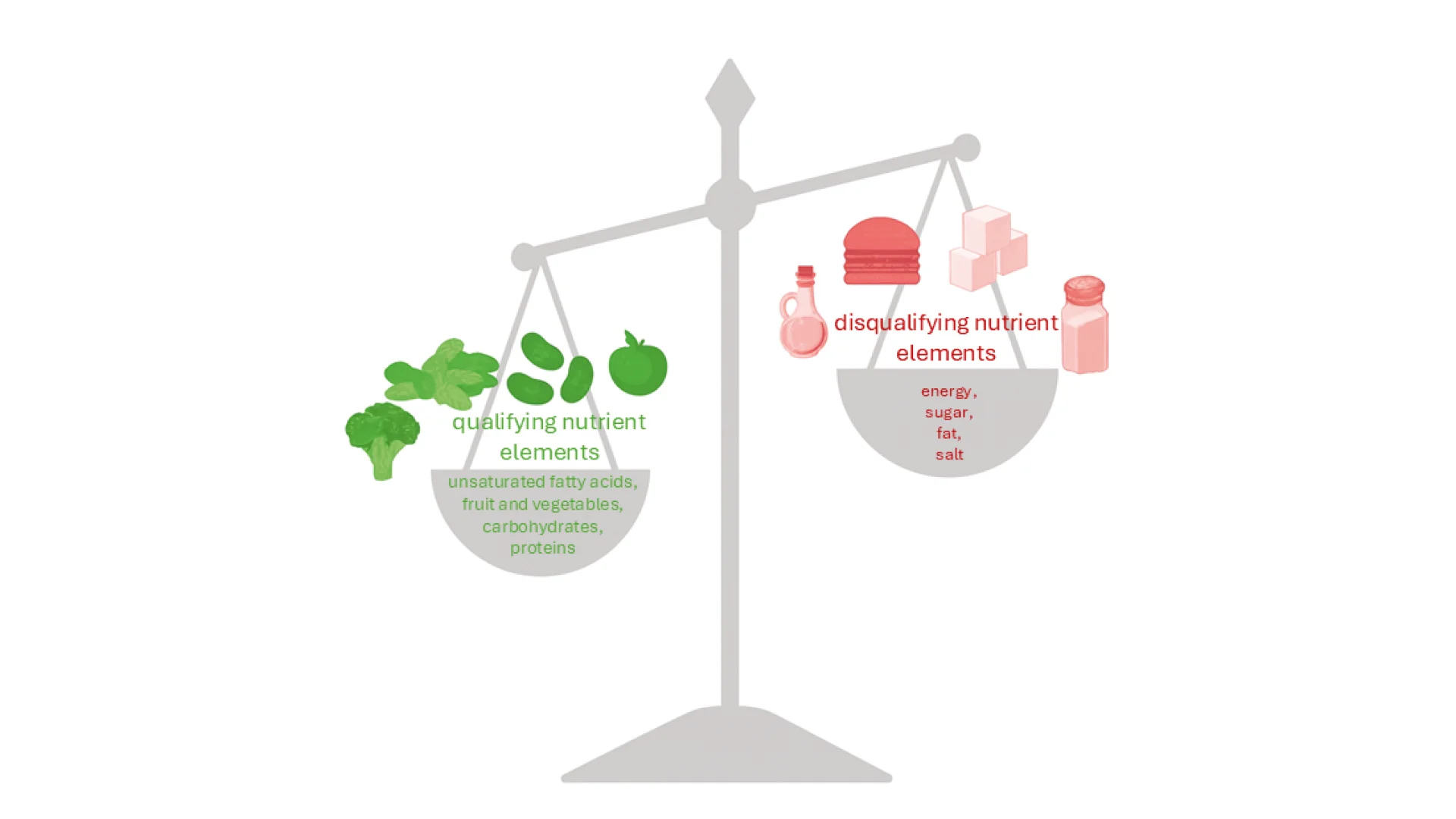
The nutritional balance of a meal in the MSI is assessed using the so called “Nutritional Balance Points” (NBP). (Figure 1)
In the NBP model:
- The nutrient content of a meal is checked against intake recommendations. The degree of alignment is quantified through a points-based scoring system.
- Points are assigned for qualifying nutrient elements that tend to have positive health effects, including unsaturated fatty acids, carbohydrates, proteins, fruits, and vegetables.
- Points are also assigned for disqualifying nutrient elements that can lead to negative health outcomes when consumed in excess. This covers total energy as well as fat, sugar, and salt content.
- The final score results from the difference between these points, determining the meal’s overall balance.
- A meal is considered:
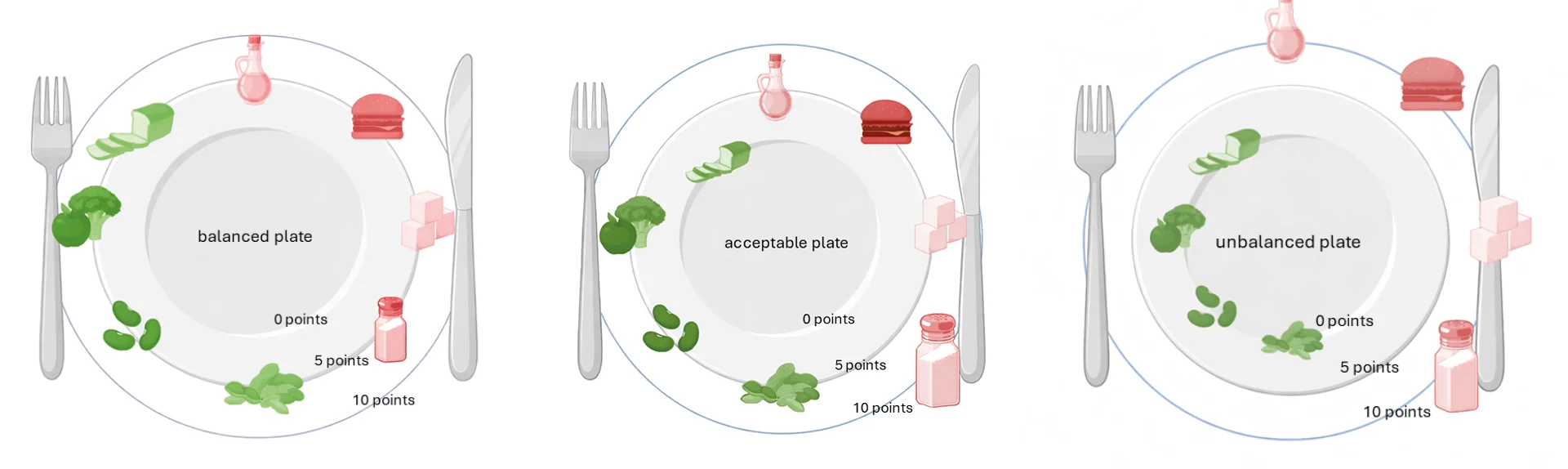
Balanced if qualifying and disqualifying elements offset each other or if qualifying elements predominate. (Figure 2)
Acceptable if disqualifying elements outweigh qualifying ones only slightly. (Figure 2)
Unbalanced if disqualifying elements clearly predominate. (Figure 2)
Balanced, acceptable or unbalanced?
The balanced plate
On a balanced plate, the qualifying nutrient elements (green) outweigh, or at least offset, the disqualifying nutrient elements (red). This is the case, for example, when each of the eight assessed nutrient elements scores 5 points, corresponding to the recommended intake levels. Ideally, most consumed meals should fall into this category.
The acceptable plate
A meal is classified as acceptable when the disqualifying nutrient elements outweigh the qualifying ones only slightly. In this example, the meal contains a very high amount of salt (= 10 points) and very few carbohydrates (= 0 points). This results in a total NBP score of -10 points. The meal is therefore considered acceptable: it can be eaten occasionally, but it should not be the norm.
The unbalanced plate
The unbalanced plate is dominated by disqualifying nutrient elements. In this case, the fat, energy, sugar, and salt contents are all excessive, each scoring 10 points. At the same time, carbohydrates, fruits and vegetables, unsaturated fatty acids, and protein sources are lacking, leading to scores of 0 in each of these categories. The total score amounts to -40 points. Such a meal is considered unbalanced and should be consumed only rarely.
Assessment of the environmental compatibility: the life cycle assessment method
To systematically capture environmental impacts, the Life Cycle Assessment (LCA) method is applied. This analysis evaluates the potential environmental impacts of food products throughout their entire life cycle, considering all phases, from raw material extraction to production, transport, usage, and disposal. Various methodological approaches are available for assessing the environmental impacts. In the case of the MSI, the ecological scarcity method is used.
In the ecological scarcity method:
- Environmental impact is expressed in eco-points.
- The environmental impact of ingredients can be quantified by examining the environmental impacts (emissions, waste, and resource use) along the supply chain. (Figure 3)
- Environmental impact is assessed based on ecological goals and the scarcity of natural resources. The further the amount of environmental impact or resource scarcity deviates from defined threshold values, the higher the assigned eco-point. These threshold values are based on scientifically established environmental goals of Switzerland.
- The eco-points of the individual ingredients of the dish are summed up.
- An ingredient receives more eco-points the greater its environmental impact.
- A menu can be classified as having very low, low, medium, high, or very high environmental compatibility based on the eco-points.

Communicatin of the MSI
To help consumers choose their menu based on environmental impact and nutritional balance, both values can be visually represented. For example, nutritional balance can be depicted using hearts, and environmental impact can be represented with leaves. This approach enhances the understanding of both scores and supports guests in making a sustainable, balanced, and intuitive menu choice.

Menu example: Thaicurry with tofu, rice and curry

The menu contains sufficient protein, carbohydrates, and vegetables, and not too much fat, energy, or salt. Only the sugar content is slightly exceeded → Balanced
The menu contains exclusively plant-based ingredients → Very high environmental compatibility
Menu example: Cordon Bleu with fries and ketchup

The menu contains too much energy, fat, and salt, and not enough carbohydrates and vegetables → Unbalanced
The menu contains a high proportion of animal-based foods such as meat and cheese → Low environmental compatibility
Note on image source: The illustrations used were created with BioRender and ChatGPT.