Master of Science in Preneurship for Regenerative Food Systems
Are you ready to transform our food system, think in systems and turn complex challenges into entrepreneurial solutions? Then the Master's programme in Preneurship for Regenerative Food Systems (PREFS) is designed for you.
With us, you take ownership of your learning. You build the knowledge, mindset and skills to help transform the food industry – and to thrive in the regenerative careers this transformation creates.

Experience PREFS
Info Events
- Online:
- Onsite:
- Tue, 29 September 2026 in Wädenswil | all master’s degree programs | 5.45 p.m. to 7.30 p.m. (including a tour of our new campus facilities)
1:1 online call
- Book a 30-minute online call with a programme advisor
Trial Class
- Experience PREFS up close: Join one of our classes
PREFS Community
Apply now
Why study Preneurship for Regenerative Food Systems?
Whether you come from agricultural, food or business sciences, already work in the food industry, or carry your own venture idea: if you want to actively help reshape food systems, this programme is for you.
To secure our future, food systems need to become regenerative and resilient. That takes people who think in systems and act entrepreneurially. We turn food losses into new value, close supply-chain loops and bring regenerative ventures to market, building food futures that are healthy for people, fair along the whole value chain and restorative for the planet.
The interdisciplinary programme is science-based, practice-oriented and future-focused. At its heart is the Agro Food Project, which runs across all four semesters. Together with peers, students work alongside experts from research groups, industry partners and NGOs. Bring your own idea or take on a real-world project idea from our partners, and develop it into a regenerative business model.
The curriculum covers: food technology and food systems, ecosystems and regenerative strategies, business modelling and finance, innovation and transformation management. The Open Curriculum lets students shape their own study journey and build deep expertise in the questions that matter most to them. Future skills run throughout the programme: systems thinking, resilience, navigating uncertainty, collaborative leadership and AI literacy.
Set in Wädenswil near Zürich, the programme combines the rigour of Swiss higher education with a community drawn from across Europe.
PREFS explained | What does "Preneurship" mean?
Preneurship is our term for all forms of entrepreneurial action: founding new ventures (entrepreneurship), driving change within organisations and businesses (intrapreneurship), and creating social and societal impact through entrepreneurial means (social entrepreneurship). Whichever of these paths you take in your studies, you will learn to think and act entrepreneurially.
Video insights with Maya Ladner, Programme Director MSc PREFS
What makes the PREFS Master's unique? Hear the insights from Maya Ladner, Study Programme Director

Find more insights into the MSc PREFS in these videos:
How does PREFS prepare you for the jobs of tomorrow?
Development and personal growth with the MSc PREFS: how does that work?
How regenerative food systems are transforming food value creation.
More than just a Master's – a shared experience
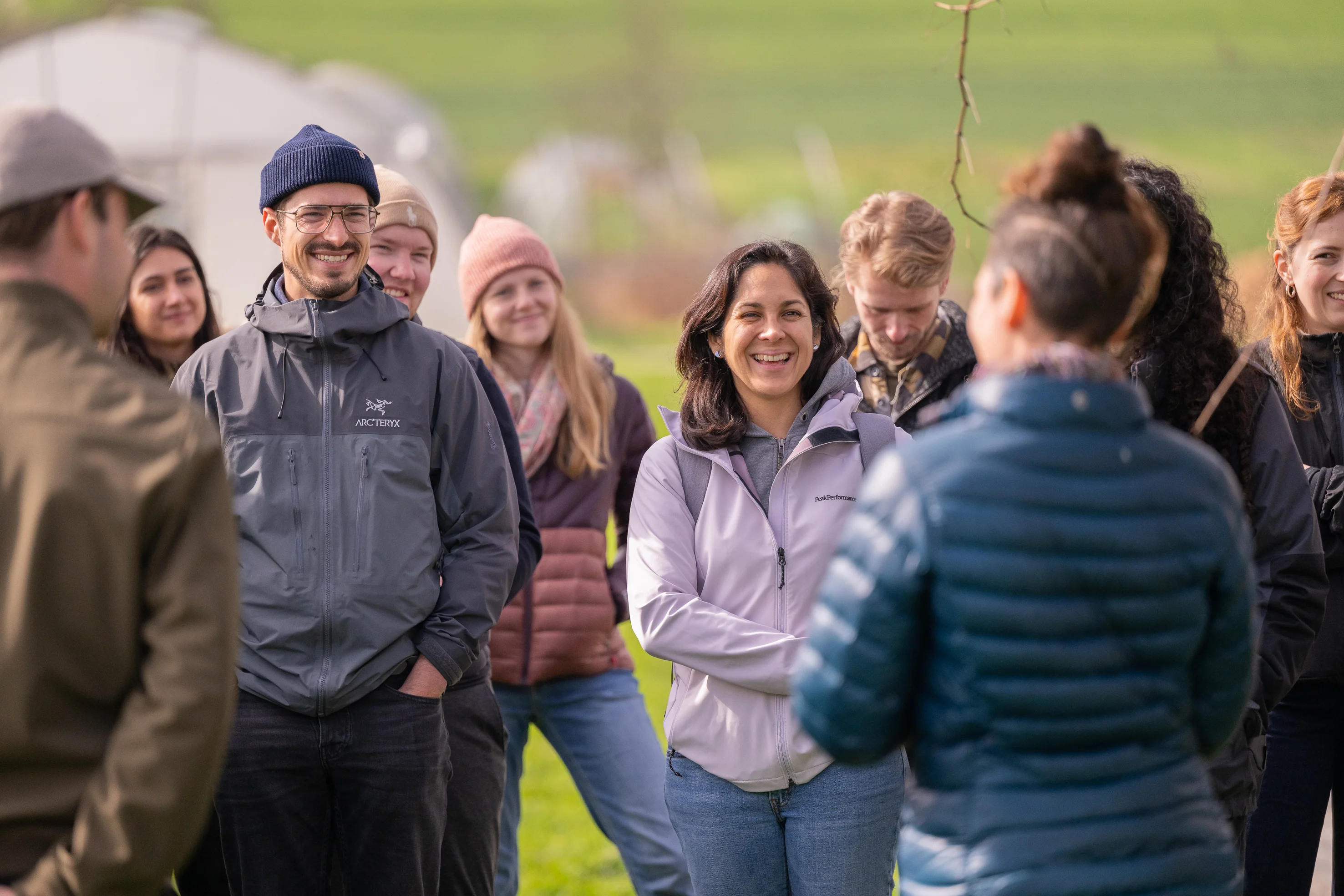
In the PREFS Master’s programme, you can feel ideas turning into tangible projects. You experience the excitement of new thinking, share the joy of creating together, and tackle challenges as a team. Community at PREFS often grows quite naturally – through conversation, shared meals or exploring new foods together. This culture of connection, passion and creativity is what makes the programme truly unique.
At a glance
Degree: MSc in Preneurship for Regenerative Food Systems
Duration: 4 – 8 semesters (flexible), 90 ECTS
Language: English
Learning approach: Practical. Project-based. Tailored to you.
Location: Wädenswil (depending on module scheduling also Zürich or Winterthur)
Programme start: End of February (calendar week 8)
Application deadline: October 31st
Fees: CHF 720 per semester (+ CHF 500 for students residing abroad)
Target group: Entrepreneurial thinkers from various fields aiming to reshape food systems.
Brochure: Download programme brochure (PDF, 3,4 MB) (PDF 631 kB)
Flexible study models
| PART-TIME | Duration: 4 semesters (90 ECTS) over 2 years Attendance: approx. 2-3 days of classroom teaching per week (on site and online) |
|---|---|
| PART-TIME EXTENDED | Duration: 5-8 semesters (90 ECTS) over 2.5 - 4 years Attendance: approx. 1-2 days of classroom teaching per week (on site and online) |
Programme structure and content
The programme comprises 90 ECTS over four semesters – or five to eight if you study alongside significant employment. Its core elements are the Agro Food Project (20 ECTS), the master's thesis (10 ECTS) and mandatory modules (26 ECTS) in food technologies and nutrition, regenerative strategies, leadership and business.
Around a third of your credits are yours to shape – through elective modules and Individual Skills. You select your elective modules from departments across the whole of ZHAW. With Individual Skills, you define the content and learning goals yourself and deepen your expertise exactly where you want to – for example through external courses, internships, summer schools or research projects at ZHAW.
You map your own route through the programme with the Individual Study Journey (ISJ).
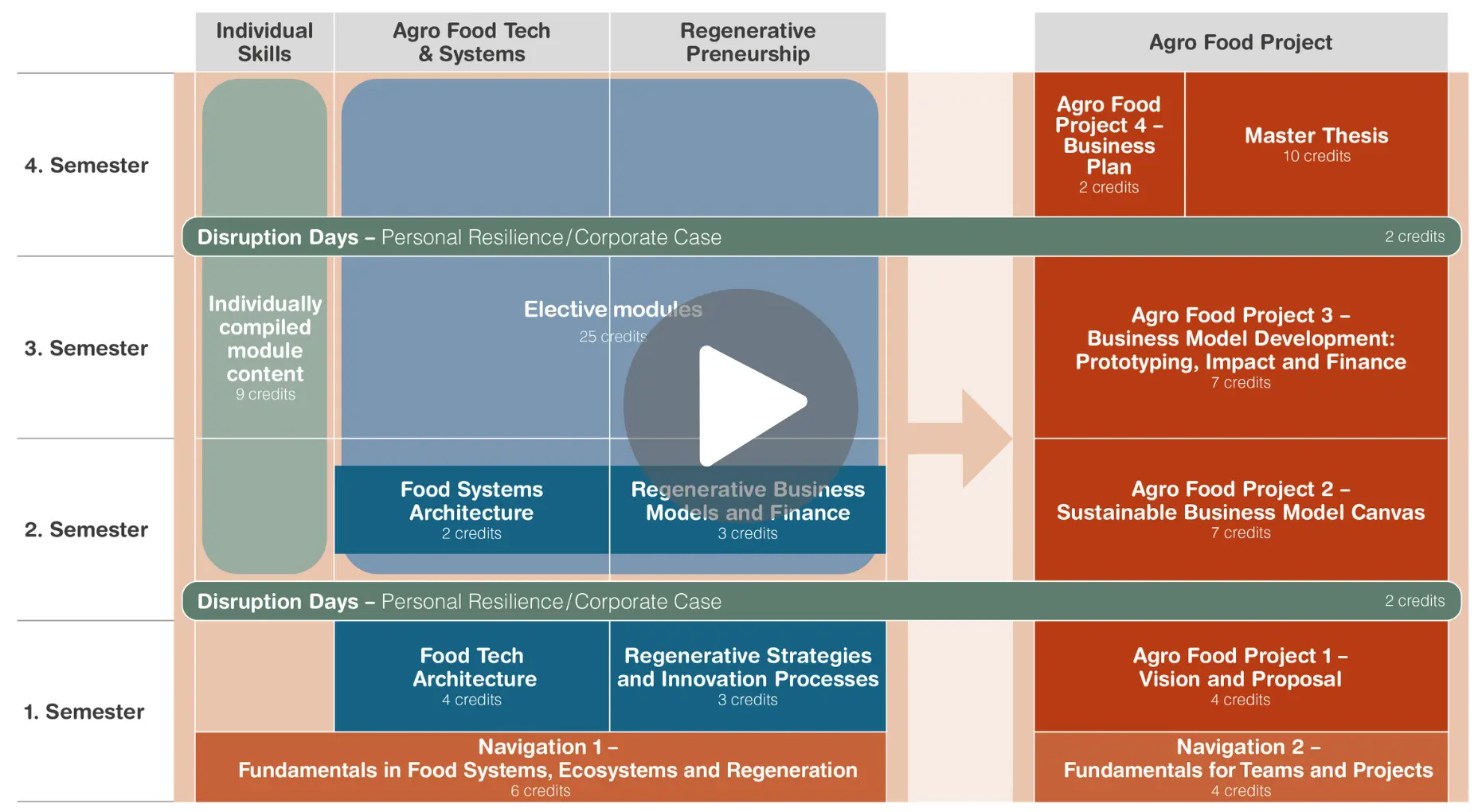
The mandatory modules at a glance:
- Navigation: This segment is divided into two modules. In Navigation 1 you gain core knowledge of food systems, ecosystems, and regeneration, while Navigation 2 equips you with essential skills for teamwork and project implementation. (total 10 ECTS)
- Agro Food Project: A four-semester practice-oriented project where you work in interdisciplinary teams on real-world challenges from business, applied research or NGOs – for example, in the fields of circular economy or climate change. (total 20 ECTS)
- Regenerative Preneurship: Two modules - Regenerative Strategies and Innovation Processes and Regenerative Business Models and Finance. (total 6 ECTS)
- Agro Food Technology and Systems: In-depth understanding of technologies and food systems in two modules. (total 6 ECTS)
- Individual Skills: Self-designed modules where you set the content and learning goals to develop your personal and professional skillset.(total 9 ECTS)
- Disruption Days: Intensive block weeks where you engage with surprising, future-relevant questions and strengthen your personal, social and entrepreneurial competencies – future skills such as resilience, communication, dialogue and reflection. (total 4 ECTS)
We encourage collaborative learning, initiative and practical experience. Throughout the programme, you are supported by mentors and coaches who guide you both academically and personally.
Elective Modules in the Open Curriculum
By selecting one third of your elective modules from other Bachelor- and Master’s programmes at ZHAW, you can sharpen your individual profile and expand your perspective. You can draw on modules from five ZHAW departments – spanning business, psychology, social work and environmental sciences – in English or German. The Open Curriculum opens up new learning opportunities, fosters networking and gives you the freedom to look beyond your own discipline.
Skills You Will Acquire
| Competence | Application |
|---|---|
| Systems Thinking | Analyse and transform food systems |
| Strategic Management | Developing and evaluating sustainable and regenerative business models |
| Leadership | Practise and reflect on leadership roles |
| Interdisciplinary Collaboration | Connect technology, business, and science |
| Project and Innovation Management | Generate ideas, implement them, and measure impact |
| Communication Skills | Negotiate with stakeholders and pitch projects persuasively |
PREFS explained | What we mean by «Regeneration»
Regenerative systems are dynamic, self-renewing structures – biological, ecological, technological, social and economic – that restore, maintain and enhance their functionality, resilience and long-term viability. In contrast to conventional systems, which tend to degrade over time, regenerative systems actively rebuild resources, adapt to change and generate a net-positive impact. In doing so, they foster continuous development towards greater stability, resilience, productivity and overall functionality.
Employment following the completion of your studies
PREFS graduates work wherever the food system is being reshaped, as food-systems specialists, consultants, researchers and policy analysts, in companies, organisations, research, the public sector, and start-ups of their own. Most take a clear step forward after graduating, prepared for the roles that exist today and those just beginning to emerge.
Programme Director Maya Ladner explains in this video how PREFS prepares you for the future of work.
Possible Career Paths
- Sustainability Manager in the Food Industry
Driving transformation along the value chain (supply chain, reporting, etc.) - Innovation Promotion and Business Development
Developing sustainable business models and supporting product innovation - Founder of Sustainable Food Initiatives
For example, in regional value chains, alternative proteins, direct marketing, or social entrepreneurship - Consultant in the private and public sector or in NGOs
For example, working with ministries, think tanks, or international organizations - Project Manager in International Organizations
Implementing global projects on food security, resilience, and regeneration
In the PREFS programme, students develop projects with real-world impact.
The student project Future Builders exemplifies how ideas are created, tested and further developed during the programme, with a strong focus on social and environmental impact.

«PREFS gave me exactly the knowledge and network I needed to build my own startup. A product with real impact—ecological, economic, and social.»
Phillippe Schläpfer | Founder of Symactiv, a regenerative fertilizer startup
- Watch the video: Phillippe's testimonial
- For questions or networking: Phillippe's LinkedIn profile

«Through PREFS I gained a deeper understanding of how complex our food system is—and how much impact we can have. Today, my team and I develop enjoyable, sustainable products from by-products. Future-proof and effective.»
Deborah Beer | Food Consultant at Betty Bossi / Coop

«During my PREFS studies, I learned to understand systems – and to actively help shape them. Today, I lead an organization that connects and supports industry, research, and start-ups to drive sustainable innovations in the food system.»
Alban Muret | Managing Director at Foodward
Admission Requirements
To participate in the Master’s programme, you must to have:
- A completed Bachelor’s or Master’s degree, for example in environmental, food, business, agricultural or nutritional sciences, biotechnology, hospitality or facility management. Different background? Admission from various fields is part of our standard procedure.
- A good command of English, B2 level or above is recommended.
- An interest in regenerative food systems and entrepreneurial thinking.
- Motivation to contribute your own ideas for sustainable transformation.
You'll find the details here: Overview of Admission Requirements
Not sure if your profile fits?
Let’s take a look together: Do the CV check!
The CV check is a non-binding initial assessment. A binding admission decision – including official grade conversion for foreign qualifications – is only made after formal application.
Internationals & Visa
Depending on your country of origin, you may need a visa to study in Switzerland. Processing takes anywhere from a few weeks to several months, so start early: gather your documents well ahead of time and apply as soon as you can, ideally by the end of August.
- Guide for students with a visa requirement
- Checklist and cover sheet for your visa application
- Incoming Students
Questions? Our International Office is happy to help: international.lsfm@zhaw.ch
Application Deadlines & Programme Start
- Programme start: Week 8 (end of February)
- Application deadline: 31 October (for international applicants who require a visa: 30 September)

Programme Director:
Maya Ladner
Deputy Programme Director:
Sabine De Castelberg
Student Advisers:
Maya Ladner, Carmen Burri and Sabine De Castelberg (1:1 online call).
Have questions about the programme? Book a 1:1 online call with one of our advisers, or reach us anytime via our contact form.
Stay connected | LinkedIn
On LinkedIn, you get a closer look at what studying PREFS is really like: how the Agro Food Projects are progressing, which events are coming up, and which lecturers and students we're putting in the spotlight.
Follow us on LinkedIn and stay up to date.
FoodTech Summer School (6 ECTS)
A two-week intensive programme in the PREFS ecosystem. Working in interdisciplinary teams, participants develop sustainable business ideas within the food system – from analysis to pitch. Ideal as an introduction to the PREFS focus areas or for deepening specific skills.
Practical relevance
The MSc in Preneurship for Regenerative Food Systems is embedded within the Business Field Development at ZHAW. This is where practice-oriented innovation and transformation projects are developed in collaboration with industry partners, start-ups, public institutions and NGOs. As a student, you gain direct insight into real-world projects and work on solutions with tangible impact.





Latest From LinkedIn
-
🌱 𝗥𝗲𝗴𝗲𝗻𝗲𝗿𝗮𝘁𝗶𝘃𝗲 𝗮𝗴𝗿𝗶𝗰𝘂𝗹𝘁𝘂𝗿𝗲 𝗰𝗿𝗲𝗮𝘁𝗲𝘀 𝘃𝗮𝗹𝘂𝗲 𝗲𝘃𝗲𝗿𝘆𝘄𝗵𝗲𝗿𝗲 𝗲𝘅𝗰𝗲𝗽𝘁 𝗼𝗻 𝘁𝗵𝗲 𝗯𝗮𝗹𝗮𝗻𝗰𝗲 𝘀𝗵𝗲𝗲𝘁 𝘁𝗵𝗮𝘁 𝗵𝗮𝘀 𝘁𝗼 𝗽𝗮𝘆 𝗳𝗼𝗿 𝗶𝘁. That's the gap PREFS alumna Marina S. puts into sharp focus ahead of Building Bridges 2026: a ...
-

🎥 𝗠𝗦𝗰 𝗣𝗥𝗘𝗙𝗦 𝗜𝗻𝘀𝗶𝗴𝗵𝘁𝘀 | 𝗛𝗼𝘄 𝗱𝗼𝗲𝘀 𝗣𝗥𝗘𝗙𝗦 𝗽𝗿𝗲𝗽𝗮𝗿𝗲 𝘆𝗼𝘂 𝗳𝗼𝗿 𝘁𝗵𝗲 𝗷𝗼𝗯𝘀 𝗼𝗳 𝘁𝗼𝗺𝗼𝗿𝗿𝗼𝘄? At MSc PREFS, future skills are at the core of the programme. Study Programme Director Maya Ladner explains what this looks ...
-

🌱 Zwei ZHAW-Projekte im Rennen um den Clima Now Spotlight 2026! Wir freuen uns sehr, dass zwei Projekte, an denen die Geschäftsfeldentwicklung der ZHAW LSFM beteiligt ist, für die «Wall of Fame» des ...