Photovoltaic potential on rooftops in Switzerland
The Renewable Energies Research Group has reassessed the photovoltaic potential of Swiss roof surfaces on behalf of the Swiss Federal Office of Energy. Using data from Sonnendach.ch and a representative sample of fictitious module installations on roof surfaces, a total potential of 53.6 TWh per year was determined. This is at the upper end of previous studies.
Challenge
Various studies have determined the potential for electricity production using photovoltaics on roofs in Switzerland. Estimates of this potential vary widely, ranging from 16 to 53 TWh per year. One reason for this wide range is the different assumptions made about the proportion of roof space that can be used for photovoltaics.
Approach and objectives
This study determines the proportion of Swiss roofs that can be used for photovoltaics. A distinction is made between flat and pitched roofs, and the roofs are categorized according to their size. The average proportion of roof space that can be used for photovoltaics is determined for each category. To this end, a randomized sample is taken for each roof category from the Sonnendach.ch database. Roof areas that are "good", "very good", or "excellent" (irradiation ≥ 1000 kWh/m2/a) are taken into account.
Results
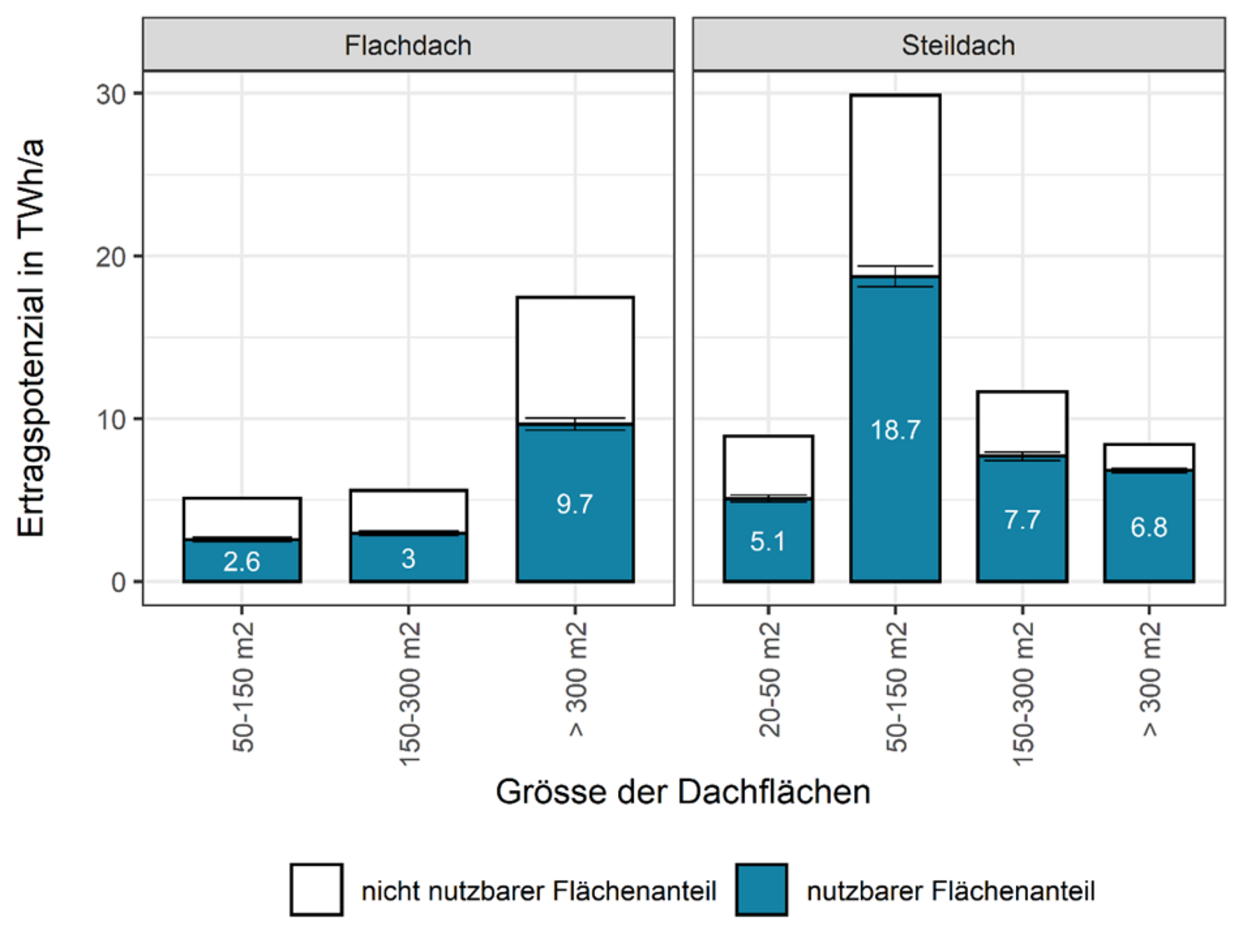
Of the total 644 km2 of roof space in Switzerland, 450 km2 (68%) are suitable for photovoltaic systems due to their size and exposure to sunlight. Of this, 60 % (± 2 % uncertainty) of the space can be covered with photovoltaic modules. This corresponds to a maximum module area of 264 km2 (± 9 km²). The proportion of roof area usable for photovoltaics is higher for pitched roofs (63%) than for flat roofs (53%). Figure 1 shows the average usable roof area, broken down into flat and pitched roofs and different roof sizes. Pitched roofs generally have a higher usable area than flat roofs.
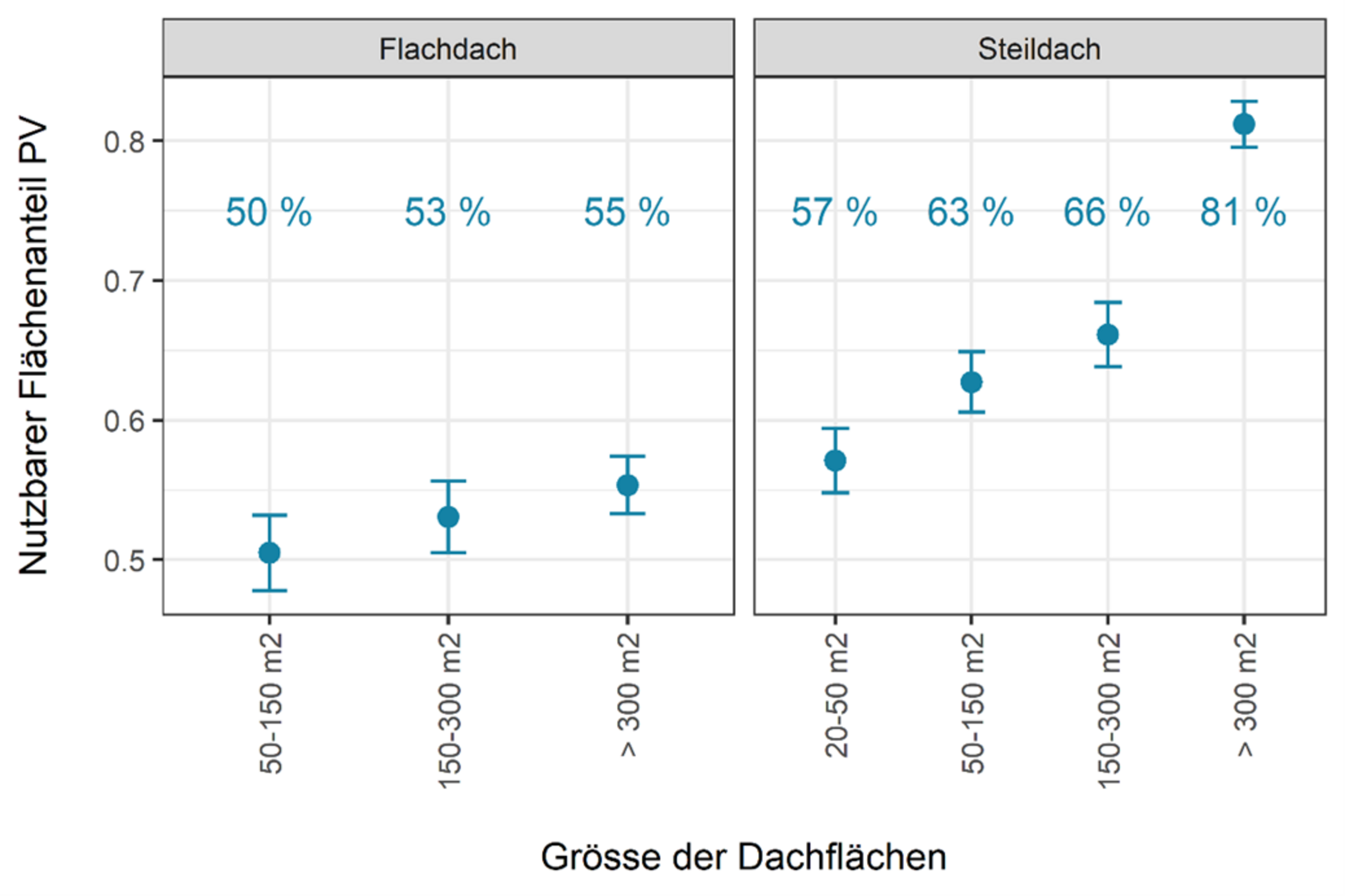
Particularly in the case of pitched roofs, the proportion of surface area that can be used for photovoltaics increases with increasing roof size. For pitched roofs > 300 m², for example, the average is 81%, whereas for pitched roofs with an area of 20-50 m², only 57% of the surface area can be used. The effect of roof size is also evident in flat roofs, although it is less pronounced there.
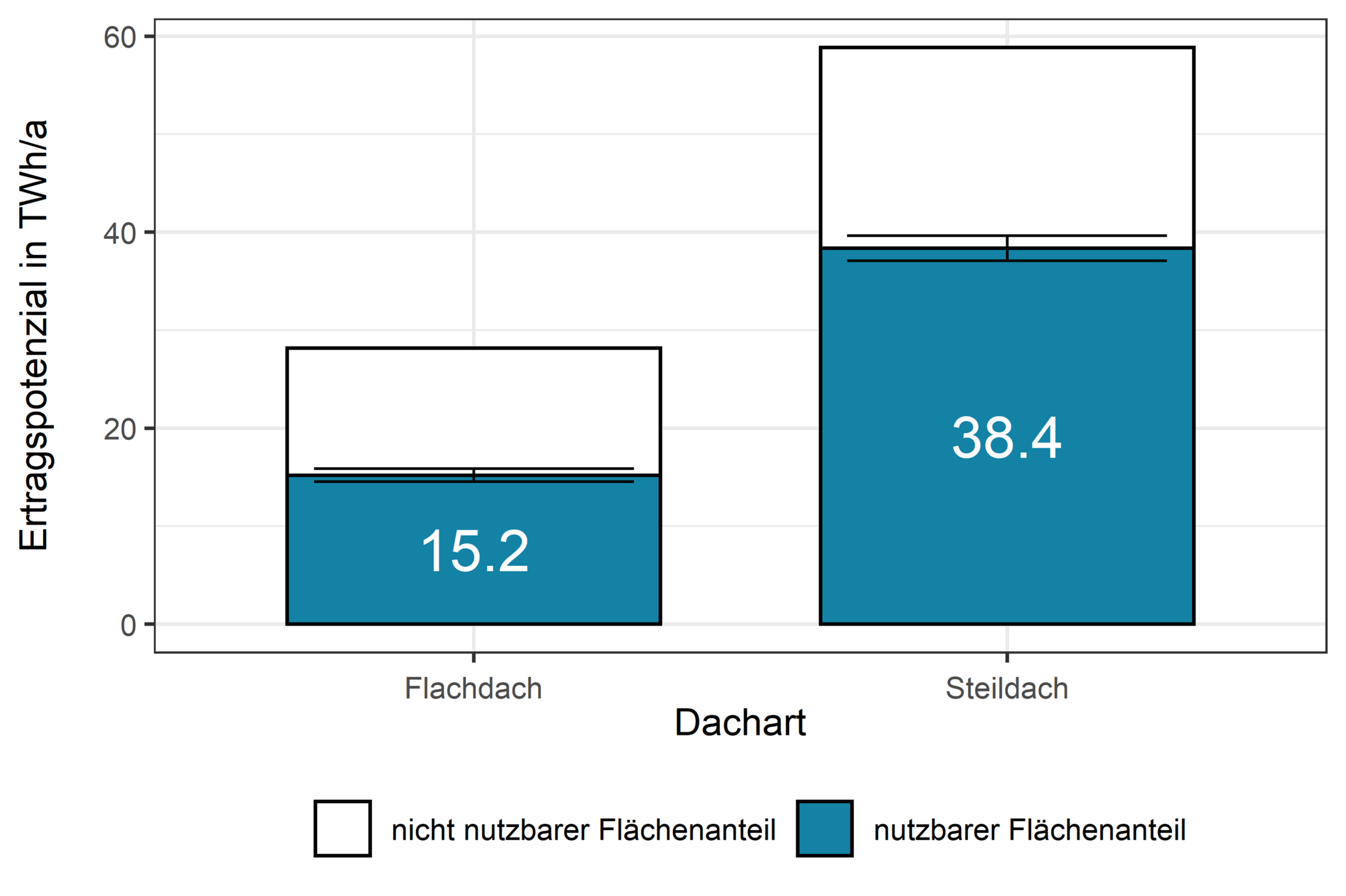
If the usable areas are applied to all roof areas in Switzerland that are potentially suitable for photovoltaics, a module efficiency of 20% and a performance ratio of 80% result in a yield potential of 53.6 TWh/a (± 1.9 TWh/a). The potential is based on the irradiation data available at the time of the study and data on the building stock from Sonnendach.ch. This potential is calculated by excluding small roof areas (20 m2 for pitched roofs and 50 m2 for flat roofs) and areas with low irradiation (suitability), as well as the reduction due to the usable area of roofs (Figure 2).

Steep roofs contribute significantly more to the potential on roof surfaces with 38.4 TWh/a (± 1.2 TWh/a) than flat roofs with 15.2 TWh/a (± 0.6 TWh/a). In addition to the usable roof area, this is primarily due to the fact that the total area of all suitable pitched roofs, at 294 km2, is around twice as large as that of suitable flat roofs, at 147 km2. The potential for flat and pitched roofs is shown graphically in Figure 3.
Previous potential studies assumed a module efficiency of 17%. Using the method applied here, this efficiency would result in an expected potential of 45.6 TWh/a (± 1.6 TWh/a). The higher module efficiency of 20% takes technological progress into account. Module degradation is not taken into account, as a further increase in efficiency can compensate for this effect.
In the case of flat roofs, the largest roof areas (> 300 m2) contribute most to the potential. This can be explained by the very large areas that can be found on industrial buildings. For pitched roofs, the greatest potential lies in the 50-150 m2 size category. The yield potential per roof category (roof type and roof size) can be seen in Figure 4.
If the potential were fully exploited, approximately 95% of buildings in Switzerland would have a PV system on at least one roof surface. At current price levels, this would result in investment costs of CHF 83 billion, with CHF 19 billion being subsidized by the one-time payment. However, due to the expected reduction in costs for PV systems in the future, the investment costs for linear expansion by 2050 will be reduced to approximately CHF 58 billion, of which CHF 13 billion would be covered by the one-time payment.
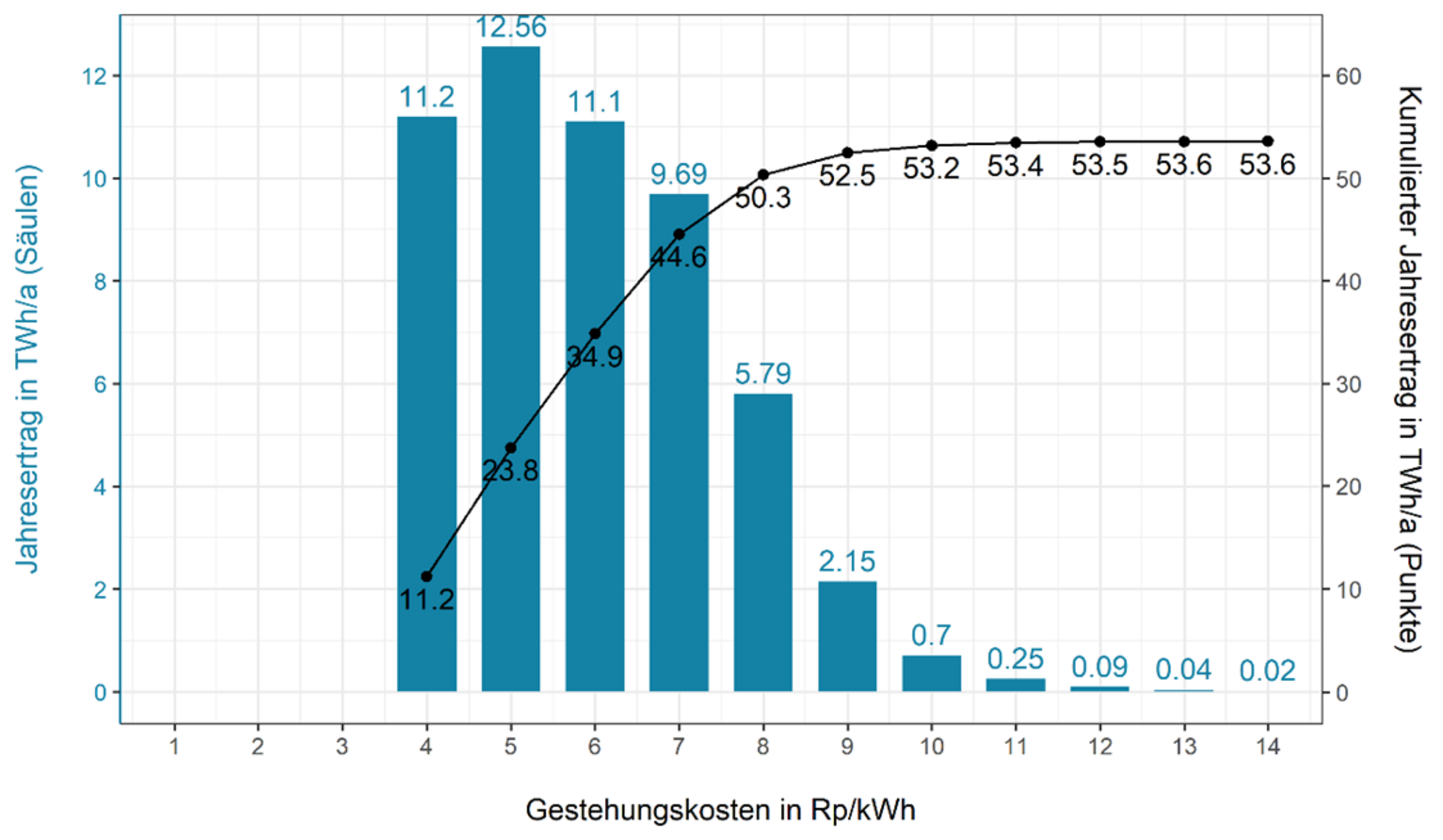
To achieve the target value of 34 TWh/a of electricity from photovoltaics in accordance with the Energy Perspectipectives 2050 (ZERO base scenario), investments of CHF 53 billion would be necessary (CHF 40 billion at future price levels), of which CHF 13 billion (CHF 9 billion at future price levels) would be incurred in one-off payments. The production costs of electricity from rooftop PV systems are between 4 and 14 cents/kWh at current price levels (Figure 5). Around two-thirds of the potential (34.9 TWh/a) can be tapped at production costs of no more than 6.5 cents/kWh.
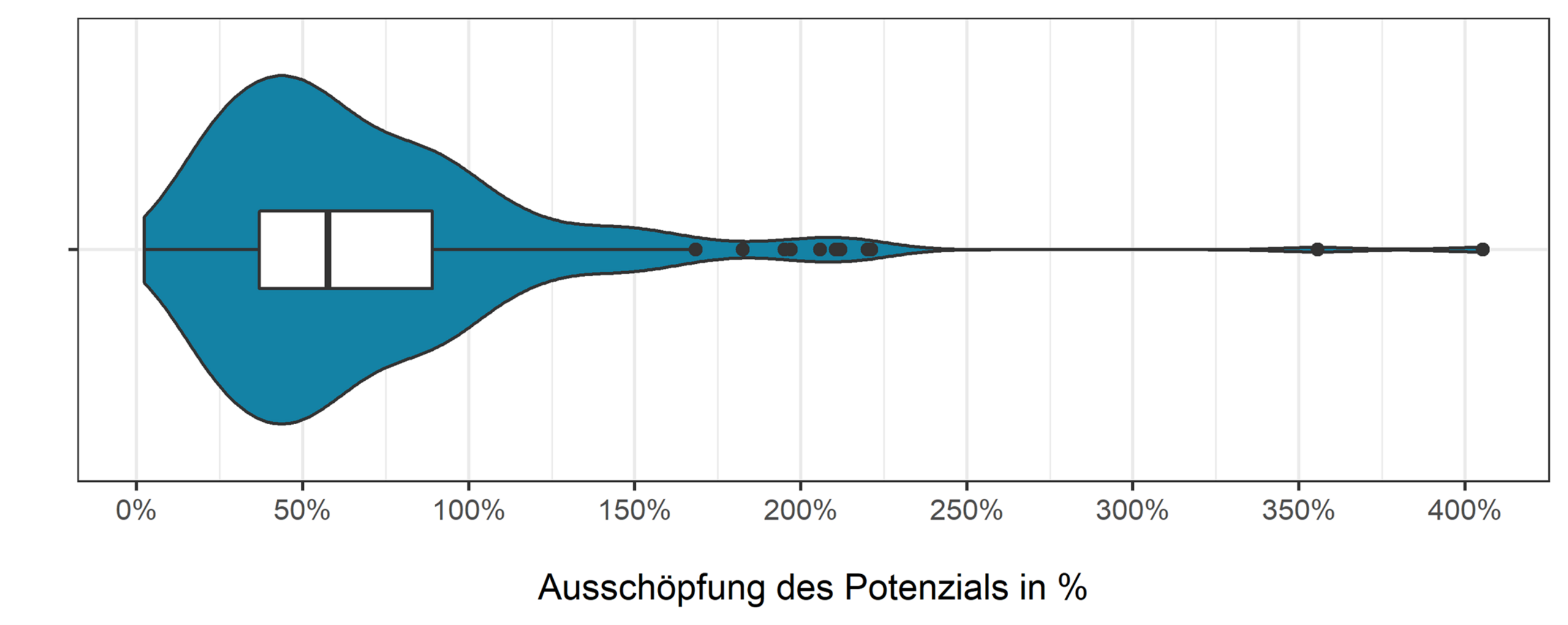
Die Ausschöpfung des ermittelten Flächenpotenzials wurde an einer zusätzlichen Stichprobe mit 226 Gebäuden ermittelt. Auf diesen Gebäuden wurde zwischen 2017 und 2021 eine PV-Anlage installiert. Diese Untersuchung zeigt, dass durchschnittlich rund die Hälfte der hier ermittelten Flächenpotenziale (49 %) beim Bau von PV-Anlagen ausgeschöpft wurden. Insbesondere bei Gebäuden mit grossen Dachflächen wurde häufig nicht die gesamte Fläche für eine PV-Anlage genutzt. Der Hauptgrund für den Bau kleinerer Anlagen wird in der bisherigen Förderpraxis mit Einmalvergütungen vermutet, welche den Eigenverbrauch von PV-Strom wirtschaftlich attraktiver macht als die Rücklieferung an das Energieversorgungsunternehmen.
Abbildung 6 zeigt die grosse Variabilität in der Ausschöpfung des Potenzials pro Dachfläche. Ausschöpfungen über 125 % sind hauptsächlich auf die Nutzung von Dachflächen mit einer geringen Einstrahlung (< 1000 kWh/m2/a) zurückzuführen, welche gemäss der hier angewendeten Methode als nicht geeignet betrachtet werden.