Green Patterns
Green Patterns are design patterns used primarily in the digital world to encourage sustainable behaviour. Unlike dark patterns, which often lead to negative behaviour, green patterns aim to inspire and encourage environmentally friendly decisions and behaviour.
Depending on the behaviour desired (i.e. changing, reinforcing, shaping), different patterns and combinations are used:
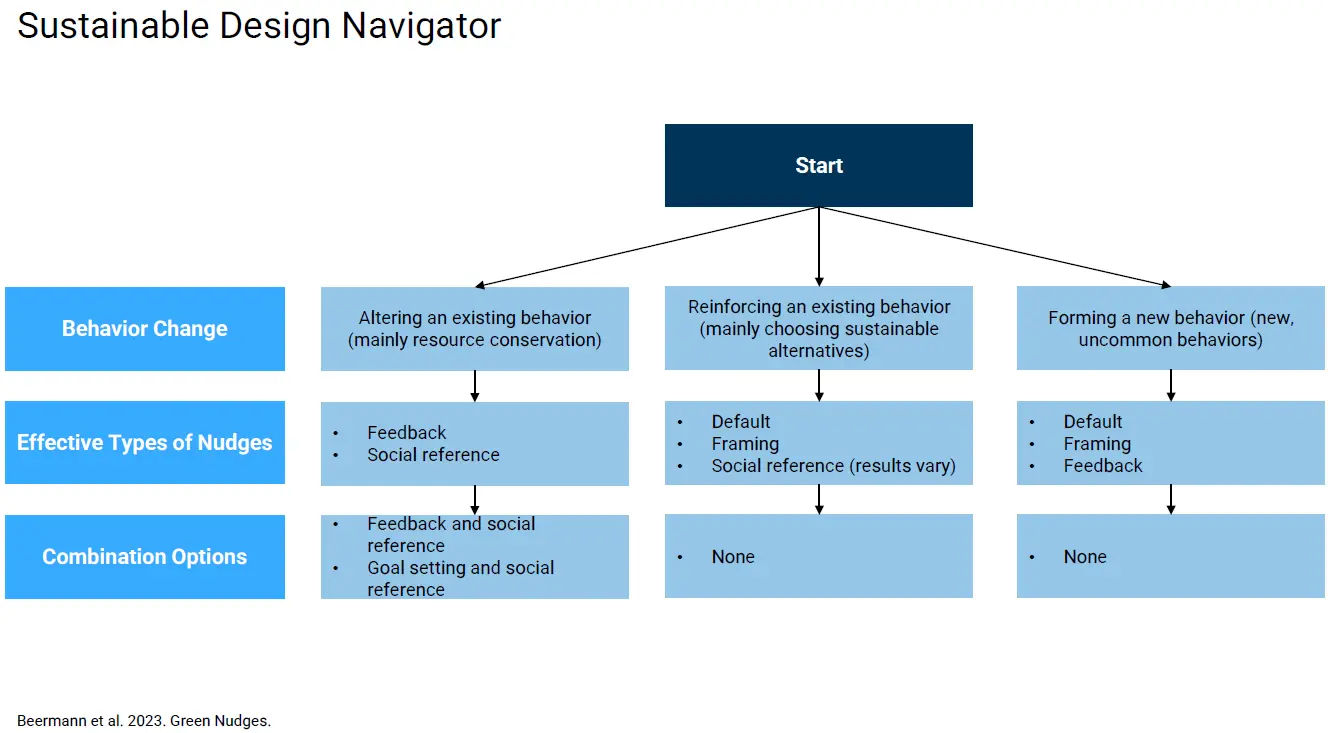
Here are some examples and definitions of these green patterns:
Pre-selection: This pattern sets environmentally friendly options as the default choice. In a dishwasher, for example, the eco mode could be set as the default cleaning mode.
Framing: This involves highlighting specific aspects of pro-environmental behaviour (PEB). This could include providing information on the environmental impact of different flight options to encourage customers to choose flights with a lower carbon footprint.
Transparency: High energy consumption is made tangible for the user. This can be implemented in user interfaces to display the energy consumption of different modes or settings, encouraging more sustainable decisions.
Social reference: This involves creating a sustainability challenge among users or tenants to encourage environmentally friendly behaviour. For example, a competition could be organised among tenants to see who achieves the most sustainable living practices.
Default: This pattern makes sustainable options the default choice in various contexts. Examples include default settings for offsetting CO2 emissions, opting out of cutlery when ordering food online, or using reused packaging material.
Priming: This pattern uses stimuli to activate associations with pro-environmental behaviour (PEB). Examples include priming for sustainable clothing or promoting less harmful flights.
Goal-setting: This involves setting goals in different contexts to encourage sustainable behaviour. Examples include Plastic Free July or Veganuary events to promote waste reduction or energy saving.
Feedback: Providing feedback on personal pro-environmental behaviour. This can take the form of concrete feedback on energy consumption, or by translating the impact of certain actions into terms that are easier for the user to understand.