Student Design Thinking Projects
Solution approaches from an external perspective for your innovation projects
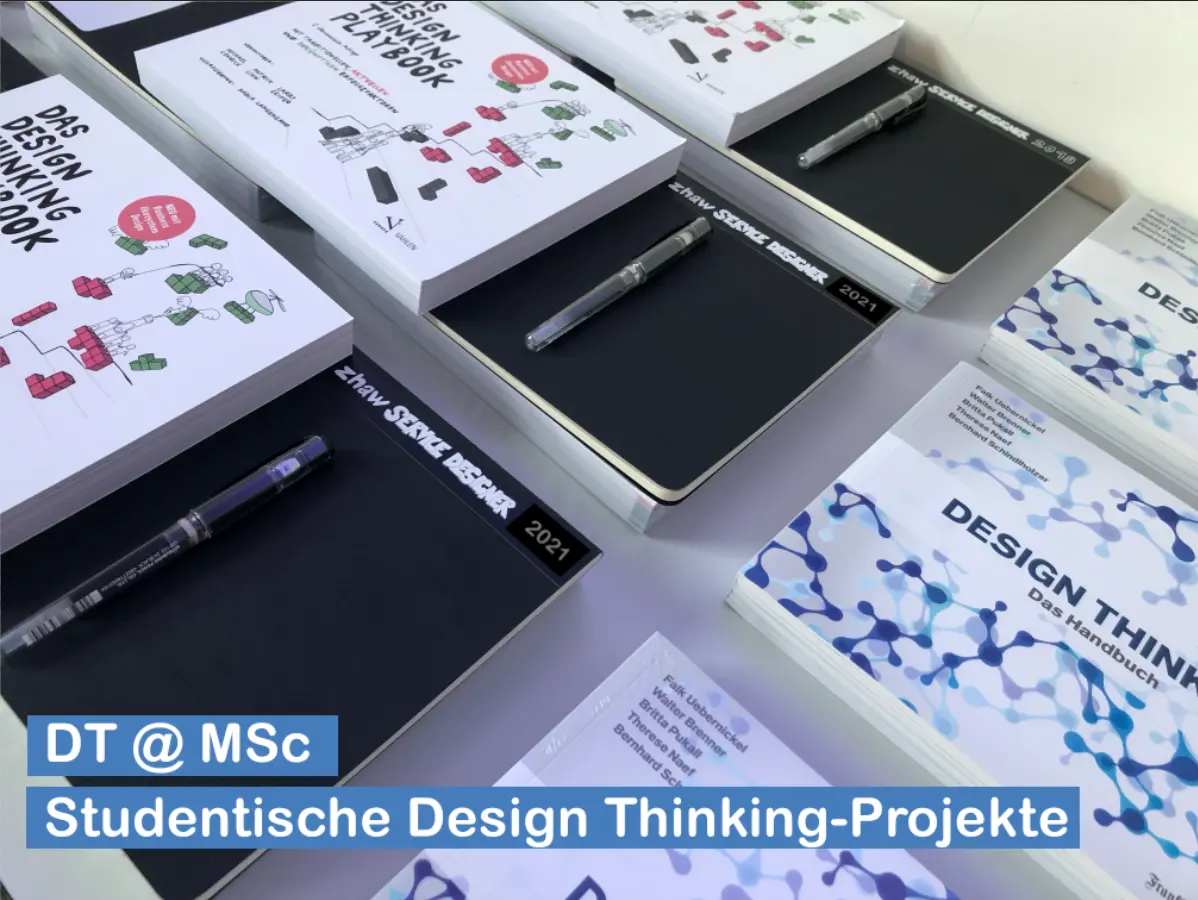
Design Thinking gives you a proven, structured way to solve complex challenges in a fast-moving, technology-driven world. Combining methods from an interdisciplinary service design process, it keeps your target group's needs at the centre of every step. Through iterative cycles, you get solutions that are not just customer-centric, but also technically feasible and genuinely value-creating for your stakeholders.
This approach goes well beyond developing new products or services. You can also apply it to redesign processes, sharpen strategic decisions, or tackle solutions for pressing societal challenges.
Student projects
As part of an elective module ("Design Thinking @ MSc") at consecutive Master's level, students work in groups of 4 to 6 to tackle a design challenge for a client.
The Institute of Marketing Management (IMM) has successfully completed more than 60 Design Thinking projects with student teams for external clients to date.
Projects are based on a question in the area of product or service design, process and sales design, or touchpoint management, preferably in a B2C context. B2B questions are suitable for these projects where access to the target group can be ensured.
Key project facts
- Teams of 4 to 6 students, investing approx. 400 to 500 hours (3 ECTS each)
- Online briefing and "onboarding" of teams in February
- Intensive workshop/design sprint the following week
- Completion of projects and presentation of solutions developed, by end of March/early April
- Deliverables: solution in the form of a prototype, documentation including an overview of the development steps (e.g. functional prototypes)
- Cost: CHF 5,000.— including a testing round with recruited participants
Project timeline
- Phase 1: Online onboarding
Teams receive an introduction to Design Thinking, covering methods for needfinding, observation, interviews and customer journey mapping.
- Phase 2: Design Thinking bootcamp
During an intensive week, teams develop ideas and initial prototypes. This phase concludes with an interim presentation.
- Phase 3: Finalisation
Teams refine and develop their solution further. The process concludes with a final presentation of the results.
Throughout the project, teams document their approach, for example in Miro, and prepare their findings for presentation.