Christopher Hartwell in the Kyiv Independent: The Price of Doing Business in Russia
Why do Western companies continue to operate in Russia despite growing political risks? In an article by the Kyiv Independent, Christopher Hartwell, Head of the International Management Institute (IMI) at the ZHAW School of Management and Law, examines the strategic considerations behind these decisions and explains why this approach is increasingly reaching its limits.
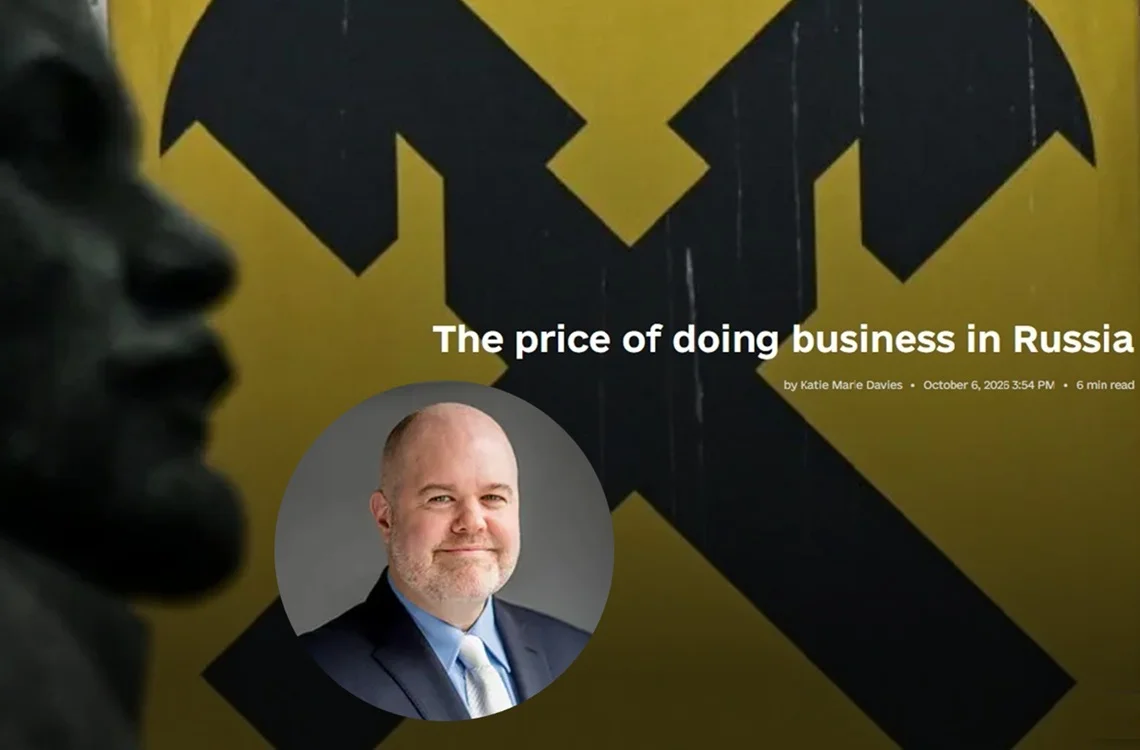
Since Russia's full-scale invasion of Ukraine in February 2022, numerous international companies have withdrawn from the Russian market. Others have deliberately chosen to stay, hoping to maintain their market position and benefit from a potential easing of political tensions at a later date.
Recent developments, however, are calling this strategy into question. As reported by the Kyiv Independent in its article “The Price of Doing Business in Russia”, the Russian assets of companies including Nestlé, Auchan and Metro have been placed under state administration. This increases the risk that Western companies could permanently lose control over their local operations.
When Political Risks Shape Business Decisions
In the article, Christopher Hartwell, Professor of International Business Policy and Head of the International Management Institute (IMI) at the ZHAW School of Management and Law, explains why companies continued their operations in Russia despite the considerable risks. One factor was the hope of preserving their position in the market in anticipation of a possible return to normal business relations.
At the same time, developments over recent years have demonstrated how unreliable such expectations can be. Hartwell points out that the growing state intervention should have been foreseeable, particularly after the Russian subsidiaries of international corporations such as Danone and Carlsberg were placed under state control in 2023.
The case of Russia thus highlights a key challenge in international management: corporate strategies must account for political and geopolitical developments, especially when business interests increasingly collide with the exercise of state power.