Our record-setting perovskite memristors published in Joule…
…and their switching secret unraveled (partially)
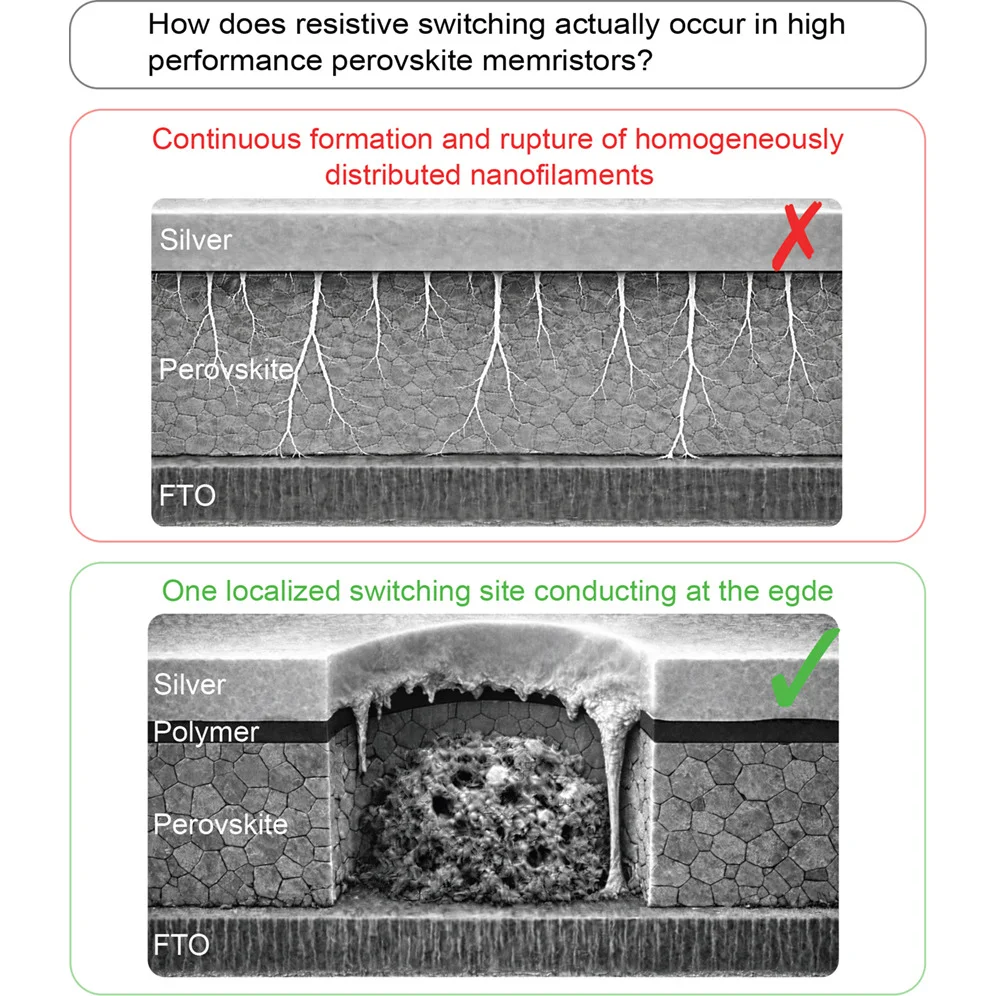
We are pleased to announce our latest publication in Joule, which provides new insight into how perovskite memristors operate and introduces a method to precisely control the switching site.
Perovskite memristors have attracted growing interest as emerging electronic devices for memory and information processing. However, their development has been limited by device variability and an incomplete understanding of the physical mechanisms behind resistive switching.
In our study, we show that switching does not occur through randomly distributed metallic nanofilaments, as commonly assumed. Instead, the switching originates from one or a few highly localized regions that form during the device’s initial operation. These regions remain stable during subsequent switching cycles and are the core of the record performance with millions of switching cycles and low-voltage (<0,1 V) operation, unprecedented for perovskite memristors.
To investigate and control the switching, we developed a light-based patterning approach that allows the switching location to be defined with high precision while eliminating the need for the conventional high-energy forming step. This leads to devices with low operating voltages, high reliability, and stable long-term performance.
Our findings establish a clearer physical picture of switching in perovskite memristors and provide a practical strategy for improving their reproducibility and scalability, bringing the technology closer to future electronic applications. Nevertheless, further fundamental questions remain for future studies, e.g. regarding the exact electrochemistry and polarity of the switching
The article is available open-access at Joule (https://doi.org/10.1016/j.joule.2026.102473).
A brief story behind the paper is posted on our Website.