AI in Education: Between Knowledge and AI Competence
The use of artificial intelligence (AI) presents new challenges for education. On the one hand, students must acquire fundamental knowledge independently; on the other hand, AI will be a key tool in their everyday professional lives. The Institute for Energy Systems and Fluid-Engineering (IEFE) at the ZHAW School of Engineering, the Vorarlberg University of Applied Sciences (FHV) and the HTWG Konstanz investigated how AI can be meaningfully integrated into engineering education.
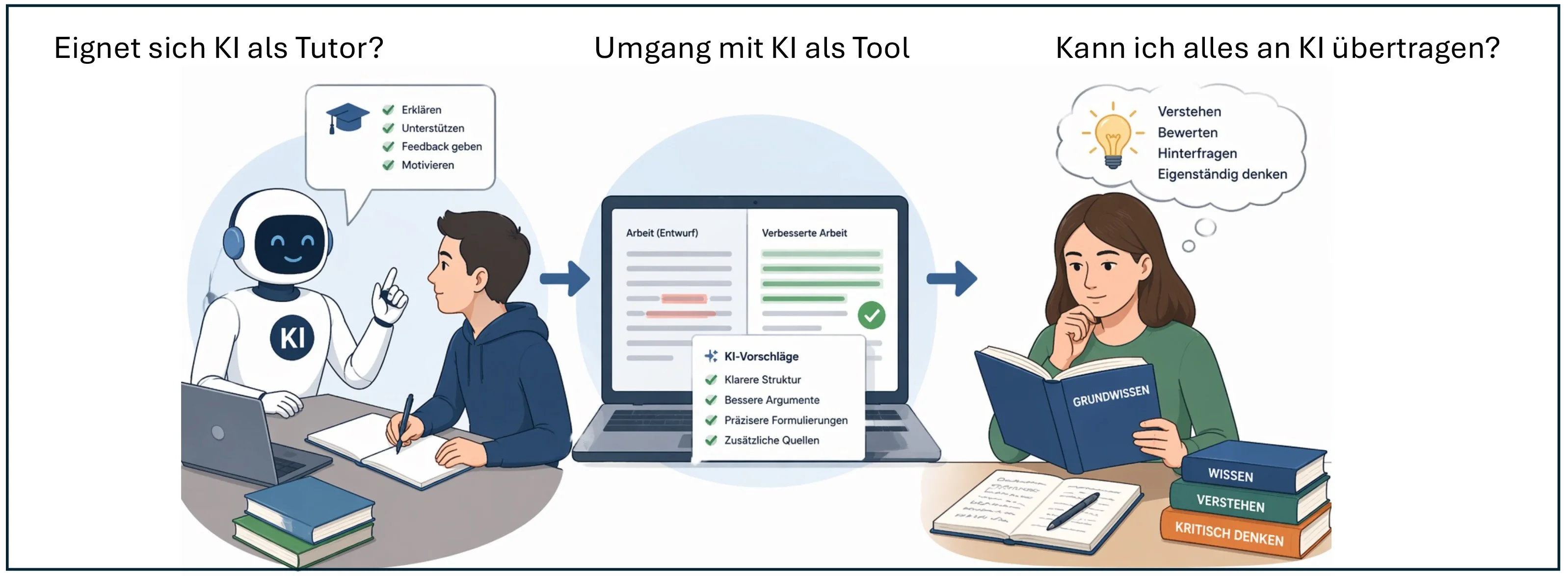
As part of the inter-university project ‘AI-Ing’, seven sub-projects were carried out (see below). In Sub-project 1, ‘Integration of AI into Teaching’, researchers at the ZHAW divided the syllabus of their ‘Computer Science Tools’ lecture into three content levels: ‘basic knowledge’, ‘advanced knowledge’ and ‘problem-solving skills’ . The aim is for students to acquire basic and advanced knowledge without the use of AI, whilst AI tools may be used specifically for problem-solving. In parallel, the FHV analysed the use of AI in term assignments. The results show that unrestricted use of AI primarily improves the quality of the work, but not the students’ skills. A balanced combination of independent learning in the areas of ‘basic knowledge’ and ‘advanced knowledge’, alongside the targeted use of AI, is therefore crucial when it comes to acquiring ‘problem-solving skills’.
Examination formats are also facing new challenges: how can the unauthorised use of AI be monitored? At the ZHAW, sub-project 2 tested the proctoring software SMOWL, which monitors identity and behaviour during online exams. It is particularly suitable for open-book exams where (digital) materials are permitted, but requires legal clarification as well as additional effort for monitoring and follow-up checks.
In the field of teaching, AI tutors have also been developed that support students’ learning by asking targeted questions, rather than providing ready-made solutions. Examples include a linear algebra tutor from the FHV (sub-project 7) and an electronics tutor from the HTWG (sub-project 3). These systems encourage independent learning, but they also have their limitations: providing direct solutions can inhibit critical thinking and foster dependency. The successful use of AI tutors therefore requires well-thought-out pedagogical concepts. This necessitates access to powerful AI models that complies with data protection regulations, as well as lecturers who understand how they work and can integrate them effectively into teaching.
Project Name
KI in der Ingenieursausbildung - Pflicht oder Kür?
The 7 sub-projects
1. Integration of AI into computer science teaching tools: lectures – tutorials – exams
2. SMOWL – Secure online exams for digital teaching
3. AI Electronics Tutor
4. Quiz generation & AI sets
5. When AI sounds better than students learn
6. CustomGPT: Linear Algebra
7. Generation of exam questions for online exams using AI
Participants
Project leader ZHAW, IEFE: Prof. Dr. Andreas Heinzelmann
Project team ZHAW: Patrik Baumann, Andreas Jehle, Fabian Jasper-Möller
Project partner: Christopher Knievel, HTGW; Steffen Fink, FVH; Kathrin Plankensteiner, FVH; Armin Simma, FVH
Project duration
June 2024 till December 2025