Memsol: A Self-Protecting Perovskite Solar Cell Concept Published in Nature
With "Memsol", we developed a new concept to mitigate reverse-bias damage
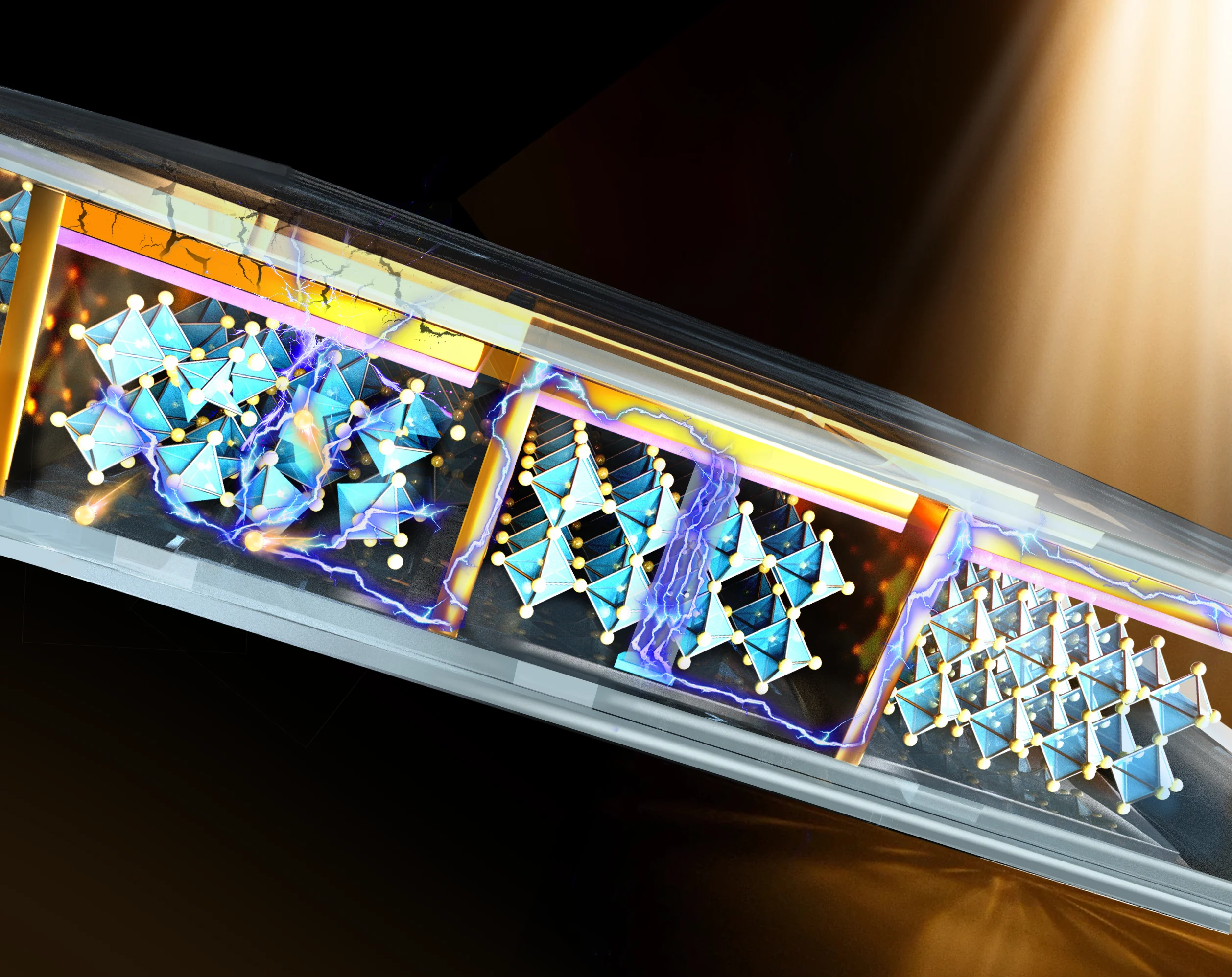
We are excited to announce our latest publication in Nature (DOI: 10.1038/s41586-026-10275-3), where we introduce Memsol—a new solar cell concept that addresses one of the most critical challenges facing perovskite photovoltaics: instability under reverse bias.
Perovskite solar cells have achieved remarkable efficiencies and offer a pathway toward low-cost, energy-efficient solar energy. However, their sensitivity to reverse-bias conditions—commonly caused by partial shading or series-connected operation—has limited their real-world deployment.
With Memsol, we take a fundamentally new approach. Instead of only improving device robustness, we integrate a memristor directly into the solar cell, enabling it to actively protect itself during operation.
The memristor is realized through area-selective deposition of a metal–insulator stack and shares the perovskite layer and electrodes with the solar-cell component. This compact design allows the device to dynamically respond to operating conditions.
What makes Memsol unique:
- It remains stable under reverse bias, eliminating a major degradation pathway
- It automatically switches between a low-resistance bypass mode and normal solar-cell operation
- It functions as both a solar cell and a built-in bypass element, potentially removing the need for external bypass diodes
We validated the concept under reverse-bias and shading conditions and demonstrated its functionality in a nine-cell series string—bringing it closer to real module operation.
Memsol opens a new direction for designing more reliable and scalable perovskite solar technologies. We anticipate that this concept can be implemented in large-area modules, helping accelerate the commercialization of perovskite photovoltaics.
Read the full paper, “Integrated memristor for mitigating reverse-bias in perovskite solar cells”, available in Nature at https://doi.org/10.1038/s41586-026-10275-3.
- A free view-only version is available via the Nature SharedIt initiative.
- To the press release (in German)
- Some images from the celebration