DeFacto article: "Neutrality: when it works and when it does not"
With the Russia-Ukrainian full-scale war going on for the fourth year, discussions about its roots and options for peace never end. Dr. Alina Nychyk and Prof. Dr. Florian Keller from the ZHAW Center for Geopolitics and Competitiveness explore the Swiss and Ukrainian concepts of neutrality and examine to what extent they should be applied in the context of current and potential military escalation.
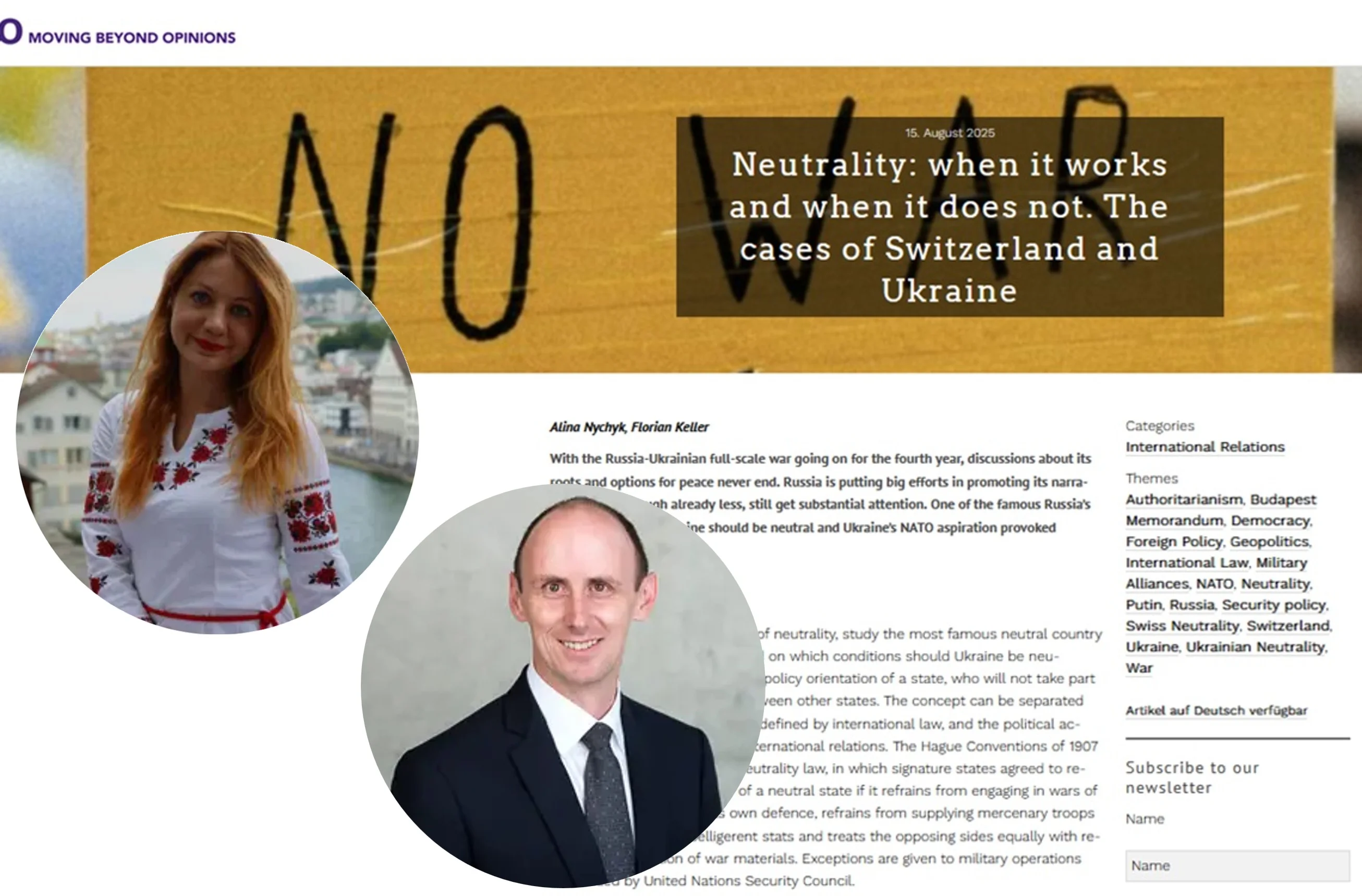
Using the examples of Switzerland and Ukraine, Nychyk and Keller argue in their article that neutrality is more than just a legal status under international law. It depends crucially on geopolitical circumstances, the balance of power, the interests of neighbouring states, and a country’s own strategic adaptability. While Switzerland has benefited from its flexible and, for other powers, useful neutrality since 1815, Ukraine—despite a constitutionally enshrined neutral status—was unable to prevent Russian attacks in either 2014 or 2022.
The comparison of historical contexts is particularly revealing: Switzerland was able to maintain and refine its neutrality in a setting of peace-oriented democracies and without imperial threats. Ukraine, by contrast, borders an authoritarian state with expansionist ambitions, one that violates international agreements whenever it sees an advantage in doing so. Without strong security guarantees, neutrality in such an environment is a fragile construct.
The ZHAW authors’ conclusion: neutrality can be a valuable tool—but only if it is respected by all relevant actors and backed by strategic safeguards. For Ukraine, this means that without credible security guarantees, neutrality alone will not pave the way to lasting peace.