Article in "The Conversation": Poland continues to support Ukraine militarily, but economic relations are strained
Head of ZHAW International Management Institute Prof. Christopher Hartwell examines the tensions between military solidarity, economic interests, and political conflicts between Poland and Ukraine. His conclusion: In the face of Russian aggression, the two countries need greater economic cooperation, not protectionism.
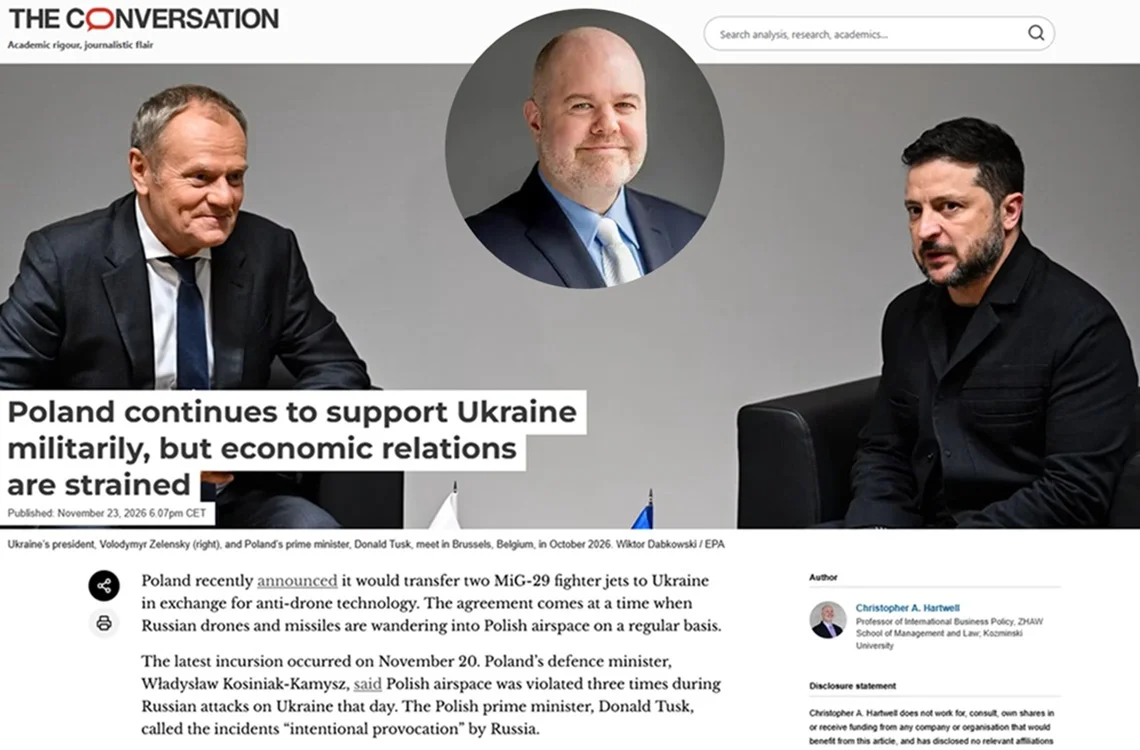
Since Russia's full-scale invasion of Ukraine in February 2022, Poland has been one of its most important supporters. The country has provided billions in military aid, supplied tanks and fighter jets, and welcomed hundreds of thousands of Ukrainian refugees. Yet while military cooperation remains strong, economic relations between the two countries are increasingly strained.
In his latest article for The Conversation, “Poland continues to support Ukraine militarily, but economic relations are strained,” Prof. Christopher Hartwell, Director of the ZHAW International Management Institute, explores the complex relationship between the two countries. He highlights just how closely their economies have become intertwined in recent years: Polish exports to Ukraine have risen from €3.1 billion in 2014 to more than €14 billion. The integration of Ukrainian businesses into the European single market is also opening up new economic opportunities.
At the same time, tensions are mounting. Agricultural trade, in particular, has become a source of conflict, with Polish farmers opposing Ukrainian imports that they see as unfair competition. Border blockades, import restrictions, and nationalist rhetoric are further straining relations. Historical disputes between the two countries are also being exploited for political purposes, making closer cooperation more difficult.
Hartwell sees this as a troubling development, particularly given the shared security challenge posed by Russia. Protectionist measures and economic isolation could not only weaken bilateral relations but also undermine Poland's economic and institutional development.
His central message: Poland should prioritize economic liberalization and continued military support for Ukraine rather than allowing protectionist interests to dictate policy. After all, a strong economic partnership built on solidarity between the two countries is also an important factor in Europe's security.
How can economic self-interest be reconciled with geopolitical responsibility? And what does protectionism mean for Europe's future?