International Business Podium with Guy Parmelin: Geopolitics and Security Are Key Issues for Switzerland
At the 18th International Business Podium hosted by the ZHAW School of Management and Law, President of the Swiss Confederation Guy Parmelin and other representatives from politics, business and academia discussed the geopolitical landscape and Switzerland’s security policy challenges. The event was organised by the ZHAW Center for Geopolitics and Competitiveness and attracted considerable interest.
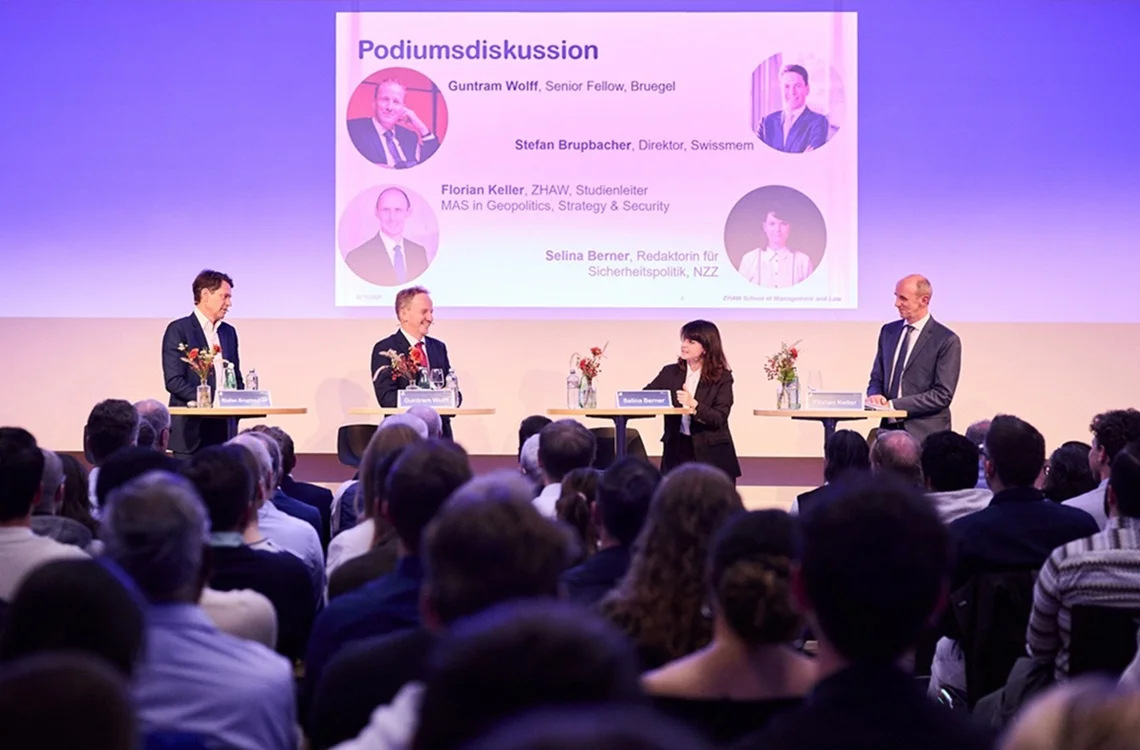
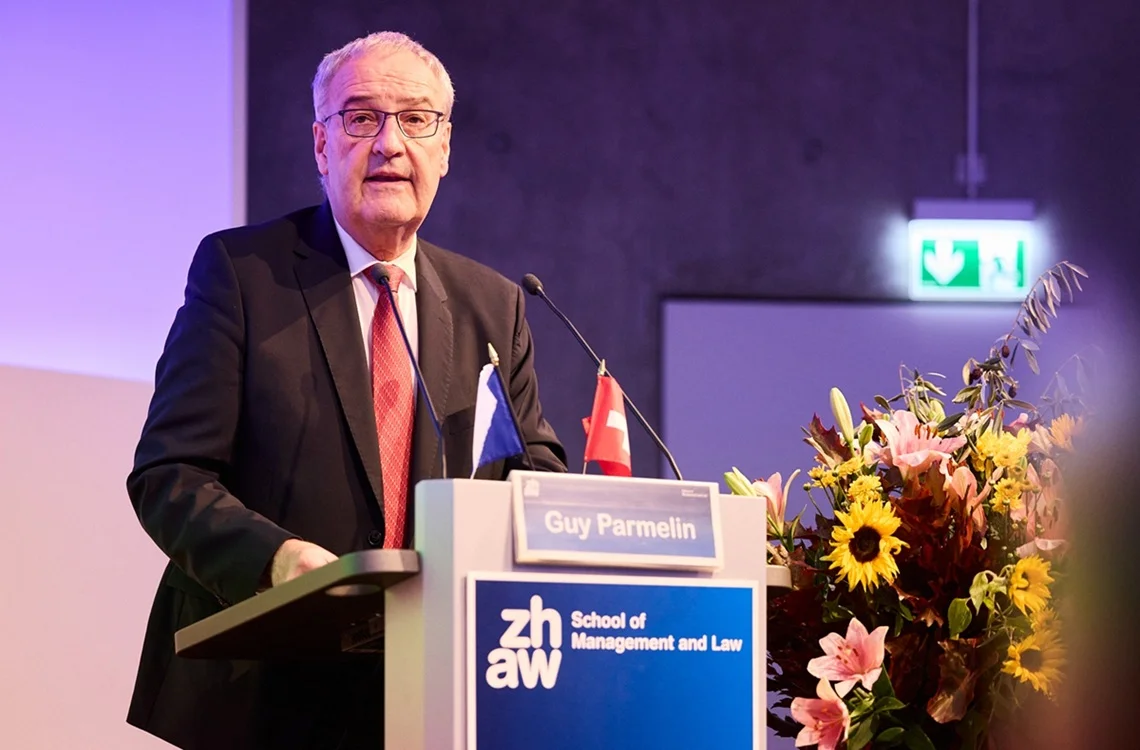
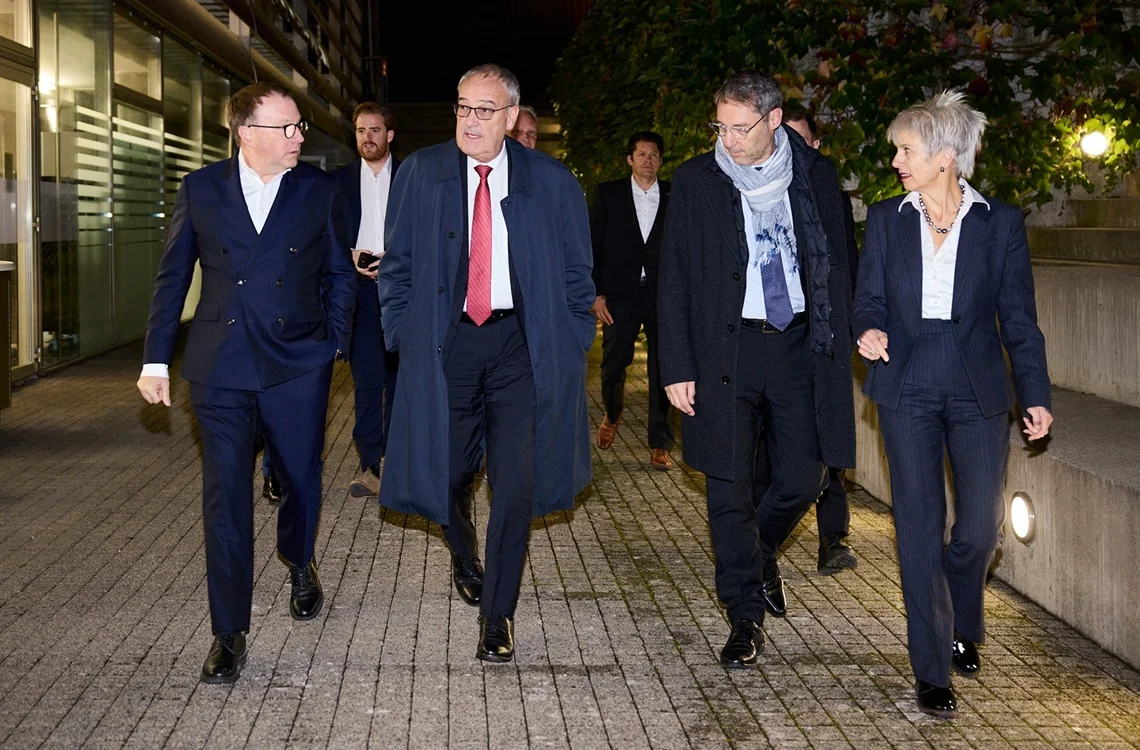
The event began on time in the packed auditorium of the ZHAW School of Management and Law in Winterthur. In her welcome address, ZHAW President Regula Jöhl explained how dramatically the global situation had changed. Many things that had long been taken for granted, such as open trade routes, reliable international rules and security in Europe, were now being called into question. This affected not only companies, which had to constantly adapt their supply chains and markets, but society as a whole. How Switzerland could hold its own in this increasingly tense environment was the central question of the evening.
Following these introductory remarks, Swiss President Guy Parmelin took the podium. Just a few days earlier, the head of the Federal Department of Economic Affairs, Education and Research (EAER) had signed the free trade agreement with Vietnam in Hanoi. Back at the Volkart Building, he explained why a strong industrial sector was also crucial to Switzerland’s ability to act in matters of national security. In a “world in turmoil”, greater cross-border cooperation in research and development was needed. At the same time, Switzerland had to remain as self-reliant as possible to preserve its independence. From the Federal Council’s perspective, one way to achieve this would be to amend the War Materiel Act, on which Swiss voters will vote at the end of November.
The subsequent panel discussion, moderated by Selina Berner, Federal Palace correspondent for the Neue Zürcher Zeitung (NZZ), explored in greater depth what the new geopolitical reality meant for Switzerland and the EU.
Guntram Wolff of the Brussels-based think tank Bruegel pointed to Europe’s growing rearmament efforts, which nevertheless remained largely organised along national lines, despite EU programmes such as “Made in Europe” and “SAFE”. France and Germany, in particular, held differing views on cooperation in the defence industry.
Stefan Brupbacher, Director of the Swiss industrial association Swissmem, explained how Swiss companies could maintain their competitive position internationally through specialised products, even in challenging conditions. At the same time, he warned of a growing reluctance in Europe to source Swiss defence products. Under the banner of “Swiss-free”, some foreign buyers were avoiding Swiss suppliers because they feared uncertainty over future deliveries due to Switzerland’s restrictive rules on the re-export of war materiel.
Florian Keller, Head of the ZHAW Center for Geopolitics and Competitiveness (CGC), broadened the lively discussion with two further perspectives. Historically, Switzerland had always faced a dilemma: balancing the demands of neutrality against the interests of its export industry. He also highlighted the new security policy landscape, which was giving rise to innovative research projects, such as one exploring the practical use of civil defence shelters. ZHAW researchers had worked on this project alongside researchers from Poland and Ukraine.
To conclude the event, Swissmem President Martin Hirzel thanked the more than 300 guests, including representatives from teaching, continuing education, research and industry.
Geopolitical expertise for business and leadership
The International Business Podium also marked the launch of the new MAS in Geopolitics, Strategy and Security. With this programme, the ZHAW International Management Institute is expanding its continuing education portfolio at the intersection of geopolitics, business strategy, technology and diplomacy.