New Publication in Cultural Trends Explores Sustainable Management in Arts and Cultural Organisations: Insights from the Getty
How can sustainability be strategically embedded in arts and cultural organisations? What role do governance, sustainability-related roles, and competencies play in transforming the cultural sector?
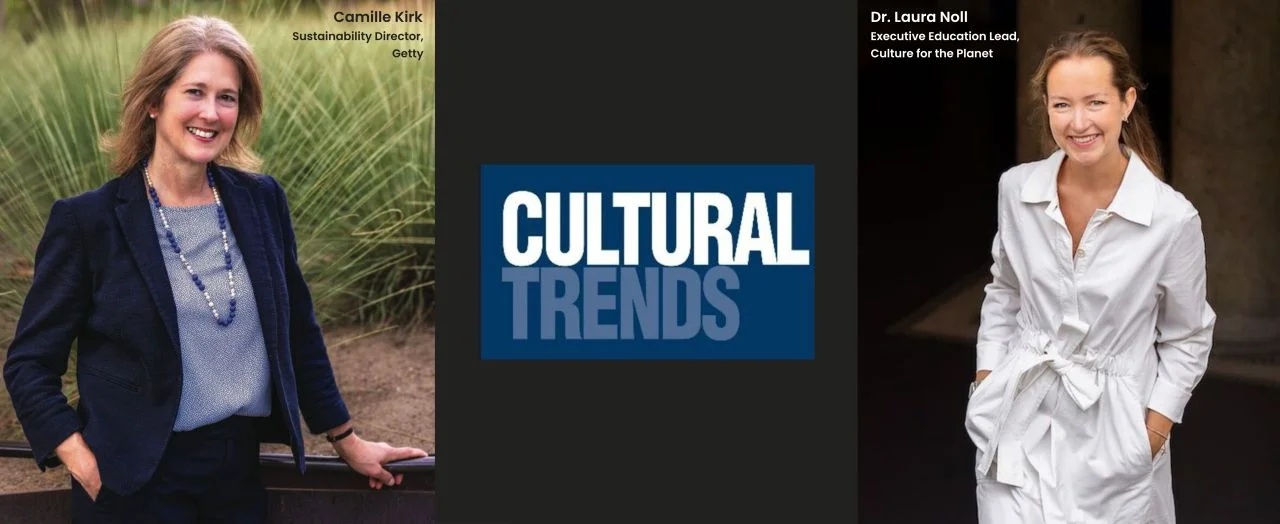
These questions are explored in a new article published in Cultural Trends, based on a conversation between Dr Laura Johanna Noll, Deputy Head of the ZHAW Center for Arts Management and Executive Education Lead at Culture for the Planet, and Camille Kirk, Sustainability Director at the Getty.
The article, “Cultural Sustainability and Cultural Leadership: Camille Kirk (Sustainability Director, Getty) in Conversation,” examines sustainability from an arts and cultural management perspective and discusses the organisational and personal conditions required to embed sustainability in museums, theatres, opera houses, and other cultural institutions over the long term.
Sustainability as an Organisation-Wide Responsibility
At the heart of the conversation is the question of how sustainability can become an organisation-wide responsibility rather than remaining confined to individual staff members or departments.
Camille Kirk describes sustainability not only as an environmental responsibility but also as a prerequisite for the long-term viability of cultural organisations. At the same time, she highlights the unique role of the arts in addressing societal challenges. Museums, for example, can create spaces where people reflect on future challenges, develop new perspectives, and actively contribute to processes of social change.
Strategic and Operational Approaches from Practice
Drawing on examples from the Getty, the article presents a range of strategic and operational measures, including:
- The electrification of infrastructure and transportation
- Energy-efficient building solutions
- More sustainable exhibition practices
- The integration of sustainability criteria into procurement processes
Kirk identifies the willingness to test new approaches, learn from experience, and continuously improve processes as an important area for organisational learning. She views sustainability as an ongoing process of learning and transformation and advocates a philosophy of “leapfrogging”, emphasising the continuous pursuit of good practices rather than the search for a perfect solution.
Competencies for Transformation
In their conversation, Dr Laura Johanna Noll and Camille Kirk also discuss the skills and competencies required for successful sustainability transformation. Alongside specialist knowledge, professionals working in arts and cultural organisations need systems thinking, as well as competencies in communication, project management, finance, and change management.
Above all, they must be able to guide people and organisations through processes of change with enthusiasm, confidence, and purpose.
Connecting Practice and Research
The interview was conducted as part of the SNSF Bridge research project Culture for the Planet, in which Dr Laura Johanna Noll serves as Executive Education Lead. The project investigates the leadership approaches, competencies, and organisational capabilities required to advance sustainability transformation across the arts and cultural sector over the long term.
One of the article’s key insights is that sustainability should not be understood as a separate mission for cultural organisations. Rather, it is a prerequisite for ensuring that museums, theatres, opera houses, and other cultural institutions remain relevant and capable of fulfilling their cultural and societal roles amid changing ecological, social, and economic conditions.
Read the Full Interview
A total of 50 complimentary e-print links are available for the article published in Cultural Trends. Interested readers can access the full interview with Laura Johanna Noll and Camille Kirk free of charge here.