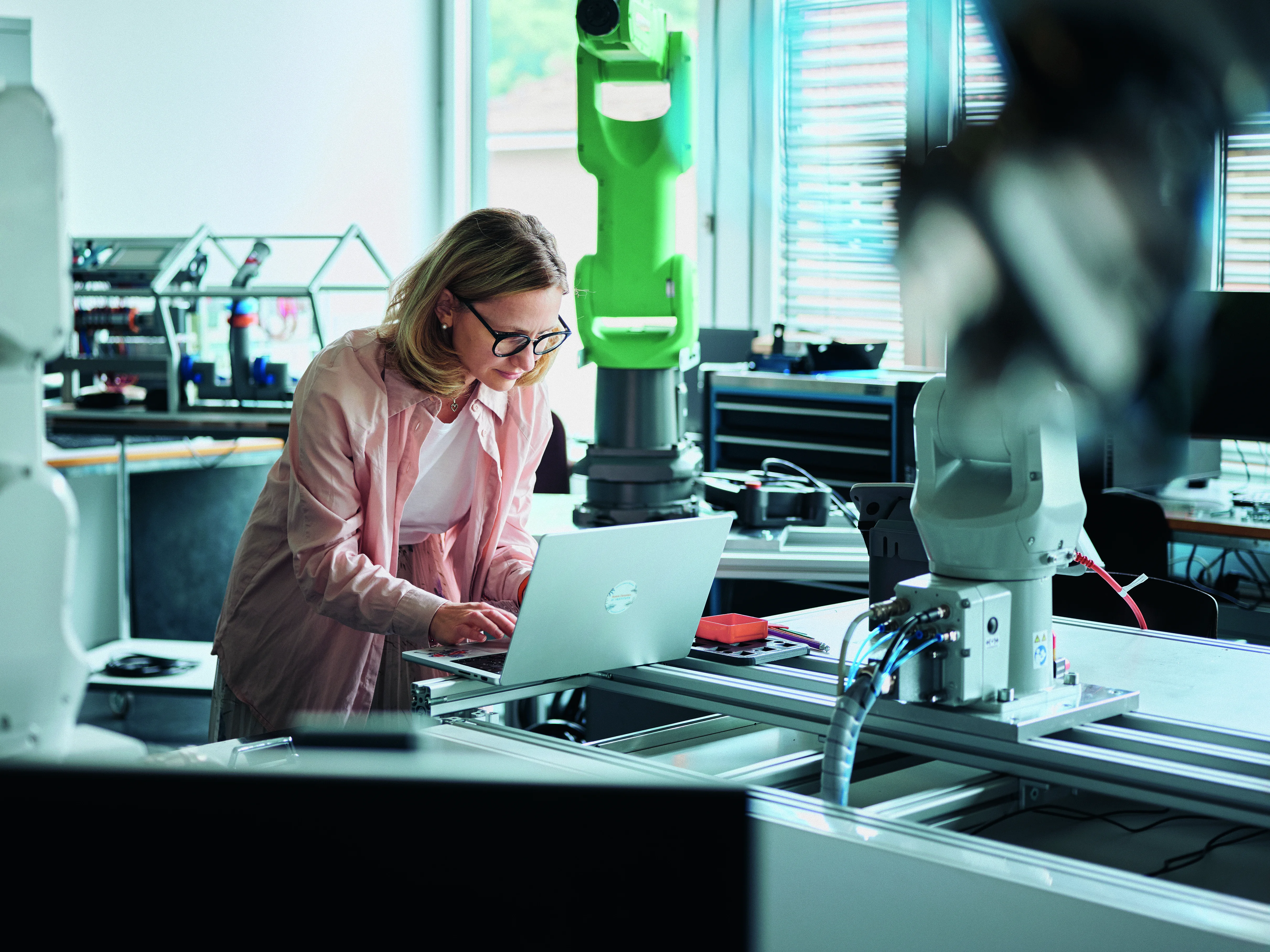
Teaching robots how to learn

Robots are playing an increasingly important role in industry and are taking on more and more complex tasks. They first have to learn how to perform these activities – and their training is also becoming increasingly complex. Olga Voll trains robots and believes in a future with robotics and artificial intelligence.
Robots are suitable for repetitive routine tasks, but also for those that could potentially be dangerous for humans. However, they first have to learn these tasks. The new Industrial AI Group at ZHAW is investigating ways to improve the learning process for complex tasks. Data Science student Olga Voll has examined two approaches to reinforcement learning for this purpose. In reinforcement learning, the robot receives feedback on its actions in the form of numbers – 100 if it has achieved the goal, otherwise less. “The robot learns from the feedback of its environment,” says Olga Voll. “It’s a learning process similar to that of humans or animals.” With a higher reward, the robot understands that it is on the right track. Ultimately, reinforcement learning is intended to enable robots to become more flexible so that a new precise program does not have to be written for every task.
A single process instead of multiple components
For her project, the student taught robots to grasp objects and move them to another location: “In the past, such processes were trained step by step. We are now trying to train the entire process from start to finish.” In addition, she worked with objects that differ in size and shape and are also placed in constantly changing positions. Thanks to a GPU-based simulation, she was able to train 512 robots at the same time instead of just one, all performing the same task. After successful training in simulation, the Industrial AI Group will transfer the models to a real UR10 robot in their new lab. This will be the focus of upcoming student projects next semester.

“The Industrial AI Group, part of the ZHAW Centre for AI (CAI), was founded in September 2023. Supported by the Rieter Foundation and Rieter AG, the group develops intelligent automation using control theory, machine learning and robotics. Their research benefits local industry and has attracted interest from companies in the MEM sector.”
Dr. Alisa Rupenyan-Vasileva, Head of the Industrial AI Group at the Centre for Artificial Intelligence
Fascinated by robotics and AI
Olga Voll also wants to motivate other students to do research in this field. In her master’s studies, she wants to continue working in robotics and transfer her model into real-world applications. Even when she enters the job market, she wants to stay in this area: “Ideally at a company that focuses on robotics research.” Robots could help people and make the world more efficient. There are ethical questions that need to be clarified and defined, and then AI and robotics will be able to make a valuable contribution to our society.