Quantum Light-Matter Engineering
The Quantum Light-Matter Engineering Group at the ZHAW Institute of Computational Physics explores new ways to control and design the properties of light and matter at microscopic scales in optical cavities.
Research
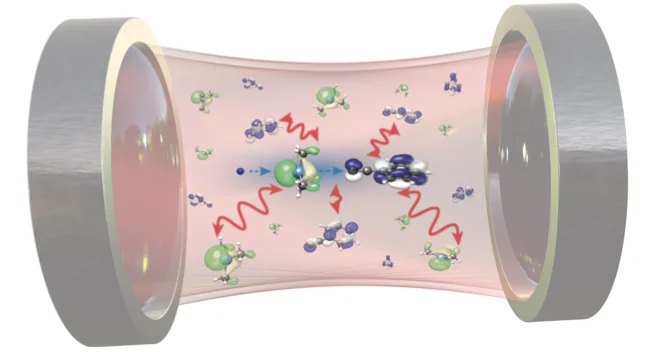
The Quantum Light-Matter Engineering Group at the ZHAW Institute of Computational Physics explores new ways to control and design the properties of light and matter at microscopic scales, where quantum effects become essential. For many engineering applications, classical simulation models—often relying only parametrically on quantum mechanics—are still sufficient. However, as technologies continue to shrink to the nanoscale in fields such as sensing, semiconductor fabrication, and quantum computing, the ability to accurately understand and predict quantum mechanical phenomena becomes increasingly critical. The main focus of our group, however, goes even one step further. Recent experimental breakthroughs have shown that strong coupling between light and matter in optical cavities can be used to actively engineer quantum effects, even at room temperature. This opens up entirely new possibilities across industries: chemical reactions could be steered to become more energy‑efficient or environmentally friendly; optical cavities could be designed to modify material properties; and performance improvements could be achieved in solar cells, batteries, or computer chips. At present, no reliable simulation tools exist to predict reliably the effects of strongly coupled light‑matter systems. Our mission is to develop these computational methods in collaboration with international partners.
In the long term, we aim to establish the foundation for manufacturing capabilities and foster an ecosystem in which startups can develop novel devices and technologies based on engineered quantum light‑matter interactions.
Research Topics
- Polaritonic Chemistry
- Simulation Method & Code Development for Light-Matter Interaction
- Microscopic Simulation of Matter at Ambient Conditions
- Methods for Collectively Correlated Electronic Structures
- Optical Cavity Design
ERC Synergy Project UnMySt
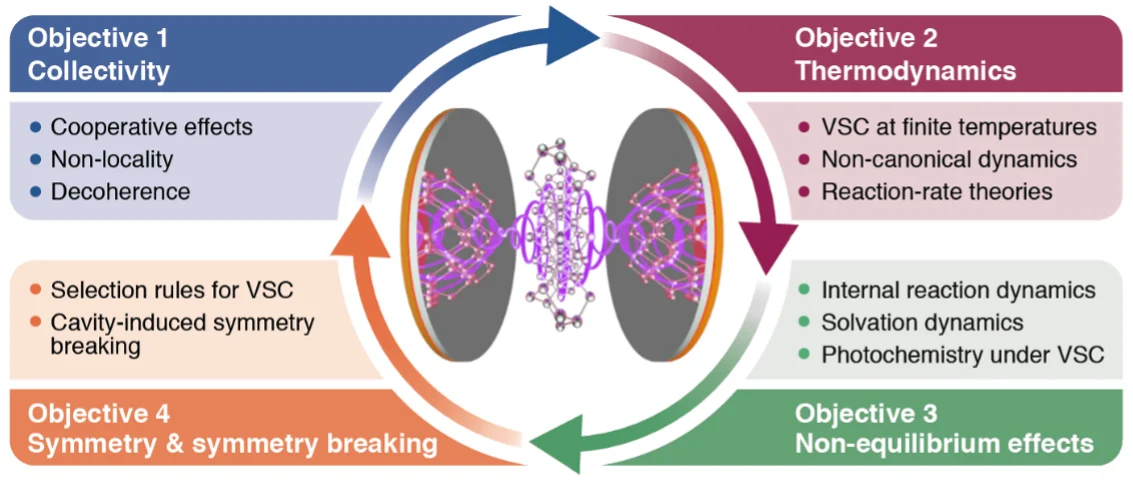
We are part of ERC Synergy Project Team UnMySt aiming to “unravel the mysteries of vibrational strong coupling”: Polaritonic chemistry is a developing field that merges chemistry and cavity quantum electrodynamics. Of particular interest is vibrational strong coupling (VSC) and its ability to modify the rate and yield of reactions, solvent polarity and other molecular properties in the absence of light. This opens up new possibilities for synthesis and materials science to edit and control chemical reactions. However, to reach its full potential, a better understanding of the mechanisms by which VSC influences material properties is needed. The ERC-funded UnMySt project aims to develop a robust framework for cavity-controlled chemistry, based on a thorough mechanistic understanding of VSC at the molecular level. This will pave the way for the rational design of strongly coupled molecular systems.
Collaborators

Prof. Angel Rubio, Dr. Michael Ruggenthaler 
Prof. Thomas W. Ebbesen and Dr. Cyriaque Genet 
Prof. Abraham Nitzan 
Prof. Maxim Sukharev 
Prof. Angel Rubio and Prof. Johannes Flick 
Prof. Tal Schwartz and Prof. Sharly Fleischer
People
-

ZHAW School of Engineering
Institute of Computational Physics
Technikumstrasse 71
8400 Winterthur
Funding

Featured Publications
A selection of some of our most relevant articles. A full list can be found here.
The connection of spin glass physics and cavity-modified intermolecular electron correlation

In this focus review, we highlight a fundamental theoretical link between the seemingly unrelated fields of polaritonic chemistry and spin glasses, exploring its profound implications for the theoretical framework of polaritonic chemistry. Specifically, we present a mapping of the dressed many-molecules electronic-structure problem under collective vibrational strong coupling to the analytically solvable spherical Sherrington-Kirkpatrick (SSK) model of a spin glass. This mapping uncovers a collectively induced spin glass phase of the intermolecular electron correlations, which could provide the long sought-after seed for significant local chemical modifications in polaritonic chemistry that currently limits applications. Overall, the qualitative predictions made from the SSK solution (e.g., dispersion effects, phase transitions, differently modified bulk and rare event properties, heating, etc.) agree well with available experimental observations. Our connection not only demonstrates that the Fermionic nature of the electrons is essential for collective strong coupling, but it also paves the way for novel computational strategies to predict the subtle chemical characteristics of the cavity-induced spin glass phase.
Read the full paper Sidler et al., Chemical Reviews 2025 (open access).
Density-functional tight binding meets Maxwell
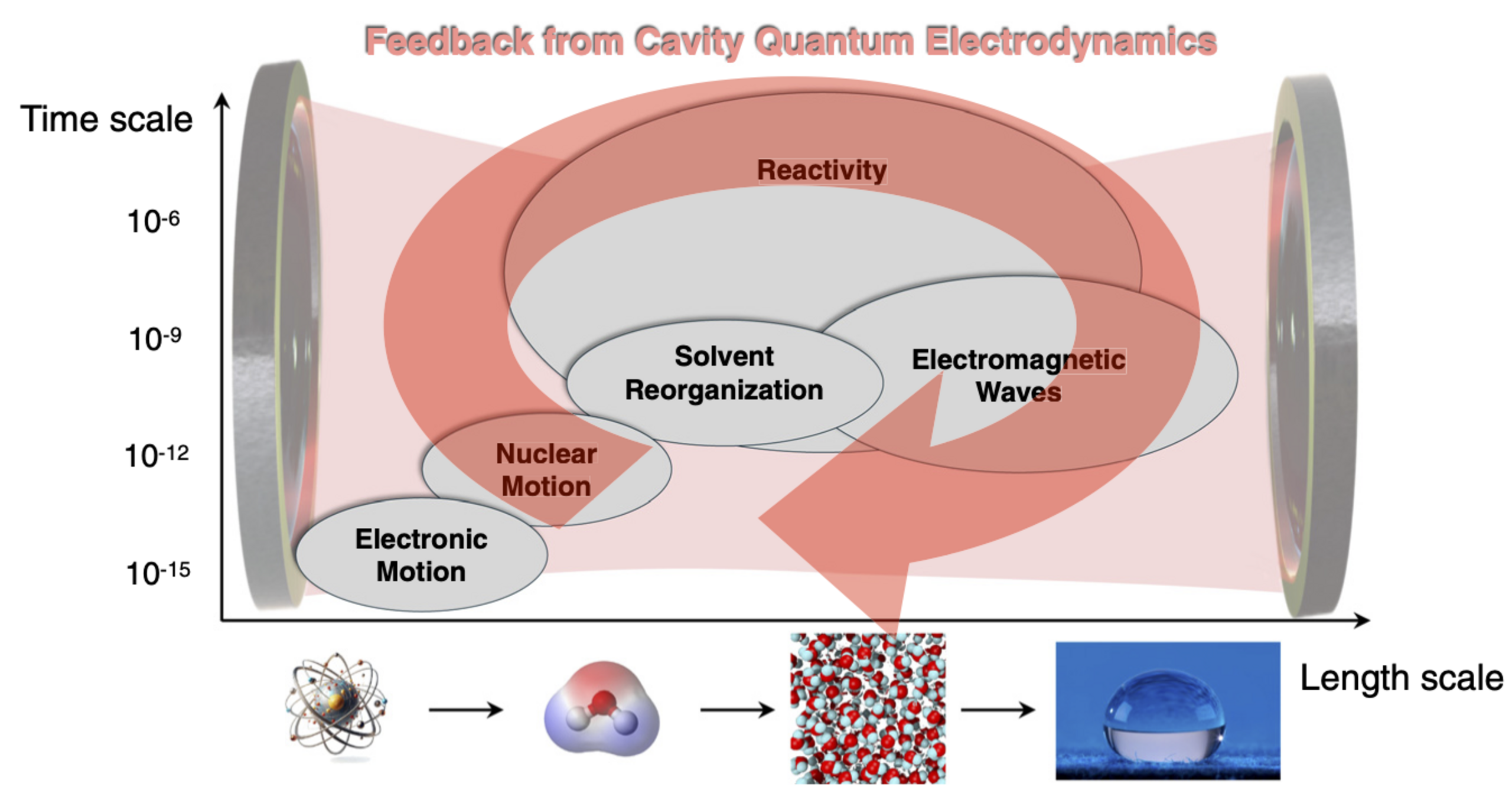
In our invited perspective article we discuss the control of chemical and material properties through strong light–matter coupling in optical cavities, which has gained considerable attention over the past decade. However, the underlying mechanisms remain insufficiently understood, and a significant gap persists between experimental observations and theoretical descriptions. This challenge arises from the intrinsically multiscale nature of the problem, where nonperturbative feedback occurs across different spatial and temporal scales. Collective coupling between a macroscopic ensemble of molecules and a photonic environment, such as a Fabry–Pérot cavity, can strongly influence the microscopic properties of individual molecules, while microscopic details of the ensemble in turn affect the macroscopic coupling. To address this complexity, we present an efficient computational framework that combines density-functional tight binding (density-functional tight binding (dftb)) with finite-difference time-domain (finite-difference time domain (fdtd)) simulations of Maxwell’s equations (dftb + Maxwell). This approach allows for a self-consistent treatment of both the cavity and the microscopic details of the molecular ensemble. We demonstrate the potential of this method by tackling several open questions. Finally, we outline future directions to enhance the predictive power of this framework. The dftb + Maxwell method enables real-time exploration of realistic chemical parameters on standard computational resources and offers a systematic approach to bridging the gap between experiment and theory.
Read the full paper Sidler et al., Nanophotonics 2025 (open access).