Movetia-funded COIL Project
1: COIL in IB Education
The rapidly evolving landscape of international business places increasing demands on managers and team members to navigate cross-cultural collaboration in digitally mediated environments. As organizations become more globally interconnected and reliant on virtual collaboration, the ability to work effectively across cultural, linguistic, and disciplinary boundaries has become an essential professional competency. Yet traditional classroom approaches frequently fall short in replicating the complexity of multicultural team dynamics, ethical dilemmas, and real-time decision-making pressures that characterize global business contexts.
Collaborative Online International Learning (COIL) responds directly to this pedagogical gap by embedding collaborative, experiential learning at the heart of the curriculum. Through structured yet dynamic multicultural group assignments, learners develop not only disciplinary knowledge but also the interpersonal, ethical, and strategic competencies essential for international business — from building cross-border partnerships to entering new markets.
COIL leverages online technology to enable learners from different countries and cultural backgrounds to collaborate on shared tasks — all without actually travelling abroad. Individual and team reflection serve as the cornerstone of cross-cultural learning within COIL, encouraging learners to examine their leadership behavior and communication styles in multicultural teams. Moreover, COIL is accessible without the financial burden of international travel, making scalable, authentic cross-cultural learning with measurable outcomes possible.
Learn more on the ZHAW Blog Lehren und Lernen: Grenzenlos lernen mit COIL
2: Our COIL Project “Redefining Leadership in the Digital Age”
The ZHAW Center for Cross-Cultural Management’s project “Redefining Leadership in the Digital Age” is a COIL funded by Movetia — the Swiss national agency for exchange and mobility. It is as a collaborative initiative with three European higher education institutions: LUMSA (Italy), Kyiv School of Economics (Ukraine), and Grenoble École de Management (France). This partnership deliberately reflects the kind of multicultural collaboration that learners will increasingly encounter in their professional lives.
Our COIL develops the cross-cultural leadership capabilities that international business demands. It brings together learners from diverse academic, cultural, and linguistic backgrounds, creating a genuinely international learning community. By working across institutional boundaries, participants experience are exposed to not only different disciplinary perspectives but also varying cultural norms around leadership, communication, and decision-making — precisely the competencies that global employers increasingly demand.
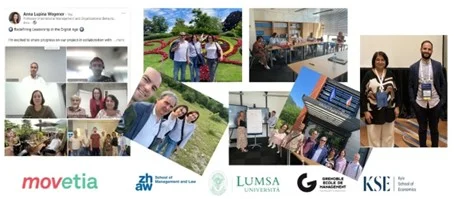
COIL Team Members
Prof. Anna Lupina-Wegener
Dr. Evangelos Syrigos
Matteo Mösli
Prof. Fabrizio Maimone
Prof. Halyna Makhova
Prof. Mykhaylo Vidyakin
Clemens Dieler
Prof. Dr. Taran Patel
Prof Dr. Chirag Patel
Dr. Matteo Opizzi
3: COIL Content
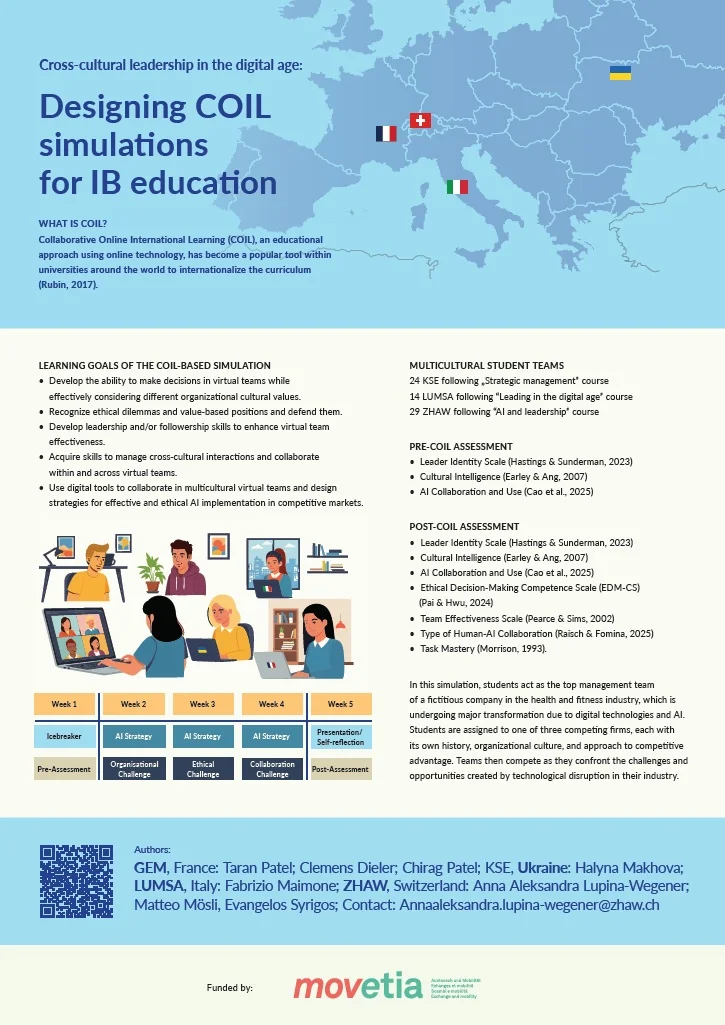
At the core of the five week COIL is an immersive, role-based learning simulation set in the health and fitness technology sector — an industry characterized by rapid technological change, intense competition, and complex ethical considerations. Learners assume executive roles within three competing companies, navigating organizational and ethical challenges in international business. They make investment decisions, develop strategic alliances with other firms in the simulation, and expand their company's market presence internationally — deciding whether to enter the French, UK, or Indian market. These decisions require them to integrate AI-enabled insights, manage cross-cultural team dynamics, and balance strategic imperatives with ethical considerations. Learners do not only make strategic decisions but also reflect critically on how their cultural backgrounds, values, and role responsibilities shape both their their individual contributions and the collective outcomes.
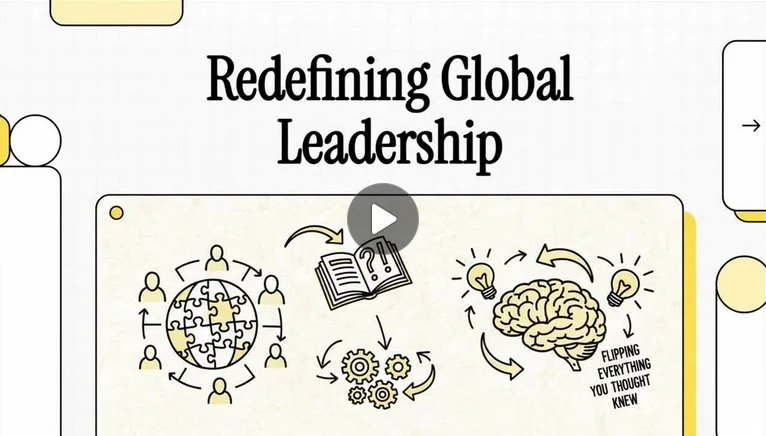
Video with Dr. Evangelos Syrigos: Redefining Global Leadership
4: Impact and Results
To ensure that the joint COIL module goals are reached and measurable, we conducted quantitative pre- and post-assessments at the beginning and end of the five-week learning experience. We evaluate students’ achievement of the COILs’ learning goals across five dimensions: cross-cultural collaboration, ethical reasoning, strategic decision-making under uncertainty, leadership and followership behavioral adaptation. Together, these dimensions capture the multifaceted nature of cross-cultural leadership in digitally mediated environments. This longitudinal design tracks individual progress and identifies learning gains attributable to the module. The assessments draw on validated instruments from literature, reflecting what effective cross-cultural leadership in the digital age actually demands. Findings from the first implementation across 15 COIL teams reveal a meaningful increase in students’ cultural intelligence across the simulation period, suggesting that immersive, role-based collaboration in multinational teams effectively fosters intercultural competence. Moreover, results shows that ethical decision-making competence had a significant positive effect on students’ performance in simulation, indicating that students who reasoned more carefully about ethical trade-offs also made more effective strategic decisions under competitive conditions.
Data collection also includes qualitative sources, including weekly self-reflection exercises and team video presentations, providing a multi-layered picture of each learner's development. The qualitative results suggest that successful cross-cultural leadership in digitally mediated environments emerged through collective sensemaking and active followership rather than hierarchical authority or national cultural knowledge. Teams that consistently anchored their decision-making in their assigned company's organizational values demonstrated stronger learning outcomes, using these shared cultural frames to structure debate, resolve disagreement, and justify ethical trade-offs. Cultural intelligence development was predominantly tacit and process-based, surfacing through repeated role-based interaction and exposure to different value logics rather than through explicit cultural skill acquisition. Ethical learning was deepest in teams that faced reputationally costly dilemmas and chose to defend value-based positions even at financial disadvantage, demonstrating the ability to recognize ethical challenges as complex trade-offs rather than binary choices. Language differences and virtual coordination challenges were rarely foregrounded as distinct obstacles; instead, students attributed communication difficulties to scheduling conflicts and time constraints, suggesting that the module successfully normalized linguistic diversity as a background condition of international collaboration rather than a barrier to it.
Complementing these student-focused findings, the project team conducted auto-ethnographic inquiry into their own cross-institutional collaboration throughout the module design and delivery process, reflecting critically on the intercultural dynamics and shared sensemaking that emerged among faculty members from four different national and institutional contexts. This research was facilitated by our team member Matteo Opizzi. More information on our auto-ethnographic approach can be found in the video below:
Video with Dr. Matteo Opizzi: “Ethnographic research: On multicultural teams”