The Global Alumni Pulse: What Moves Graduates Worldwide
During the World Economic Forum in Davos, deans from leading business schools, together with CEOs, met to discuss the challenges facing business education and executive education.

Click to watch a detailed video of the panel discussion.
The panel discussion was based on a worldwide alumni survey conducted by the Financial Times, the honor society Beta Gamma Sigma, and the ZHAW School of Management and Law. The survey's findings form the Global Alumni Pulse. This is a data-driven tool designed to track how leadership expectations, leadership competencies, and the social and personal hopes and fears of alumni worldwide are evolving. Similar to established global benchmarks such as competitive indices, the Alumni Pulse is intended to provide a longitudinal perspective in the future.
"As business schools, we have the privilege of educating the next generation of leaders. That's why it's essential to listen to them," said Reto Steiner, Dean of the ZHAW School of Management and Law, during his visit to Davos. This was also emphasized by Andrew Jack, Global Education Editor of the Financial Times: “Business schools should learn almost everything from the alumni. [...] It's fundamental to listen and hear and get perceptions of what they've learned, what they need, what they're seeing now that they're out in the world of work.”
Key findings from the discussion
- Business schools must increasingly fulfill their social responsibility to prepare students for an uncertain world while striving to shape the world.
- Horizontal skills, such as leadership and communication, are becoming even more critical compared to vertical skills like marketing.
- Artificial intelligence is increasingly taking over routine tasks, allowing graduates to concentrate on more complex work. This could possibly lead to the elimination of entry management levels.
- Business schools maintain comparable quality standards worldwide. Although business schools worldwide adhere to comparable quality standards, graduates are influenced by their geographical environment, which must be taken into account by business schools, posing a variety of challenges. For instance, alumni in Asia identify an aging society as a significant issue, while those in South America point to public safety and corruption, and in Africa, the focus is on climate challenges.
In April 2026, the survey results and the resulting report were presented to the management of international business schools at the ICAM AACSB Conference in Seattle.
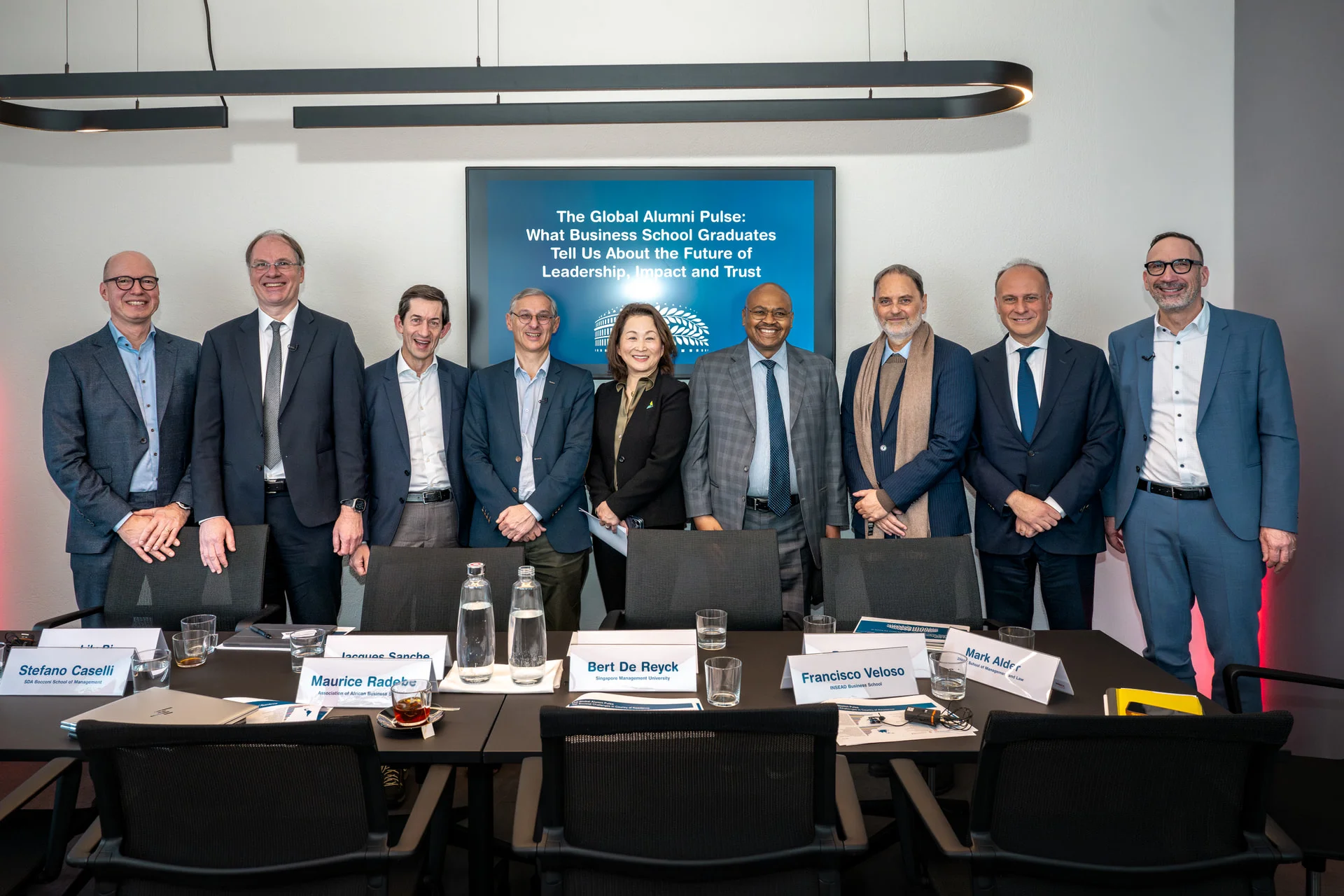



Panel Discussion Participants:
- David Bach, President, IMD (CH)
- Lily Bi, President and CEO, AACSB International (USA)
- Stefano Caselli, Dean, SDA Bocconi School of Management (IT)
- Andrew Jack, Global Education Editor, Financial Times (UK/USA)
- Maurice Radebe, Chairman of the Association of African Business Schools (ZA)
- Bert De Reyck, Dean, Lee Kong Chian School of Business, Singapore Management University (SG)
- Jacques Sanche, CEO of Bucher Industries and Chairman of Burckhardt Compression (CH)
- Reto Steiner, Dean, ZHAW School of Management and Law (CH), and Academic Head of the Global Alumni Survey, together with FT and BGS
- Francisco Veloso, Dean, INSEAD Business School (FR)
- Mark Alder, Professor of Didactics and Rhetoric, ZHAW School of Management and Law (CH)