CAS Data Competence for Business
ApplyAt a glance
Qualification:
Certificate of Advanced Studies ZHAW in Data Competence for Business (12 ECTS)
Start:
05.03.2027
Duration:
132 Lessons, more details about the implementation
Costs:
CHF 8'340.00
Comment on costs:
/ Early bird discount: Register by 30 September 2026 to benefit from a 10% discount on the course fees.
/ The full tuition fees must be paid before the start of the programme.
/ The tuition fees include the enrolment and examination fees as well as all course-related materials.
/ MAS participants receive a discount of CHF 1,000.
/ Additional costs may arise in connection with resit examinations, revisions of assessed work, or rebookings.
Location:
- ZHAW School of Management and Law / Campus St.-Georgen-Platz, 8401 Winterthur
- Online (Saturdays, except for days with workshops and performance assessments)
Language of instruction:
- English
- Teaching material is in English. German if required or in the case of an exclusively German-speaking class.
Further information:
- There is an attendance requirement of 80%
Objectives and content
Target audience
This program is designed for professionals and managers who aim to leverage data for decision-making and value creation:
Professionals and managers from business functions (e.g., marketing, finance, operations) who seek to better understand and contextualize data-driven challenges
Project managers and product owners involved in data, analytics, or AI initiatives
Professionals working at the interface between business, IT, and data teams
Individuals responsible for data-driven initiatives, digital transformation, or innovation
Decision-makers who want to assess and steer the use of data science within their organizations
The focus lies on the use of data in a business context and on deriving informed decisions. For topics related to building and operating data infrastructures, the CAS Data Engineering offers a complementary specialization.
Objectives
After completing this CAS, you will be able to:
- structure and clearly formulate data-driven challenges in a business context
- assess the opportunities, risks, and limitations of data science and contextualize them for business use
- identify relevant data sources and evaluate their potential for business processes
- understand and apply key concepts and methods in the data domain
- critically interpret results from analyses and models and translate them into decisions
- define and assess requirements for data quality, data management, and deployment
- effectively manage data-driven initiatives at the interface between business, IT, and data teams
- derive informed, data-driven decisions that support value creation and transformation
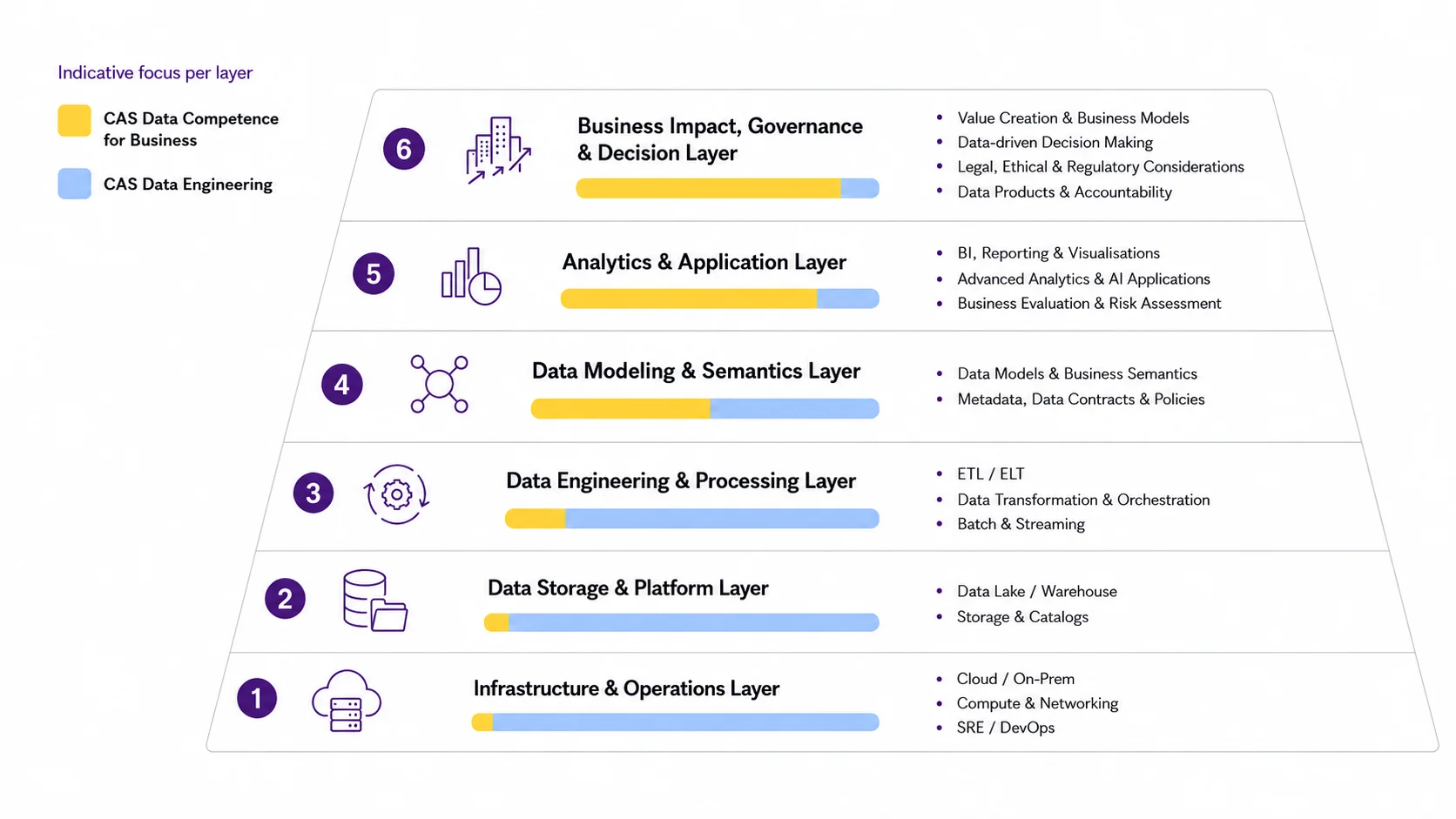
Two Perspectives on the Data Value Stack:
CAS Data Competence for Business vs. CAS Data Engineering
The CAS Data Competence for Business focuses primarily on the business use, evaluation and responsible assessment of data and AI applications, while the CAS Data Engineering greater emphasis on the technical foundations, architectures and processes along the data value stack.
Content
Module I: Introduction into Data Competence for Business
This module provides the conceptual foundations for working with data in a business context. It establishes a solid understanding of key concepts and relationships in the data domain and contributes to the “demystification” of data science. The aim is to systematically structure data-driven challenges and recognize the value of data for business processes.
Content:
- Core concepts and terminology in data science and the data domain
- Paradigm shifts in data management
- Roles and personas in data science
- Integration of data into enterprise and IT architectures
- Service-oriented architectures
- Methods for structuring data-driven challenges
- Identification and evaluation of data sources
- Data collection techniques
- Process analysis using business data
Focus:
Developing a solid understanding of the value of data and the structured framing of data-driven challenges in a business context.
Module II: Advanced Data Management
This module deepens the implementation perspective and demonstrates how data, models, and software are integrated into productive business environments. It provides an understanding of data management methods as well as the conditions required for deploying data-driven solutions effectively and sustainably .
The module is structured into two main areas:
Data by Design:
- Structuring data-driven challenges (problem framing)
- Data risks, compliance, and governance
- Data preparation and annotation
- Data ingestion and data management
- Data partitioning and scalability
- Exploratory data analysis and quality assessment
Deployment in Data Science:
- Feature engineering and modelling
- Model tuning, evaluation, and selection
- Software construction in a data context
- Integration and deployment of data and models
- Consumption of data products
- Model operation and maintenance
Focus:
Understanding how data and models are not only developed, but also effectively integrated into existing systems and sustainably applied in a business context.
The CAS can be completed individually or for subsequent MAS:
-
MAS Business Engineering
Subjects:
- Informatik / Data Science / Ingenieurswissenschaften
- Management / Wirtschaft / Verwaltung
Qualification: MAS (60 ECTS)
Mit dem MAS Business Engineering bringen Sie sich selbst und das Business-IT Alignment systematisch auf die nächste…
-
MAS IT-Leadership und TechManagement
Subjects:
- Management / Wirtschaft / Verwaltung
- Informatik / Data Science / Ingenieurswissenschaften
Qualification: MAS (60 ECTS)
Mit dem MAS IT-Leadership und TechManagement bringen Sie sich selbst und Ihre IT-/ Digitalorganisation im KI-Zeitalter…
Methodology
The CAS is characterized by methodological diversity. In addition to lectures, presentations, (group) exercises, case studies or work on practical case studies, great importance is attached to the exchange of experience between participants.
Assessment
The certificate of achievement consists of a project that accompanies the entire CAS and is worked on in groups. The project work is presented by the groups in a colloquium for each module and discussed in plenary.
More details about the implementation
The lectures take place on Friday and Saturday. Changes are possible.
Enquiries and contact
-

Head of Program:
Maria Rothstein
+41 58 934 42 52
E-Mail -
Continuing Education Management:
Anette Kizilelma
+41 58 934 45 58
E-Mail -
Administration:
Ayham Almasri
+41 58 934 46 33
E-Mail


Provider
Instructors
Application
Admission requirements
The certificate course is aimed at graduates of universities (FH/university) with at least three years of professional experience, as well as professionals without a university degree who have at least five years of professional experience and relevant further education qualifications (higher technical college or higher technical examination with a federal certificate/diploma).
Knowledge of English is required.
The course director decides on final admission.
Information for applicants
Registrations will be considered in the order in which they are received.
General terms and conditions
General terms and conditions for continuing education courses
Starting dates and application
| Start | Application deadline | Registration link |
|---|---|---|
| 05.03.2027 | 22.01.2027 | Application |