New publication: Supporting biodiversity researchers in engaging effectively with policy
How can biodiversity researchers ensure that their work meaningfully informs policy processes and leads to real-world impact? This practical question is at the heart of a newly published commentary in the Bulletin of the Ecological Society of America, co-authored by ZCSL colleague Adina Arth.
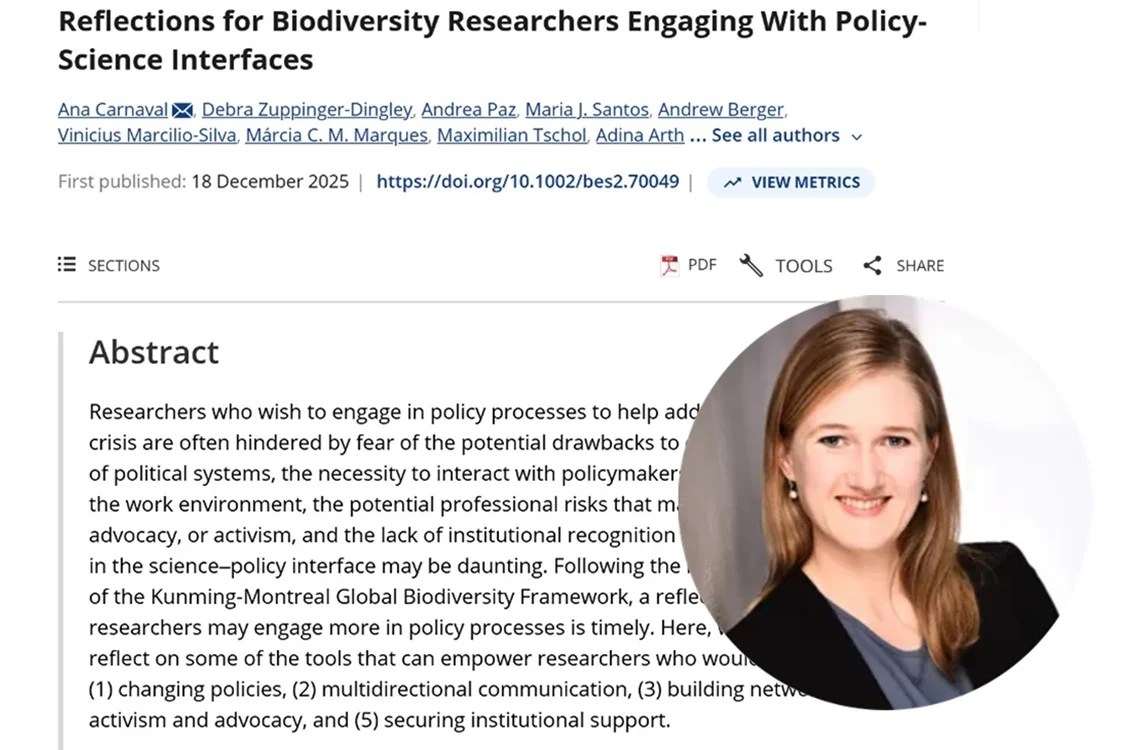
The open-access article, “Reflections for Biodiversity Researchers Engaging With Policy–Science Interfaces”, takes the Kunming-Montreal Global Biodiversity Framework as a point of departure and explores how scientific knowledge can be more effectively integrated into policy-making at the science–policy interface.
The commentary highlights several key insights for researchers interested in policy engagement:
- Engaging with policy extends beyond interactions with politicians and includes NGOs, public administrations, civil society, communities and other influential actors.
- Understanding the policy landscape – including actors, decision-making processes and power dynamics – is essential for identifying realistic entry points for engagement.
- Effective interaction relies on multidirectional communication, emphasising dialogue, co-creation and mutual learning rather than one-way knowledge transfer.
- Networks are crucial for opening doors, ensuring continuity and sharing responsibility.
- In practice, policy engagement may also involve advocacy and activism, an area that can be challenging but is often part of real policy processes.
- Institutions matter: universities and research organisations can enable policy engagement by recognising these efforts, creating time and spaces for them, and valuing non-traditional outputs.
The article is aimed at researchers, educators and practitioners working on biodiversity and sustainability and can serve as guidance, a basis for reflection, or teaching material.