SIG Writing Conference 2026 at ZHAW: Writing Research for Writing Practice
How can findings from writing research be effectively applied in practice? What role do empirical studies, theoretical models, and new methods play in writing instruction, text assessment, and professional development? With these questions in mind, the SIG Writing Conference 2026 at the ZHAW School of Applied Linguistics was entirely dedicated to the dialogue between research and practice. More than 200 international scholars from 30 countries across all continents gathered in Winterthur for the 21st edition of the renowned EARLI Special Interest Group Writing Conference.
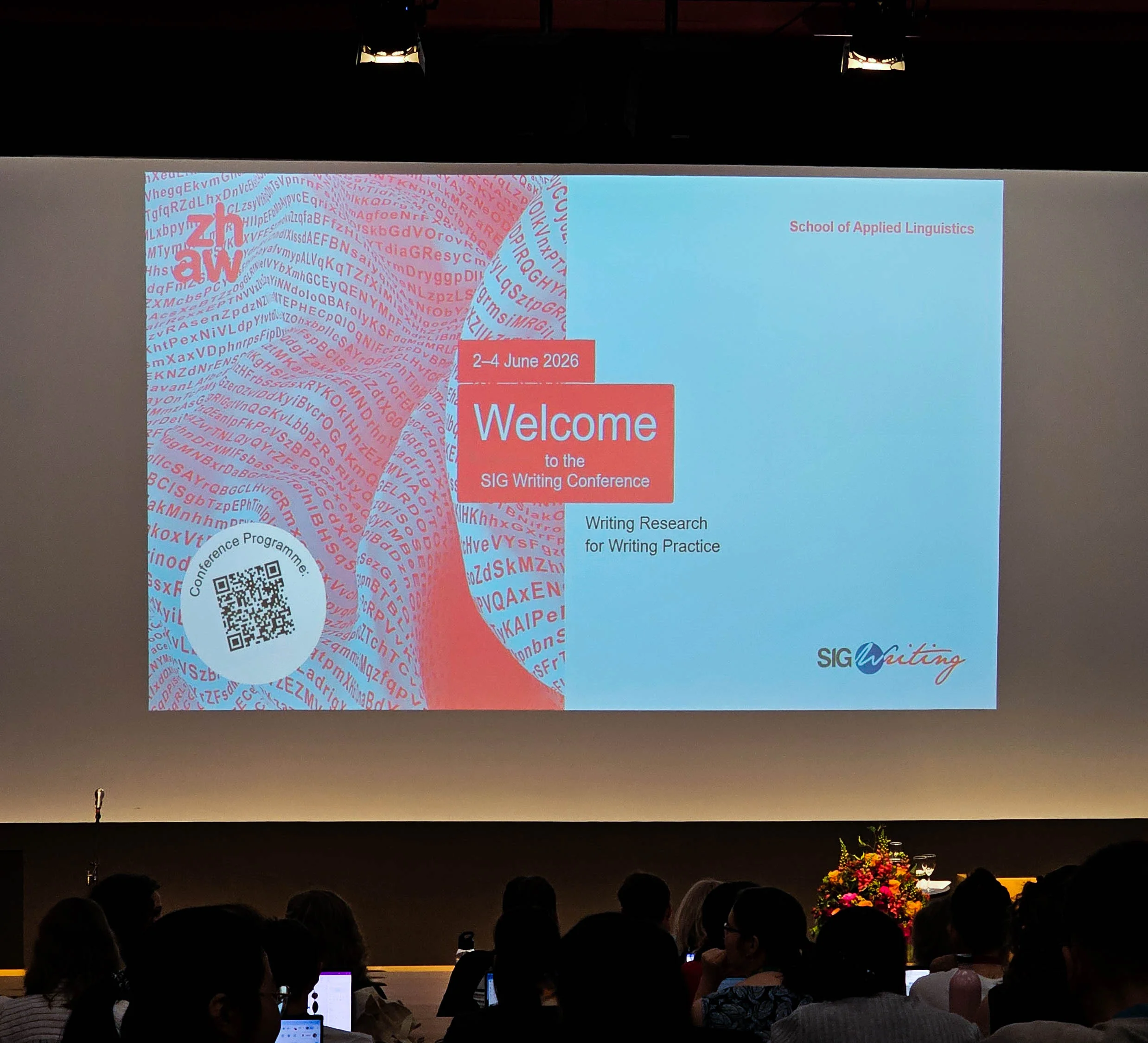
Under the theme “Writing Research for Writing Practice,” the conference provided a platform for discussing current developments in writing research and their application in real-world contexts. Particular emphasis was placed on presentations that bridge the gap between academic findings and the concrete challenges of writing in everyday life and in professional settings.
Key insights from the keynotes and the Hayes Award Lecture:
In her keynote address, Vera Busse (University of Münster, Germany) impressively demonstrated how evidence-based writing instruction can be successfully implemented in elementary schools. Presenting the KommSchreib! Project, she highlighted how targeted professional development for teachers and practical materials can help strengthen students’ writing skills and motivation, particularly in heterogeneous classes.
Evgeny Chukharev (Iowa State University, USA) explored the role of large language models (LLMs) in writing research and pedagogy. He demonstrated how Artificial Intelligence systems can be designed to align more closely with human cognitive processes and ethical principles. Using projects on eye-tracking-based writing processes and the evaluation of writing argumentative texts, he highlighted the potential of combining data-driven and symbolic approaches.
In the Hayes Award Lecture, Markus Linnemann (University of Koblenz, Germany), the Hayes Award winner of the Journal of Writing Research from 2024, examined writing fluency as a central dimension of writing development. He demonstrated how automated basic processes interact with complex cognitive skills and why isolated training is often insufficient. Rather, he argued that the integration of fluency-building into comprehensive literacy learning contexts is crucial for achieving sustainable progress in writing.
A Diverse Program and International Exchange
From June 2 to 4, 2026, the varied program reflected the breadth and dynamism of the field of research:
- Two keynote speeches and the Hayes Award Lecture in the Aula of the School of Applied Linguistics; the live streams were followed by many people
- An extensive academic program featuring eight parallel sessions (symposia, paper presentations, posters, roundtables, and demonstrations)
- The SIG Writing Business Meeting as an important forum for exchange within the community, with strong participation, particularly from attendees who were not yet members of the SIG.
John R. Hayes (Carnegie-Mellon University, USA) and Gert Rijlaarsdam (University of Antwerp, The Netherlands) were awarded Honorary Membership of SIG Writing, acknowledging their longstanding influence not only on writing research as a field, but also as founders and drivers of the writing research community. John R. Hayes joined the conference online to present the Hayes Award of the Journal of Writing Research 2026 to Lisa Haake (Leibniz University Hannover, Germany).
Prior to the conference, 16 early career researchers and 12 trainers/mentors gathered in Männedorf for the SIG Writing 2026 Research School. During four days, they explored analytical approaches to writing processes and how to create your own research trajectory, and discussed all things related to completing a doctoral dissertation and build a career as researcher.
At the Research School, Juhayna Taha (University College London, GB) was awarded the Best Early Stage Short Talk (BESST) Award for her pitch on her research project investigating the underlying processes of written language difficulties in Arabic-speaking children with developmental language disorder.
In addition to the academic program, the conference offered numerous networking opportunities. Guided city tours, insights into the former industrial site, and a visit to the university library allowed participants to get to know Winterthur better. The joint conference dinner served as a convivial highlight.
Both the SIG Writing 2026 Conference and Research School highlighted how crucial the exchange between research and practice is for the further development of writing skills. Innovative approaches emerge particularly where scientific findings are consistently linked to concrete application contexts.
A heartfelt thank you to all participants for their inspiring contributions and engaging discussions. We would also like to thank our sponsors, the organising team and Sibylle Hurschler Lichtsteiner (PH Lucerne), Stefan Daniel Keller (PHZH), Afra Sturm (FHNW) & Mirjam Weder (University of Basel) for their valuable support and commitment in making this such a memorable and successful conference.
See you in two years at SIG Writing 2028 in Odense, Denmark.
Support



Students of BA in Multilingual Communication
Students of BA in Language and Integration