Prof. Dr. Rolf Krebs
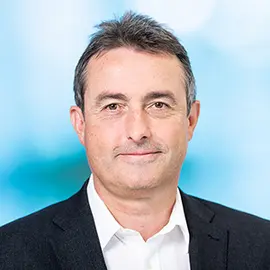
Prof. Dr. Rolf Krebs
ZHAW
Life Sciences und Facility Management
Institut für Umwelt und Natürliche Ressourcen
Grüentalstrasse 14
8820 Wädenswil
Arbeit an der ZHAW
Tätigkeit
Institutsleitung Umwelt und Natürliche Ressourcen
Lehrtätigkeit in der Weiterbildung
CAS Altlastenbearbeitung (SIPOL)
Berufserfahrung
- Leiter Anorganische Chemie, Gewässer- und Bodenschutzlabor
Kanton Bern
04 / 2002 - 04 / 2005 - Leiter Bodenschutz, Amt für Umweltschutz
Kanton St.Gallen
04 / 1998 - 04 / 2002
Aus- und Weiterbildung
Ausbildung
- Dr.sc.nat. ETH / Umweltnaturwissenschaften
ETH Zürich
02 / 1992 - 09 / 1996 - Dipl.nat. ETH / Umweltnaturwissenschaften
ETH Zürich
09 / 1987 - 10 / 1992
Weiterbildung
- CAS Management for Leaders
ZHAW
06 / 2016 - CAS Leadership advanced
ZHAW
05 / 2015
Netzwerk
Mitglied in Netzwerken
Bodenkundliche Gesellschaft der Schweiz
Projekte
- Auswirkungen von Bau und Betrieb auf betroffenem Boden der EKZ PV-Anlagen in Spanien / Projektleiter:in / abgeschlossen
- Hydrothermal carbonization as a sustainable solution for faecal waste treatment / Teammitglied / abgeschlossen
- Überprüfung des Konzepts zur Gefährdungsanalyse und Gefährdungsbewertung für die Herleitung von Prüf- und Sanierungswerten / Projektleiter:in / abgeschlossen
- Schwermetalle in Schweizer Grüngut / Projektleiter:in / abgeschlossen
- Selbstkalibrierende Steuerung für ressourcenschonende Bewässerung in der Landwirtschaft / Projektleiter:in / abgeschlossen
- Gefährdungsabschätzung Schiessplätze / Projektleiter:in / abgeschlossen
- Hydrothermale Carbonisierung als Alternative zur thermalen Trocknung von Klärschlamm / Projektleiter:in / abgeschlossen
- Monitoring der Rekultivierung im Benknerriet / Projektleiter:in / abgeschlossen
Publikationen
Beiträge in wissenschaftlicher Zeitschrift, peer-reviewed
- Gerner, G. et al. (2023) 'Hydrothermal carbonization of sewage sludge : new improvements in phosphatic fertilizer production and process water treatment using freeze concentration', Energies, 16(20), p. 7027. doi: 10.3390/en16207027.
- Chung, J. W. et al. (2022) 'Hydrothermal carbonization as an alternative sanitation technology : process optimization and development of low-cost reactor', Open Research Europe, 1(139). doi: 10.12688/openreseurope.14306.2.
- Gerner, G. et al. (2021) 'Sewage sludge treatment by hydrothermal carbonization : feasibility study for sustainable nutrient recovery and fuel production', Energies, 14(9), p. 2697. doi: 10.3390/en14092697.
- Chung, J. W. et al. (2017) 'Removal of Escherichia coli by intermittent operation of saturated sand columns supplemented with hydrochar derived from sewage sludge', Applied Sciences, 7(8). doi: 10.3390/app7080839.
- Egli, M. et al. (2017) 'The long-term interaction of mine tailings with soils and the wider environment : examples from Mont Chemin, Switzerland', Journal of Geochemical Exploration, 182(Part A), pp. 53–69. doi: 10.1016/j.gexplo.2017.08.011.
- Spataru, A. et al. (2016) 'Enhanced adsorption of orthophosphate and copper onto hydrochar derived from sewage sludge by KOH activation', RSC Advances, 6(104), pp. 101827–101834. doi: 10.1039/C6RA22327C.
- Chung, J. W. et al. (2015) 'Removal of rotavirus and adenovirus from artificial ground water using hydrochar derived from sewage sludge', Journal of Applied Microbiology, 119(3), pp. 876–884. doi: 10.1111/jam.12863.
- Stucki, M. et al. (2015) 'Hydrothermal carbonization of sewage sludge on industrial scale : energy efficiency, environmental effects and combustion', Journal of Energy Challenges and Mechanics, 2(2), pp. 38–44. Available at: http://www.nscj.co.uk/JECM/issues/JECM-2-2.pdf.
- Jäger, H. et al. (2015) 'Pre-alpine mire sediments as a mirror of erosion, soil formation and landscape evolution during the last 45 ka', Catena, 128, pp. 63–79. doi: 10.1016/j.catena.2015.01.018.
- Escala, M. et al. (2013) 'Hydrothermal carbonization of organic material with low dry matter content : the example of waste whey', Journal of Residuals Science & Technology, 10(4), pp. 179–186. Available at: http://www.dpi-journals.com/index.php/JRST/article/view/1941.
- Escala, M. et al. (2013) 'Hydrothermal carbonization as an energy-efficient alternative to established drying technologies for sewage sludge : a feasibility study on a laboratory scale', Energy & Fuels, 27(1), pp. 454–460. doi: 10.1021/ef3015266.
- Jean Petit Matile, L. et al. (2013) 'Characterization of a new heat dissipation matric potential sensor', Sensors, 13(1), pp. 1137–1145. doi: 10.3390/s130101137.
- Eckmeier, E. et al. (2013) 'Black carbon contributes to organic matter in young soils in the Morteratsch proglacial area (Switzerland)', Biogeosciences, 10(3), pp. 1265–1274. doi: 10.5194/bg-10-1265-2013.
- Egli, M. et al. (2012) 'Charcoal and stable soil organic matter as indicators of fire frequency, climate and past vegetation in volcanic soils of Mt. Etna, Sicily', Catena, 88(1), pp. 14–26. doi: 10.1016/j.catena.2011.08.006.
- Egli, M. et al. (2012) 'Soil organic carbon and nitrogen accumulation rates in cold and alpine environments over 1 Ma', Geoderma, 183-184, pp. 109–123. doi: 10.1016/j.geoderma.2012.03.017.
- Nicolescu, R. et al. (2010) 'Environmental exposure to lead, but not other neurotoxic metals, relates to core elements of ADHD in Romanian children : performance and questionnaire data', Environmental Research, 110(5), pp. 476–483. doi: 10.1016/j.envres.2010.04.002.
- Egli, M. et al. (2010) 'The influence of weathering and organic matter on heavy metals lability in silicatic, Alpine soils', Science of the Total Environment, 408(4), pp. 931–946. doi: 10.1016/j.scitotenv.2009.10.005.
- Limbach, L. K. et al. (2008) 'Removal of oxide nanoparticles in a model waste water treatment plant : influence of agglomeration and surfactants on clearing efficiency', Environmental Science & Technology, 42(15), pp. 5828–5833. doi: 10.1021/es800091f.
- Velea, T. et al. (2008) 'Heavy metal contamination in the vicinity of an industrial area near Bucharest', Environmental Science and Pollution Research, 16(1), pp. 27–32. doi: 10.1007/s11356-008-0073-5.
- Kulli Honauer, B. et al. (1999) 'The influence of nitrilotriacetate on heavy metal uptake of lettuce and ryegrass', Journal of Environmental Quality, 28(6), pp. 1699–1705. doi: 10.2134/jeq1999.00472425002800060002x.
- Krebs, R. et al. (1998) 'Solubility and plant uptake of metals with and without liming of sludge-amended soils', Journal of Environmental Quality, 27(1), pp. 18–23. doi: 10.2134/jeq1998.00472425002700010004x.
- Krebs, R. et al. (1998) 'Gravel sludge as immobilizing additive in soils polluted by heavy metals : a field study', Water, Air, & Soil Pollution, 115(1-4), pp. 465–479. doi: 10.1023/A:1005167004828.
- Lothenbach, B. et al. (1998) 'Immobilization of cadmium and zinc in soil by Al-montmorillonite and gravel sludge', European Journal of Soil Science, 49(1), pp. 141–148. doi: 10.1046/j.1365-2389.1998.00140.x.
- Gupta, S. K., Vollmer, M. K. and Krebs, R. (1996) 'The importance of mobile, mobilisable and pseudo total heavy metal fractions in soil for three-level risk assessment and risk management', Science of the Total Environment, 178(1-3), pp. 11–20. doi: 10.1016/0048-9697(95)04792-1.
Schriftliche Konferenzbeiträge, peer-reviewed
- Hutter, M., Krebs, R. and Mayer, J. (2017) 'Stickstoffnutzungseffizienz roher und anaerob vergorener Güllen : eine Studie mit unterschiedlichen 15N Methoden', in Wiesinger, K. et al. (eds) Beiträge zur 14. Wissenschaftstagung Ökologischer Landbau, Ökologischen Landbau weiterdenken - Verantwortung übernehmen - Vertrauen stärken. Berlin: Dr. Köster, pp. 314–317.
- Berner, F., Maag, D. and Krebs, R. (2007) 'A simple test system for assessing biofilm development on different surfaces', in Irish Branch of Society for General Microbiology Conference, Limerick, Ireland, 19-20 April 2007, p. 30.
Weitere Publikationen
- Krebs, R. et al. (eds) (2017) Bodenschutz in der Praxis. 1. Auflage. Bern: Haupt.
- Baier, U. et al. (2015) 'Behandlung des Prozessabwassers aus hydrothermal karbonisiertem Klärschlamm vor der Einleitung in eine ARA', GWF. Wasser, Abwasser.
- Krebs, R. et al. (2013) Weiterentwicklung der hydrothermalen Karbonisierung zur CO2-sparenden und kosteneffizienten Trocknung von Klärschlamm im industriellen Massstab sowie der Rückgewinnung von Phosphor. Winterthur: ZHAW Zürcher Hochschule für Angewandte Wissenschaften. doi: 10.21256/zhaw-4975.
- Jean Petit Matile, L., Achermann, M. and Krebs, R. (2009) 'Entwicklung und Anwendung einer Grobscreening-Methode zur Untersuchung des Abbauzustandes von Moorböden am Beispiel des Lobsigensees', in Abstract Volume 7th Swiss Geoscience Meeting. ZHAW Zürcher Hochschule für Angewandte Wissenschaften, p. 293. doi: 10.21256/zhaw-4032.
- Velea, T. et al. (2008) 'NEPOLL : environmental pollution in the vicinity of an industrial area near Bucharest and the impact upon the health of people living in this area', Danube News, 2008(17), pp. 7–9. Available at: https://www.danube-iad.eu/docs/danube_news/Danube_News_17.pdf.
Interessenbindungen
Aktuelle Interessenbindungen
Beirat
Lucky Shrimp AG, Winterthur
Beirat Lucky Shrimp AG im Bereich Aquakulturen
05 / 2022 - 12 / 2026