Food strategies for all: participation and transformation in smaller cities
Food strategies are important to promote sustainable development locally. But how can they also be implemented in smaller communities?
Result
Phase 1
Development of the report "Food Strategies for All – Participation and Transformation in Smaller Towns. Interim Report on the Foundational Phase." This report presents an approach for the simplified development of food strategies. Four central themes were identified:
First, it is important to be able to demonstrate the relevance and benefits of food strategies and to raise awareness among municipal actors about sustainable food systems, as a prerequisite for developing a food strategy at all.
Second, developing a food strategy is best done in seven development steps, from initiation through to evaluation.
Third, project organization is essential to the development process, in order to do justice to the topic's interdisciplinarity and complexity and to bring stakeholders — including decision-makers — on board.
Fourth, a participatory process is recommended for developing a food strategy, one that specifically involves local actors in the food system and takes existing initiatives into account.
Phase 2
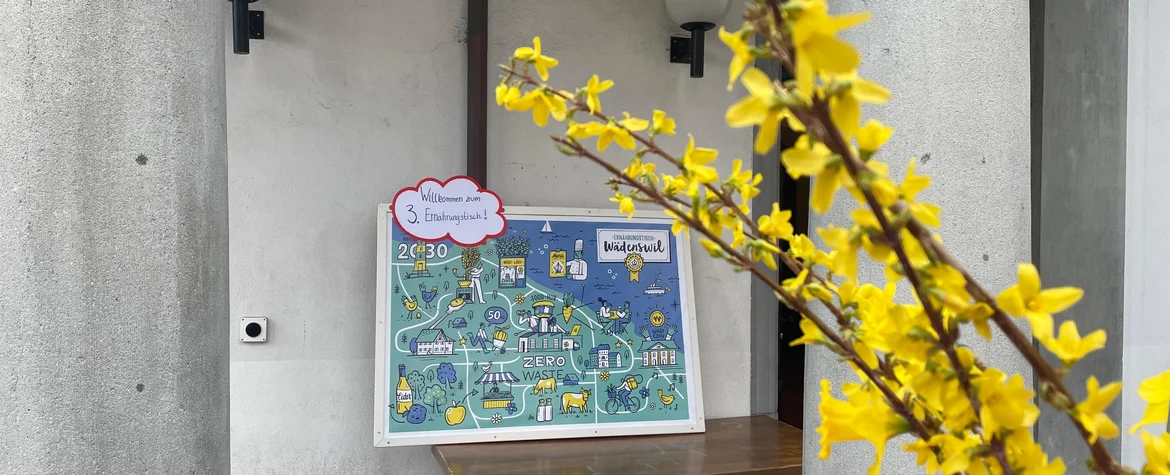
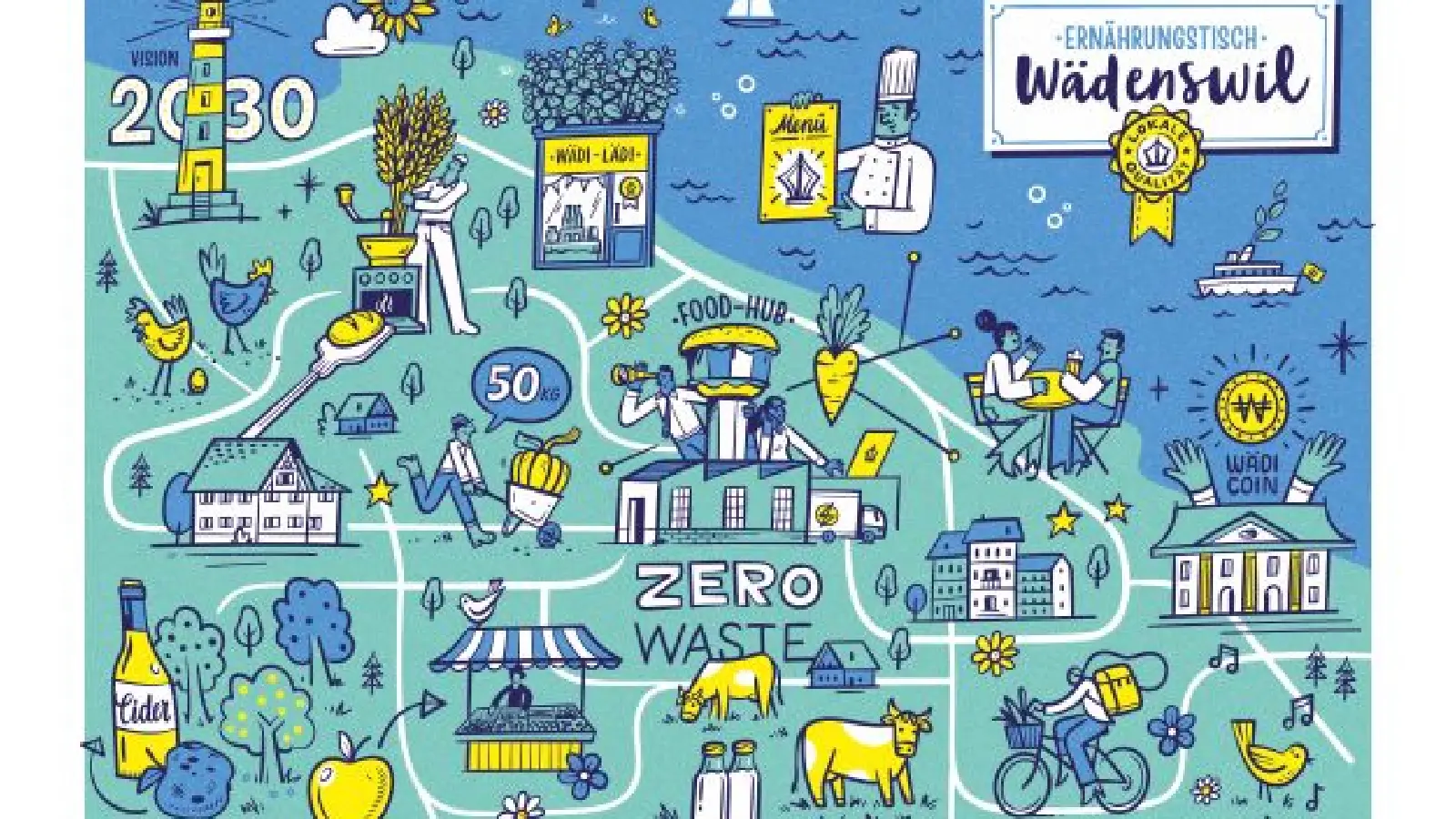
In both pilot municipalities, local challenges and potentials in agriculture and the food economy were identified together with local actors, and possible fields of action for a sustainable local food system were subsequently developed. For each field of action, project ideas and solution approaches were worked out and discussed together with actors in both municipalities. This resulted in a compass for each municipality, which can serve as a foundation for further work by the municipalities or their actors.
Phase 3
The findings were disseminated through talks, webinars, and workshops.
Description
Food strategies are processes designed to promote sustainable development at the local level. But how can they be implemented in smaller communities?
Both globally and locally, food systems are at the heart of sustainable development and are closely linked to the environment, the economy, our social structures, and our health. Through food strategies, communities can work together with residents and stakeholders to define goals for sustainable development and develop concrete measures for their implementation.
The research project “Food Strategies for All” by the Geography of Food research group examines the potential of food strategies for sustainable development in smaller towns. The project aims to initiate the transition toward more sustainable local food systems and promote sustainable patterns of production and consumption. In the long term, the goal is to reduce negative environmental impacts while strengthening local economic value creation and fostering a resilient and healthy society.
The project’s objective was to develop resources to support communities in developing food strategies. Stakeholders in the local food system are to be motivated and empowered to initiate and implement participatory processes for transforming the local food system.
Why Small Towns?
In major Swiss cities such as Zurich, Basel, and Bern, strategies for sustainable local food systems have already been developed and concrete measures formulated. But how can the development of sustainable food systems also be promoted in smaller communities?
Due to differences in the food system—such as the greater importance of agriculture, limited resource availability, higher levels of interconnectedness, and other specific needs—existing processes for developing food strategies must be adapted for smaller communities. At the interface between urban and rural areas, there is particular potential to incorporate the entire value chain—from agricultural production to consumption—into the development of goals and measures.
Project Timeline
The project was carried out in three phases:
- Analysis of experiences in developing and implementing food strategies in larger cities and a needs assessment in smaller cities and municipalities.
- Participatory development of food strategies or similar roadmaps towards a sustainable food system in two municipalities
- Development of support material and formats for municipalities
Key data
Projectlead
Prof. Dr. Isabel Jaisli, Carmen Kummer
Deputy Projectlead
Project team
Sonja Trachsel, Hanna Della Casa, Claudia Veith, Toya Bezzola (Food of Change GmbH)
Project partners
Food of Change GmbH; Transition Town Wädenswil TTW / Klimaidee Wädenswil
Project status
completed, 04/2023 - 08/2026
Institute/Centre
Institute of Natural Resource Sciences (IUNR)
Funding partner
Stiftung Mercator Schweiz; Stadt Wädenswil
Project budget
263'000 CHF
Further documents and links
Publications
-
Ist-Analyse Bericht zum Hinwiler Ernährungssystem
2026 Ritter, Frenzi; Della Casa, Hanna
-
Bericht für eine regionale und zukunftsweisende Land- und Ernährungswirtschaft in Pilotgemeinde 2
2026 Ritter, Frenzi; Della Casa, Hanna
-
Ernährungszukunft Wädenswil : ein Konzept für eine nachhaltige Land- und Ernährungswirtschaft
2025 Ritter, Frenzi; Della Casa, Hanna
-
Ernährungszukunft Wädenswil : Projektbericht
2025 Kummer, Carmen; Della Casa, Hanna; Näf, Melissa; Koch, David
-
Co-creating sustainable food futures : integrating perspectives from farm to fork for local food system transformations
2024 Kummer, Carmen; Jaisli, Isabel; Trachsel, Sonja
-
Ernährungsstrategien für alle – Partizipation und Transformation in kleineren Städten : Zwischenbericht Grundlagenetappe
2024 Bezzola, Toya; Geisser, Tobias

School of Life Sciences and Facility Management
Grüentalstrasse 14
8820 Wädenswil