Editorials 2025
Universities of applied sciences have been firmly established for over 25 years

Our universities of applied sciences have been an integral part of the Swiss education landscape for over a quarter of a century. They bridge the gap between higher education and vocational education and training. They help to ensure academic mobility in our education system and facilitate lifelong learning. Today’s generation of students could hardly imagine an educational landscape without them.
Universities of applied sciences were created with a clear purpose: to bring higher education closer to professional practice – or professional practice closer to higher education. This continues to shape them to this day. As the youngest type of higher education institution, they address real-world challenges through applied research, ensuring that their findings directly benefit professional practice. For over 25 years, this has greatly benefited Zurich as a centre for education and business.
However, we must not rest on our laurels. Universities of applied sciences must continue to evolve if they are to enrich the educational sector over the next 25 years. The world in which our students live, and in which businesses and organisations must prove themselves, is becoming increasingly complex. Universities of applied sciences must expand their networks even further – both amongst themselves and with other universities, but most importantly with the world of business.
Job profiles are changing too, and new skills are in constant demand. The rise of artificial intelligence is perhaps the most obvious example. It raises important questions: which technological possibilities lend themselves to teaching, and where do we need clear boundaries? How can we ensure that information continues to be assessed critically? It is crucial that our students are optimally prepared for a future that will be even more digital, dynamic and demanding than we could ever have imagined.
As we look to the future, we need both a strong foundation and the courage to embrace change. Our universities of applied sciences offer both. They have been firmly established within our education system for over 25 years. At the same time, they are remarkably open to new ideas and developments. I look forward to shaping the future of these institutions together with their three presidents.
Dr. Silvia Steiner, Government Councillor and President of the Zurich University of Applied Sciences Council
We are shaping change together
A university of applied sciences must always look ahead and anticipate labour market requirements several years in advance to equip its students with the right skills. This is no easy task, particularly in times of technological disruption. The School of Applied Linguistics is a compelling example of how institutions can reinvent themselves during periods of rapid structural change. In a field disproportionately affected by artificial intelligence, the School acted early and fundamentally redesigned its degree programmes. The revised curricula prepare graduates to work as language experts at the interface between humans and machines, combining human and artificial intelligence to provide key consultancy services for companies. This example shows that those who embrace change and actively shape it will remain competitive.
Shaping the future is also a guiding principle in the fields of AI and robotics. The ZHAW recently became an academic partner of AI House Davos, a non-commercial initiative. Alongside other institutions and companies, the ZHAW contributes to fostering dialogue and collaboration in support of meaningful, ethical and sustainable AI innovation. In 2025, the ZHAW introduced a new in-house focus area: Physical AI. Its aim is to strengthen interdisciplinary collaboration in robotics and AI. The humanoid robot KAI plays an active role by exploring new application scenarios, promoting interdisciplinary exchange and encouraging discussion of socially relevant questions relating to embodied intelligence. The robot also enables a wider audience to engage with robotics at events, generating considerable enthusiasm.
Collaboration benefits technological progress and, in turn, the region as a whole. In the canton of Zurich, collaboration between the ZHAW, the University of Zurich and the Zurich University of the Arts is helping to establish a dynamic platform for research, development and innovation. LINA (Shared Large-scale Infrastructure for the Development and Safe Testing of Autonomous Systems) provides comprehensive testing infrastructure for autonomous systems and robotics technologies, with a particular focus on flight systems. This infrastructure enables companies and research institutions to safely test drones, robots and related systems and concepts, from early prototypes through to market-ready applications. In addition to strengthening innovation potential and expanding networks in robotics technologies, it also promotes public acceptance of autonomous technologies in the canton of Zurich and beyond.
Interdisciplinary research will continue to play a central role in the future. The newly established Center for Animal Rights at the ZHAW School of Management and Law is a prime example of interdisciplinary collaboration. It addresses issues arising from the numerous links between animal, human and environmental rights and sustainability. In doing so, it explores the complex interrelationships that are central to major challenges such as climate change, species extinction and zoonoses. In September, Saskia Stucki, director of the institute, was awarded the Swiss Latsis Science Prize for her research on animal rights. She is the first researcher at a Swiss university of applied sciences to receive this prestigious award. This clearly reflects the growing importance of applied, practice-oriented research.
In February 2025, Regula Jöhl assumed the presidency of the ZHAW. She approaches her responsibilities with great skill, foresight and an excellent sense of constructive collaboration. We would like to thank Regula for her invaluable work and look forward to continuing to define the future of our educational landscape together.
Dr. Michael Alkalay, member of the University of Applied Sciences Council and ZHAW representative
Prof. Dr. Thomas Gächter, member of the University of Applied Sciences Council and ZHAW representative
Dr. Matthias Kaiserswerth, member of the University of Applied Sciences Council and ZHAW representative
Ulrich Jakob Looser, member of the University of Applied Sciences Council and ZHAW representative
Adding value through shared knowledge
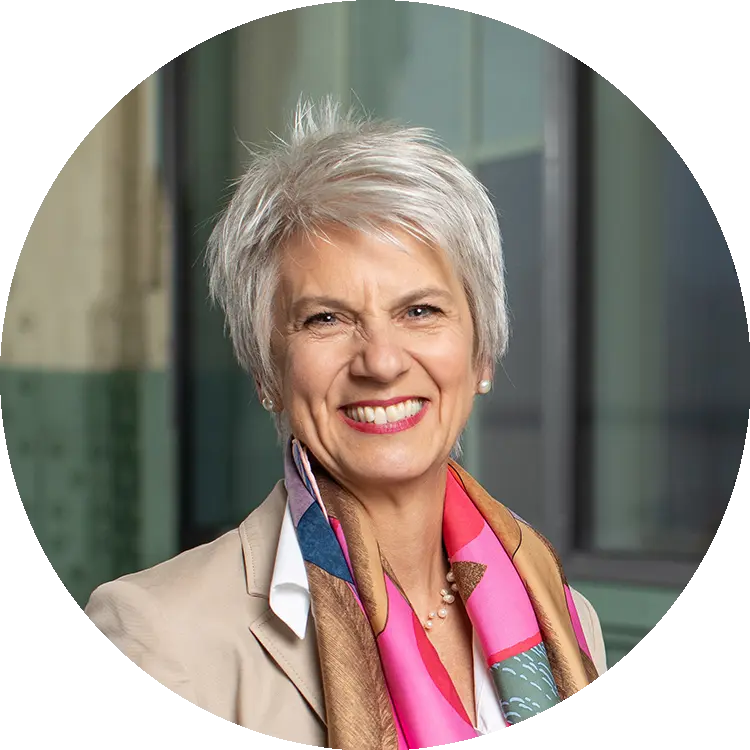
The ZHAW entered 2025 with a new university strategy that combines tried-and-tested methods with new ideas. Creating and sharing knowledge has always been and will remain the main goal of a university. In other words, it is about being transformative. It is equally important to create an environment in which knowledge can generate impact. As a university of applied sciences, the ZHAW focuses on questions that matter to society as well as the economy while still thinking outside the box. In order for our work to be transformative and sustainable, we embrace entrepreneurial thinking and strong partnerships.
Entrepreneurial thinking means critically questioning the status quo, staying agile and recognising opportunities. With this mindset, good ideas don’t get stuck in the lab, on the screen or in people’s minds but actually go on to benefit society and the economy. One great example of how this kind of thinking is being fostered is the ZHAW’s summer schools. They enable students to work in interdisciplinary teams and develop solutions for real-world problems faced by companies while getting the opportunity to network with students from partner universities. This kind of hands-on, real-world approach and collaboration across national and disciplinary borders is exactly what the ZHAW is all about.
In 2025, the ZHAW established new partnerships with 19 universities across the globe, from Italy to Australia. This enables us to conduct excellent research with renowned partners, reinforcing our position as a leading higher education institution in Europe and overseas. Our appealing mobility opportunities boost our students’ international profile, which is essential for success in a globalised society, economy and academic landscape.
Alongside our international networks, we remain committed to our local roots, which are fundamental for creating tangible value and knowledge. An independent study has quantified the ZHAW’s economic impact in the Zurich region. For every Swiss franc invested in the ZHAW by the canton, three Swiss francs are generated in return. Almost half of the 3,800 graduates of the Bachelor’s and Master’s programmes who enter the labour market each year end up working in one of the regions surrounding the ZHAW’s three campuses in Winterthur, Zurich or Wädenswil. By bridging the gap between science and real-world application, the ZHAW serves as a key research partner, collaborating with hundreds of organisations across the canton annually. We offer practical solutions and robust analyses that lead to greater success in our partners’ daily work. We are proud of these figures and are motivated to remain innovative, focus on practical implementation and keep pace with rapid technological developments.
My first year at the ZHAW was marked by many inspiring conversations and encounters. I was impressed with the wealth of expertise in our eight Schools and central administrative units, and how motivated the ZHAW community is to create even greater value and impact. I am looking forward to supporting more hands-on projects and further strengthening of collaboration across our organisation to generate more knowledge and create even greater value.
Professor Dr. Regula Jöhl, President of the ZHAW