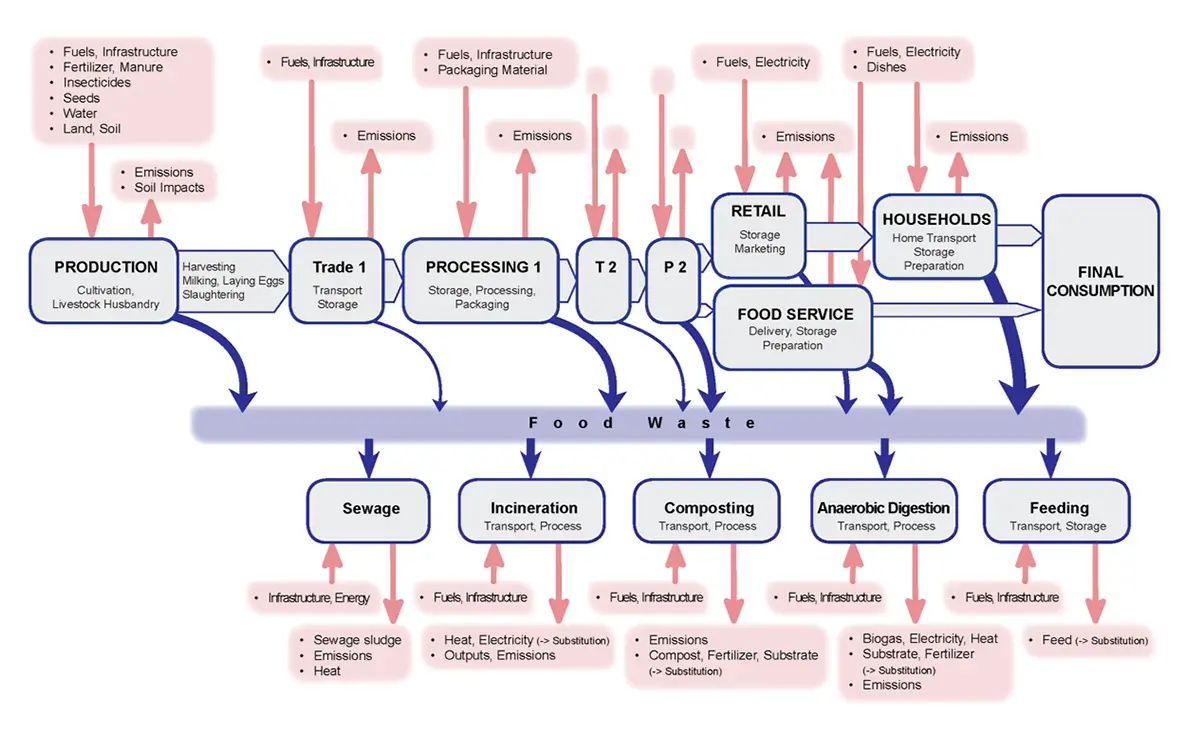
Food chain model
The production, processing and distribution of food account for between 20% and 30% of environmental effects in Switzerland. In order to significantly reduce the impact of food waste in a targeted manner, a model is being developed at the ZHAW with the objective of calculating the environmental effects of food waste and working out optimisation and reduction measures.

The production, processing and distribution of food account for between 20% and 30% of environmental effects in Switzerland. At the same time, around one-third of food is lost between field and fork. These food losses have a negative effect on the environment that amounts to approximately 10 trillion environmental impact points, equating to half of the environmental impact of all car journeys.
For the implementation of the UN’s Sustainable Development Goals, which have also been ratified by Switzerland, the volume of food waste should be halved by 2030.
Environmental assessment of food waste
In order to achieve the objective of halving the volume of food waste, it needs to be possible to environmentally assess measures aimed at avoiding it. A model is being developed as part of a new project at the ZHAW involving the Institute of Food and Beverage Innovation (ILGI), the Institute of Natural Resource Sciences (IUNR) and the Institute of Applied Simulation (IAS). This model calculates the environmental impact of measures aimed at optimising the food chain and reducing food waste. This food chain model is based on the methodology of an ETH Zurich doctoral thesis entitled “Environmental Assessment of Food Losses and Reduction Potential in Food Value Chains”.
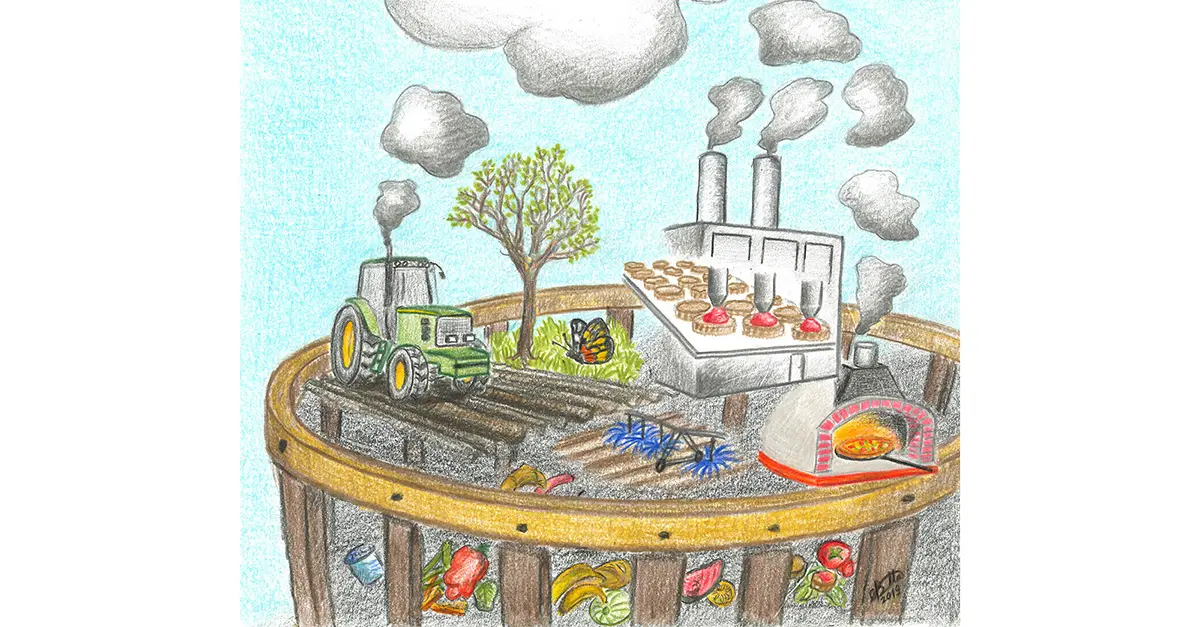
Use of the new model
The new model can be used universally in the areas of education, research and consulting services. Thanks to its various user interfaces, it is suitable for various target groups. For instance, the model can be used in schools as a means of interactive learning, allowing pupils to find out which foods have the greatest environmental impact and what it is especially important to pay attention to (e.g. origin, seasonality). It can also be used to advise those processing food by modelling detailed scenarios in which the specific input parameters of the relevant businesses are incorporated. Milk processors can, for example, find out whether they can reduce their environmental impact by installing photovoltaics on the roof or by further processing whey, a by-product, into whey powder.