Finance, Land-Use Planning, and Human Resources Pose Challenges for Swiss Municipal and City Authorities
A sound financial budget, forward-looking land-use planning, and a qualified workforce head the list of strategic priorities for Swiss municipalities and cities. A new ZHAW study shows that strategic planning is widely established in municipalities and is perceived as an effective management tool.

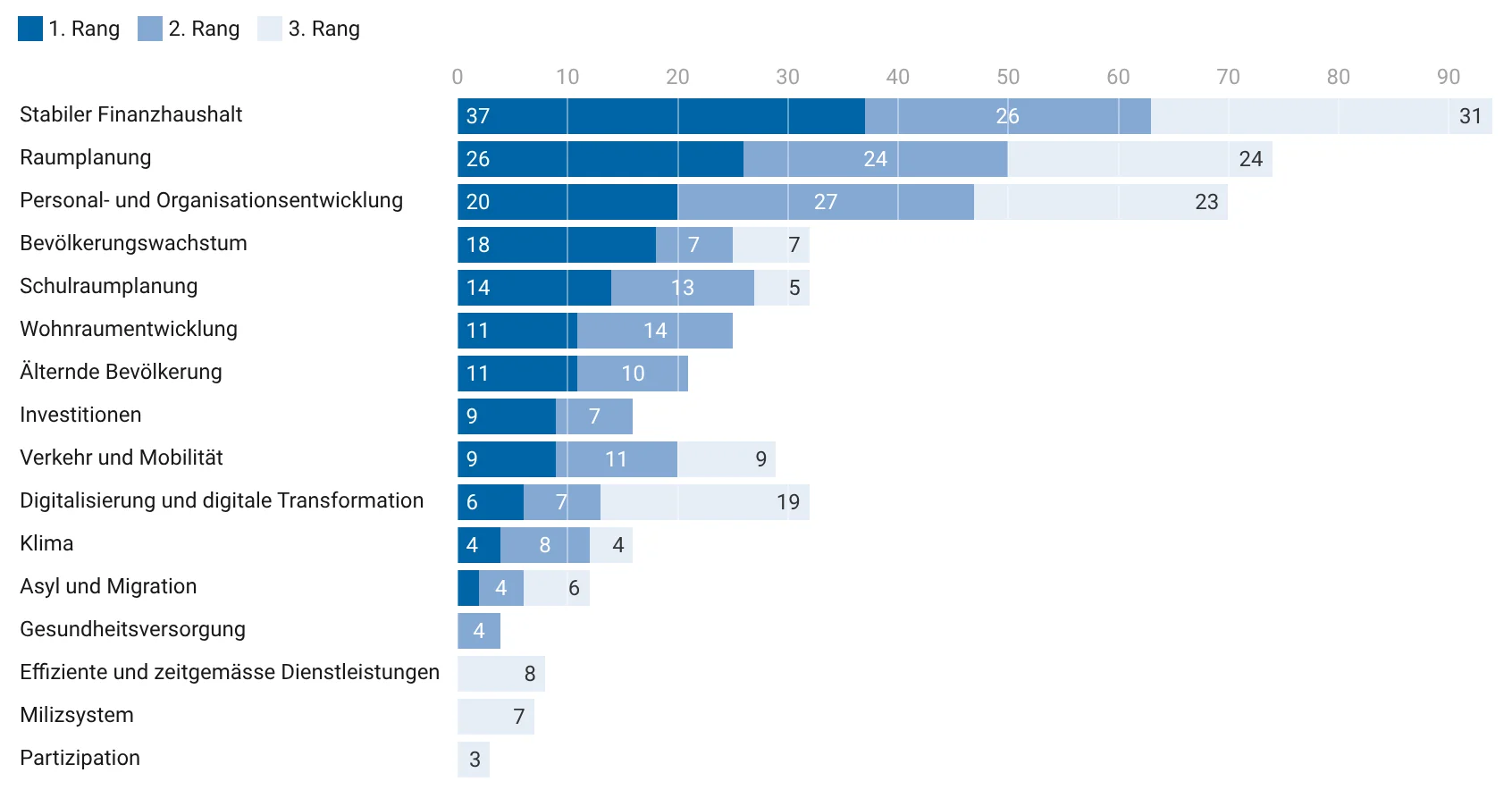
The most significant strategic challenges, in descending order (based on the number of mentions), are a stable financial budget (94 mentions), land-use planning (74 mentions), and human resources/organizational development (70 mentions). In addition, digitalization and digital transformation (32 mentions), population growth (32 mentions), and school facility planning (32 mentions) are also frequently cited as strategic challenges. In general, flexibility throughout the entire strategic process is considered an important factor.
“Eighty-four percent say they make a point of remaining flexible in their strategic planning so they can respond to new developments,” explains ZHAW expert Caroline Brüesch.
Municipalities and cities rely on strategic management
A large proportion of municipalities and cities consider strategic planning valuable, with 81 percent of respondents saying the benefits outweigh the cost and effort. Strategic planning and financial management are closely linked, with 85 percent of municipalities reporting that their budgets reflect their strategic goals. In addition, 78 percent report that new expenditure is specifically geared toward achieving strategic goals.
Strategy remains primarily the responsibility of the executive and senior officials
“Strategic planning processes in the Swiss municipalities and cities surveyed are well established and primarily supported by the executive branch (96 percent) and administrative leadership (87 percent),” says Caroline Brüesch in response to the findings. Non-managerial employees (21 percent), the legislature (28 percent), and the general public (25 percent) are involved in strategic planning processes significantly less often. Implementation is partly managed through clearly defined responsibilities and key performance indicators. Forty-eight percent of municipalities hold administrative leadership responsible for implementing the strategy, 29 percent use key performance indicators to track strategic goals, and 36 percent link the evaluation of their executives to the achievement of these goals.
This new ZHAW study provides the first Switzerland-wide overview of strategic planning processes in Swiss municipalities and cities with more than 5,000 registered residents. A total of 184 municipalities and cities across Switzerland, representing all language regions, participated in the online survey. This corresponds to a response rate of 43 percent. The results provide a nationwide overview and help municipalities and cities reflect on and further develop their own strategic processes.
Downloads
- Nationale Umfrage zum Strategieprozess in Gemeinden und Städten mit mehr als 5000 Einwohnerinnen und Einwohnern (PDF 900 kB)
- Merkblatt Nationale Umfrage zum Strategieprozess in Gemeinden und Städten mit mehr als 5000 Einwohnerinnen und Einwohner (PDF 753 kB)
- Medienmitteilung: Strategische Planung von Gemeinden und Städten (PDF 113 kB)
- Communiqué de presse : Planification stratégique des communes et des villes (PDF 111 kB)
- Comunicato stampa: Pianificazione strategica di comuni e città (PDF 112 kB)
Further Informationen
Contact
Mirjam Schwarz, Wissenschaftliche Mitarbeiterin, ZHAW School of Management and Law, +41 58 934 77 27, mirjam.schwarz@zhaw.ch
ZHAW Medienstelle, +41 58 934 75 75, medien@zhaw.ch