Young people are curious and cautious about using AI in their everyday lives
AI is already an integral part of many adolescents’ digital lives in Switzerland. Most approach the technology with openness while maintaining a reflective attitude.
Artificial intelligence has become part of the digital routines of teenagers in Switzerland, the JAMES focus report on the use of AI reveals. The report is based on data from the national JAMES study on adolescents’ media use, which is carried out every two years by the ZHAW on behalf of telecommunications company Swisscom.
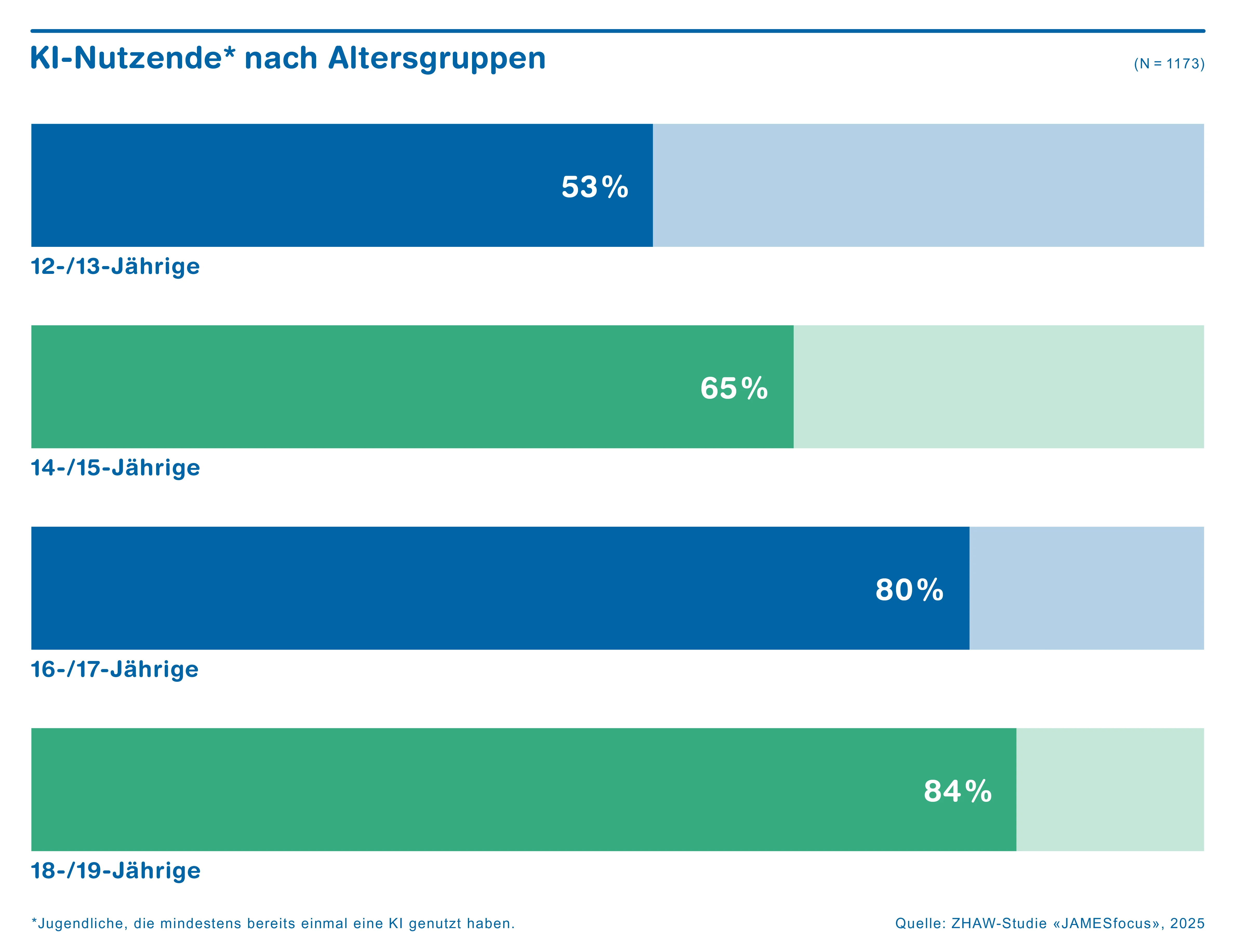
According to the report, 71 per cent of the nearly 1,200 adolescents surveyed in spring 2024 use AI tools. Usage increases with age: while around half of 12- to 13-year-olds use AI, the figure rises to 84 per cent among 18- to 19-year-olds. The most commonly used tool is ChatGPT. AI tools are used primarily to obtain information, while entertainment plays a secondary role.
Gregor Waller, researcher at the ZHAW and co-leader of the study, says that most adolescents are embracing the technology while remaining reflective and cautiously optimistic. However, attitudes vary according to gender and social environment: girls have a significantly more negative attitude towards AI than boys. Adolescents from urban areas are also more open to new technologies than their peers from rural regions.
Adolescents and parents should explore AI together
Jael Bernath, researcher at the ZHAW and co-author of the study, says that, although AI tools are used in a wide range of situations, a nuanced understanding of their risks and opportunities is often missing, even among adults. She believes that adolescents and parents should explore these technologies together and learn from each other. There is also a need for new media literacy programmes and teaching approaches in schools.