DIGILOG at Women in Data Science (WiDS) 2025: Poster Presentation on the Digital Transformation of Europe’s Municipalities
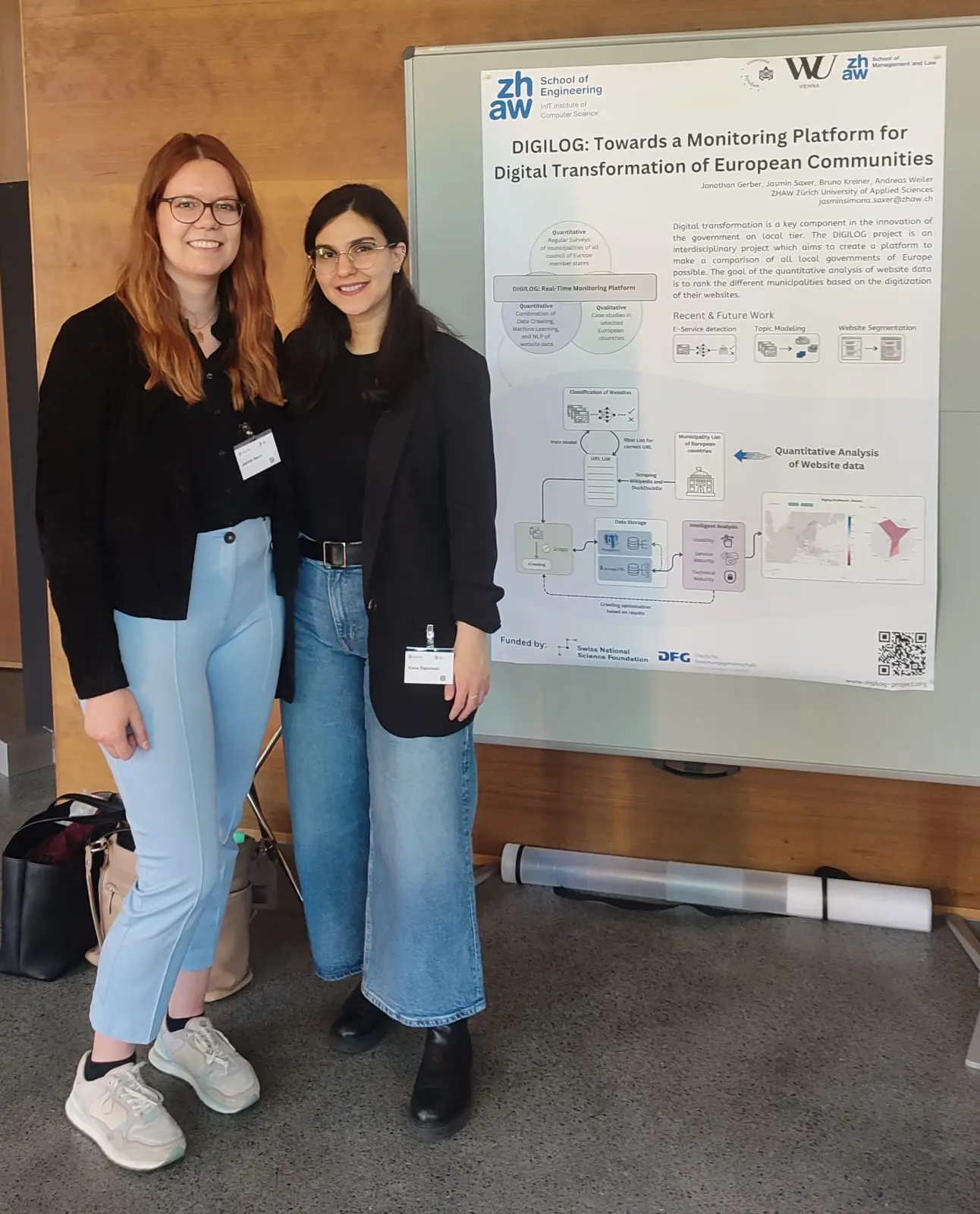
At this year’s Women in Data Science Zurich (WiDS) 2025 event, Jasmin Saxer had the opportunity to present the DIGILOG research project during a poster session and a two-minute lightning talk. The conference, which highlights the work of women in data science and fosters interdisciplinary exchange, offered a valuable platform to showcase DIGILOG's latest insights.
The presentation sparked numerous engaging discussions and attracted significant interest, underlining the relevance of understanding local-level digital transformation across Europe through innovative data-driven approaches.
DIGILOG is a collaborative project between the ZHAW Institute of Computer Science, the ZHAW School of Management and Law, the Potsdam University, and the Vienna University of Economics and Business Administration (WU). The project aims to monitor and evaluate the digital transformation of municipal governments across the 47 member states of the Council of Europe by combining quantitative and qualitative research methods.
A key component of the project involves large-scale web crawling and the application of machine learning techniques to analyze municipal websites. This is complemented by in-depth case studies and surveys from political science to provide contextual insights into local administrative practices and digital development.
The poster focused on DIGILOG’s latest work on web data acquisition, embedding and classification of municipal websites, and the development of a new dual-classified webpage segmentation benchmark to assess both functional categories and digital maturity.
Visit the DIGILOG website for more information and to explore the first results: https://www.digilog-project.org/results-and-dashboard/
This project is supported by Grant No. GR 200839 of the Swiss National Science Foundation (SNF) and German Research Foundation (DFG) for the research project DIGILOG.