Information Filtering in Digital Markets: Impacts on Competition, Choice and Market Efficiency (DigiFilter)
What we see shapes how we decide – and digital platforms increasingly shape what we see. This project explores how digital filters and limited attention affect markets, and how information environments can be designed to foster fairer competition, greater transparency, and better decisions.
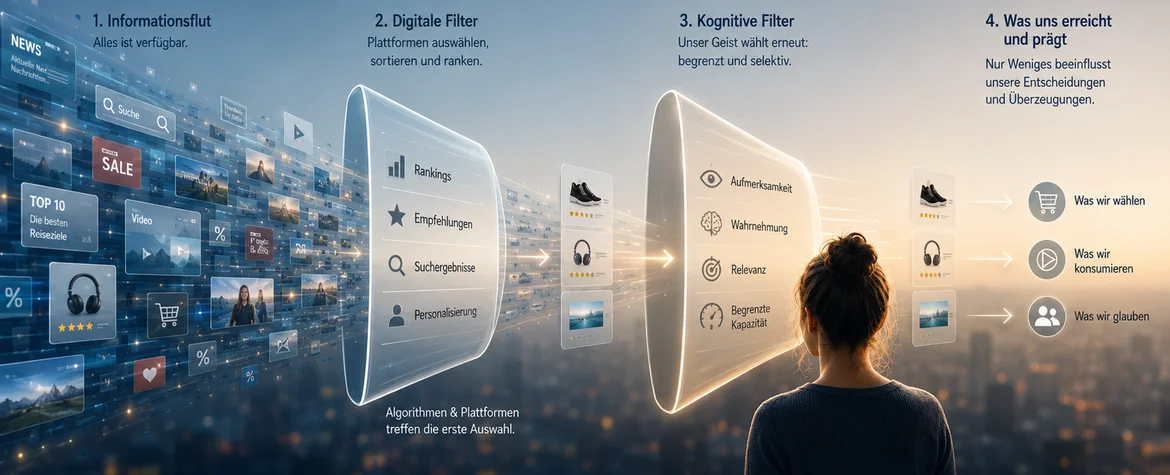
Description
In the digital world, filters and ranking systems—such as recommendations, search results, and platform rankings—strongly influence which information people actually see. In turn, this shapes the products they choose, the content they consume, and the opinions they form.
At the same time, human attention is limited: no one can process the full volume of available information, so people inevitably focus on what appears most relevant or important.
My research examines how these two layers interact: digital filtering by platforms and the limits of human attention and perception. The aim is to understand when such filters help people make better decisions—and when they may unintentionally distort competition, reduce transparency, or lead to systematically poorer choices.
Based on these insights, the project seeks to develop clear and practical guidelines for designing digital information environments that support fair competition, better decision-making, and greater social welfare.
Key data
Projectlead
Project status
ongoing, started 04/2026
Institute/Centre
Center for Labor, Digital and Regional Economics (CLDR)
Funding partner
Digitalisierungsinitiative der Zürcher Hochschulen DIZH

School of Management and Law
Gertrudstrasse 8
8400 Winterthur