VARESI – Recycling industrial waste materials for a sustainable industry
How can industrial residues contribute to climate-friendly heat supply? The VARESI project combines anaerobic digestion and hydrothermal carbonization to valorize organic residues directly on site for energy production. Complemented by water recovery and techno-economic assessments, the project develops sustainable solutions for industry.
Description
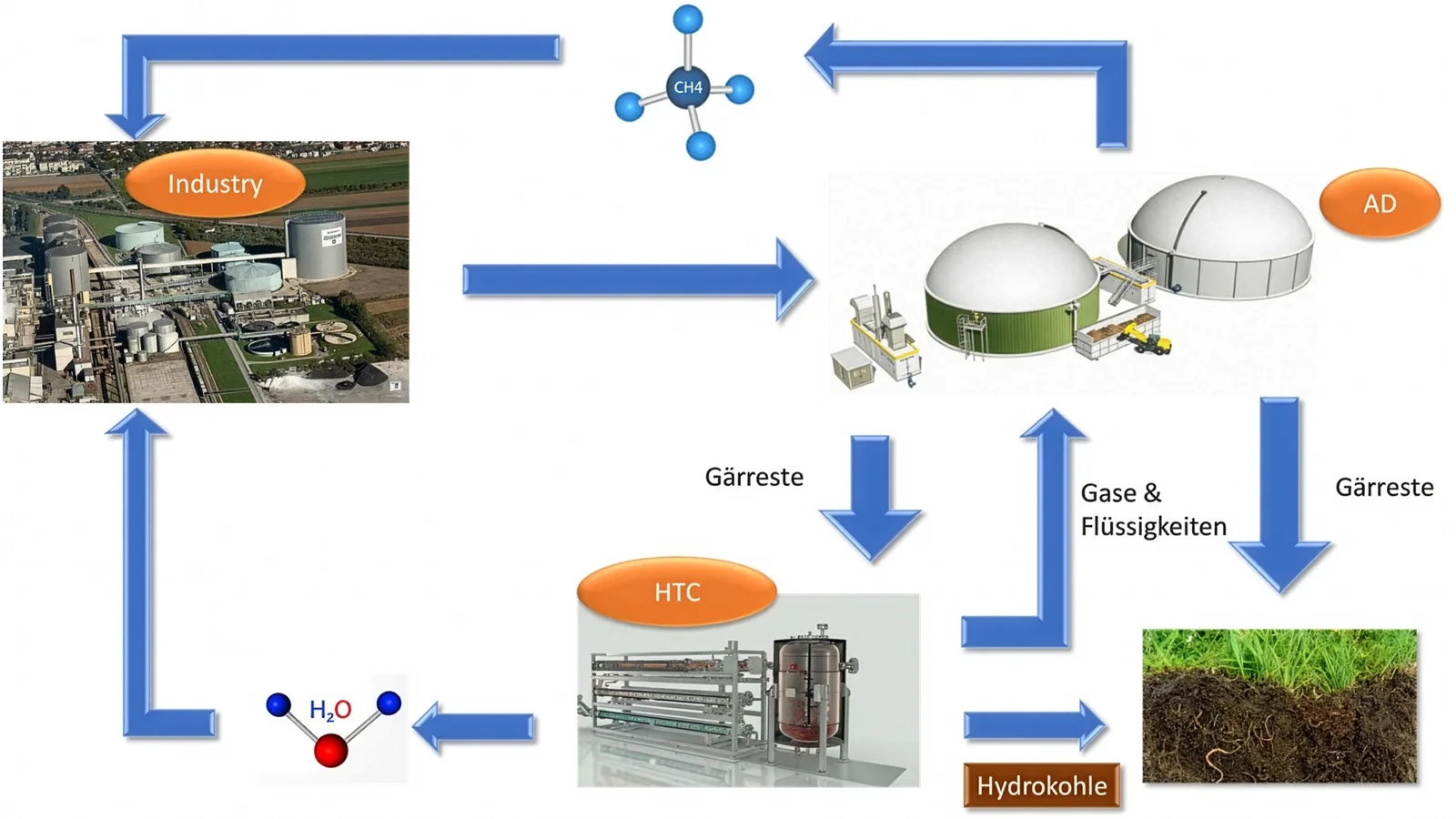
As part of the 14th ERA-NET Bioenergy Call, the project "VARESI" developed an innovative zero-waste concept for the production of heat and water from industrial residues. The core of the approach was the combination of anaerobic digestion and hydrothermal carbonization (HTC), enabling significantly more efficient energy recovery from wet biomass. Readily biodegradable compounds were first converted into biogas or biomethane, while the remaining carbon was processed through HTC. This produced biochar as a storable energy carrier, while part of the carbon was transferred to the process water and subsequently utilized for additional energy recovery in a second anaerobic digestion stage.
In addition to energy generation, the complete utilization of process water was a key objective. By combining anaerobic treatment with membrane filtration, both the chemical energy contained in the process water could be recovered and purified water streams could be provided. A laboratory-scale system operated continuously and stably for more than 200 days demonstrated the technical feasibility of this utilization pathway.
The paper industry was selected as a case study. Using the example of TELA GmbH, the VARESI concept demonstrated a substantially improved utilization of existing biomass streams. Compared with conventional operation, the process simulations indicated an additional energy yield of approximately 11,000 to 13,000 MWh per year. This additional energy could replace fossil fuels and reduce CO₂ emissions by around 2,500 tonnes annually. The results confirmed the potential of HTC as a key technology for the sustainable utilization of wet biomass and highlighted the importance of feedstock-specific process optimization to maximize energy recovery.
Key data
Projectlead
Deputy Projectlead
Co-Projectlead
Project team
Alexander Treichler, Michèle Nathalie Senn, Yves Moser, Katharina Schmid Lüdi, Britta Hölzel, Dr. Jörg Musiolik
Project partners
Universität für Bodenkultur Wien; AAT Abwasser- und Abfalltechnik GmbH
Project status
completed, 01/2022 - 12/2024
Institute/Centre
Institute of Chemistry and Biotechnology (ICBT); Institute of Sustainable Development (INE)
Funding partner
ERA-NET; Bundesamt für Energie BFE
Project budget
182'922 CHF
Further documents and links
School of Life Sciences and Facility Management
Müller-Thurgau-Strasse 27
8820 Wädenswil