StopSH – InterventionS TO Prevent Sexual Harassment against nurses
The StopSH project aims to develop, test and evaluate tailored interventions with practice partners. These interventions are designed to prevent patients’ sexual harassment of nurses and to minimise its negative consequences.

Background
Sexual harassment is a form of violence. It includes any unwanted behaviour of a sexual nature or based on gender that violates a person’s dignity. Such behaviour can occur through gestures (non-verbal), words (verbal) or acts (physical). In the healthcare sector, workplace sexual harassment by patients occurs regularly, with nurses being particularly affected.
Research demonstrates that sexual harassment has far-reaching negative consequences for those affected, their employers and the quality of patient care. Despite its high frequency and negative consequences, there are hardly any evidence-based preventive measures against patients’ sexual harassment.
To reduce both the incidence and negative effects of sexual harassment against nurses, it is necessary to develop tailored interventions that operate at multiple levels, including the individual, organisational and network levels.
In this project, the term “nurses” refers to all levels of professional nurses, including nursing assistants and trainees. The StopSH project responds directly to the need of interventions and focuses on the acute care sector in the German-speaking part of Switzerland.
Information and support services
Have you been a victim of sexual harassment at work? Do you represent an institution and need support following an incident? You can find further information and support services below:
- «Verstehen Sie keinen Spass, Schwester?» A guide for nursing professionals and other healthcare workers. Developed by SBK, the Swiss Professional Association of Nurses (available in German only)
- Belästigt.ch Online advice for those affected. Tips and information for victims of sexual harassment in the workplace.
- KMU konkret+ Training and prevention programmes to prevent sexist and sexual harassment in the workplace for institutions, management and staff; legal advice on how to proceed in specific cases.
Objectives
The main objective of the StopSH project is to develop a targeted intervention package to address patients’ sexual harassment of nurses in the acute care sector. It aims to empower both healthcare organisations and nurses to take action against sexual harassment. This includes the prevention of such incidents and the mitigation of their negative consequences.
Method and procedure
The StopSH project comprises four phases spread over five years, which will be carried out in a participatory manner with practice partners and an advisory board. In the first phase, a systematic literature review will be conducted to identify existing measures against sexual harassment of nurses.
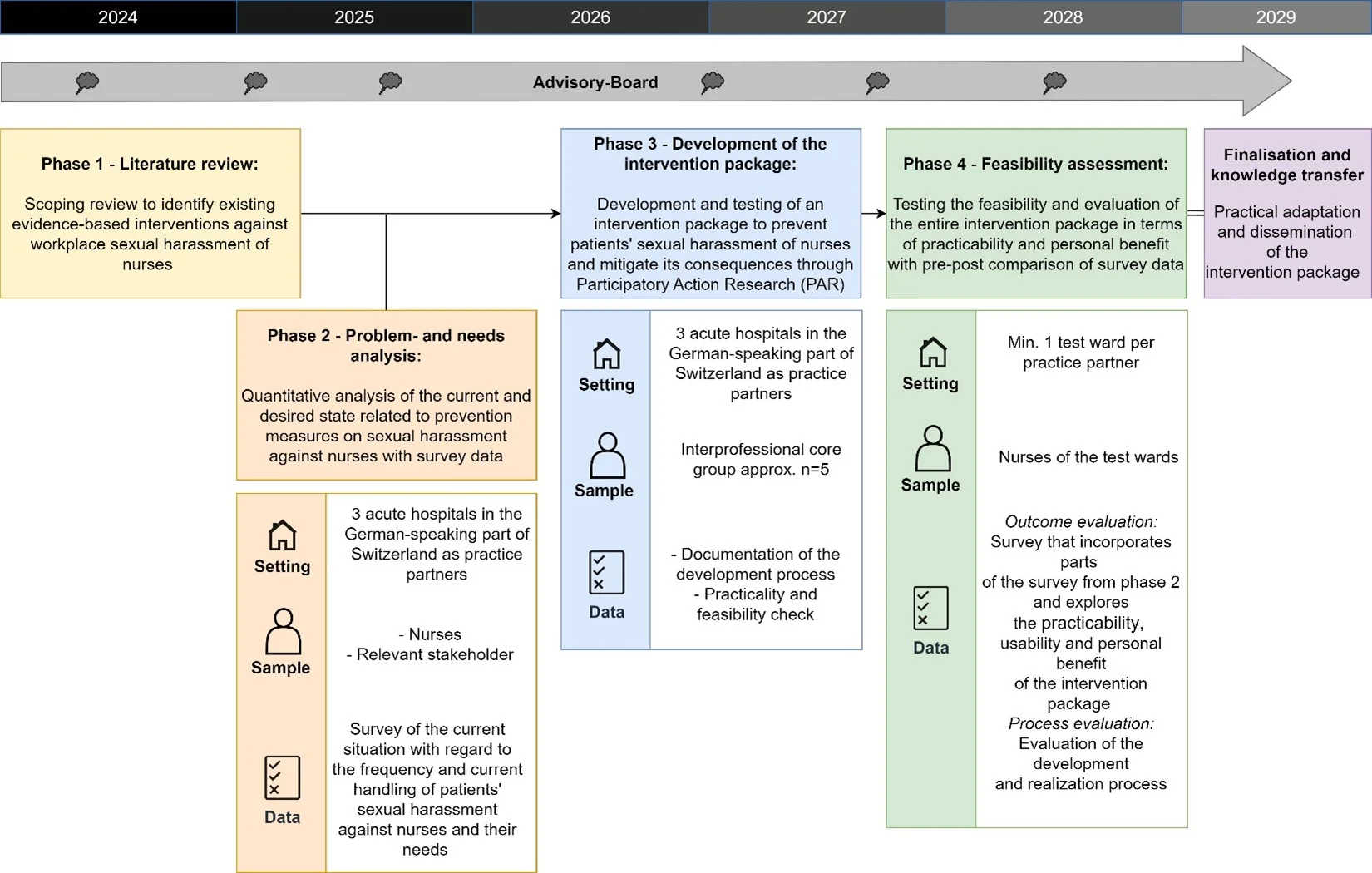
The second phase is dedicated to analysing the problems and needs of Swiss acute care organisations. In the third project phase, interventions against patients’ sexual harassment will be developed, tested and refined in collaboration with practice partners.
In the fourth phase, the feasibility and benefits of the entire intervention package will be assessed. Following the feasibility assessment, the intervention package will be further adapted and finalised in the sixth project year based on the evaluation results. This will be followed by a practical synthesis of the findings and a targeted knowledge transfer. The plan is to develop a user-friendly, practical digital action pathway for everyday nursing.
Results
By the end of the project, StopSH aims to deliver a practice-oriented and implementable intervention package against patients’ sexual harassment in acute care settings. In doing so, it will make an important contribution to promoting the occupational safety of nurses.
The project was launched in February 2024 and is currently in its second phase. Data analysis is underway, providing valuable insights for the next stages of the project. The first phase – a comprehensive scoping review – has been completed.
Results of project phase 1
Key findings of the literature review: Possible measures against sexual harassment described in the literature can be grouped into eight categories (see figure below). These measures target either the organisational or the individual level. Interventions that extend beyond a single institution and operate at the network level are not described in the literature. The results were published in a peer-reviewed scientific journal.

Explanations of the figure
- Approaches addressing organisational culture comprise measures that promote a respectful and appreciative working culture. These include a clear zero-tolerance policy towards any form of violence, as well as an open, transparent approach to sexual harassment.
- Approaches adapting infrastructure and working environment refer to measures and strategies designed to adapt working conditions and the working environment to counteract sexual harassment. Examples include adjustments of shift allocation, stress reduction and structural measures such as the presence of security staff.
- Approaches targeting leadership emphasise the central role of managers in preventing sexual harassment and mitigating its consequences. Their responsibilities include identifying instances of sexual harassment, supporting affected nurses during an incident, ensuring thorough documentation and consistently monitoring and reviewing the implemented measures.
- Guidelines as approaches are described in the literature as essential. Their existence can raise awareness of sexual harassment and improve access to support. However, it is not only important that such guidelines exist, but also that staff are appropriately trained accordingly.
- Reporting of incidents as approaches describe measures relating to the reporting of incidents. Whether through formal complaints, standardised reporting systems or verbal reports, it is central that incidents are documented to prevent further incidents. Furthermore, reports must be treated confidentially and with care.
- Approaches in education are the most frequently cited measures in the literature for tackling sexual harassment. Training courses for nurses help to increase their awareness and supports them in recognising, anticipating and preventing such situations, as well as intervening and responding more effectively. Regular training sessions are essential.
- Nurses’ approaches to reacting or coping include measures that those affected can use themselves to respond to or cope with sexual harassment more effectively. They include, for example, risk assessment, direct confrontation, avoidance or distancing, seeking support and self-reflection.
- Patient-centred approaches refer to strategies that can be specifically applied when working with patients who exhibit sexually harassing behaviour. These approaches take into account that such behaviour may stem from unmet or misunderstood patient needs. Measures include identifying and addressing potential needs, for example by ensuring privacy, adapting the care environment or using targeted communication.
Publications and reports
Bruschini, M. M., Nielsen, M. B. D., Naef, R., Schubert, M., & Quasdorf, T. (2025). Approaches to preventing workplace sexual harassment of nurses or minimising its adverse consequences: A scoping review. BMC Nursing. https://doi.org/10.1186/s12912-025-04179-2
Bruschini, M. M., & Schubert, M. (2025). Interventions to prevent sexual harassment against nurses—StopSH: Protocol for an intervention development study. JMIR Research Protocols, 14(1), e71425. https://doi.org/10.2196/71425
Bruschini, M. M., Quasdorf, T., & Schubert, M. (2024). Existing interventions to prevent workplace sexual harassment against nurses and minimise its negative consequences—A scoping review protocol. Open Science Framework. https://doi.org/10.17605/ OSF.IO/3QAPF
Bruschini, M. M., Hediger, H., & Busch, A.-K. (2023). Patients’ sexual harassment of nurses and nursing students: A cross-sectional study. International Journal of Nursing Studies Advances, 5, 100121. https://doi.org/10.1016/j.ijnsa.2023.100121
Michel, F. (2024). Vom Schweigen zum Handeln. Krankenpflege, 11(12), 12–16. https:// sbk-asi.ch/assets/PDF-Archiv/dbc7dabcf0/2411_DE_Hauptartikel_low.pdf
Conference papers and abstracts
Bruschini, Milena, 2025. Was hilft bei sexueller Belästigung gegenüber Pflegepersonen?. In: SBK Kongress 2025, Slot 21 Arena: Impulsreferat 2, Kursaal Bern, 08.05.2025
Bruschini, Milena, 2024. Problem sexuelle Belästigung gegenüber Pflegepersonen: was nun?. In: SBK Kongress 2024, Slot 16 Arena: Impulsreferat 1, Kursaal Bern, 03.05.2024
Bruschini, Milena, 2023. Sexuelle Belästigung. In: SBK ZH/GL/SH Webinarreihe, online, 6. Juli 2023.
Project organisation
Project lead
- Prof. em. Maria Schubert, ORCID Profile
Project team
- Milena Bruschini, Research Associate, ZHAW School of Health Sciences, Institute of Nursing
- Prof. Tina Quasdorf, Research Associate, ZHAW School of Health Sciences, Institute of Nursing
Project duration
- February 2023-November 2029
Project partners
Practice partners
Members of the StopSH Advisory Board, including representatives
- Swiss Professional Association of Nurses (SBK)
- Swiss Nurse Leaders (represented by Gabi Brenner)
- Federal Office of Public Health (FOPH) (represented by Brigitte Hofer)
- Belästigt.ch
- City of Zurich Office for Gender Equality (represented by Aner Voloder)
- Stopp-sexuelle-belästigung.ch
- Nurses and stakeholders from the acute care sector
University partners
Partnership
Project phases 3 and 4, the finalisation of the intervention package and its practical adaptation and distribution are being implemented by ZHAW School of Health Sciences as part of a partnership with the Swiss Association of Nurses (SBK) and the association Swiss Nurse Leaders.


Project funding
The Federal Office for Gender Equality (FOGE) is providing financial support for phases 3 and 4 of the StopSH project, including the finalisation, practical adaptation and dissemination of the intervention package.
