Master in Nursing
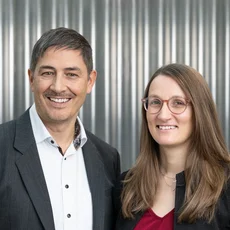
«In this Master's programme, students benefit from a close relationship between teaching and research.»
Prof. André Fringer and Prof. Veronika Waldboth, Co-Heads of the Master's degree programme in Nursing and Co-Heads of the Research Unit for Nursing
The Master of Science in Nursing prepares you for the diverse role of an Advanced Practice Nurse (APN). It opens new career opportunities in practice, management, teaching and research.
Five reasons for doing a Master’s degree programme at ZHAW
- The close relationship between applied research and teaching empowers you to improve health and quality of life of people affected by ill health and their families.
- Moreover, we work with students in co-creative ways, so you help develop ideas, implement projects and share a passion for nursing expertise and research.
- By studying alongside with students from other disciplines of the School of Health Sciences, you gain a comprehensive understanding of your profession.
- Additionally, guest lecturers from Switzerland and abroad help you expand both your national and international professional network.
- Consequently, a Master of Science (MSc) in Nursing enables you to anticipate and develop innovative solutions in clinical practice, research, teaching and management.
Advanced practice in nursing
With the MSc in Nursing, you gain advanced clinical knowledge as well as scientific skills for evidence-based practice, modern leadership, and research.
Consequently, the Master's programme prepares you for the multifaceted role of Advanced Practice Nurse (APN). As a Clinical Nurse Specialist (CNS) or Nurse Practitioner (NP), you analyse and manage highly complex situations using your expert knowledge.
In addition, you develop tailored solutions for patients and their families, thereby actively shaping care and healthcare change processes.
Individual career opportunities
We support your personal career path while strengthening your professional and methodological skills. Our flexible study structure enables individual study paths as well as personal goals.
With a Master of Science in Nursing, a wide range of career opportunities in clinical practice, research, teaching, and management become possible. Furthermore, the degree qualifies you for doctoral studies and opens new perspectives in research and teaching.
International orientation
With the international focus of our Master's programme, we encourage you to explore the APN roles, responsibilities and practice in an international context.
Furthermore, an internship abroad with partner schools around the world allows you to expand your international professional network.
Admission requirements
- Swiss Bachelor’s degree in Nursing
- Applicants without a Swiss Bachelor’s degree are considered in an equivalency procedure
- Good knowledge of English and German
Programme structure
The Master's programme in Nursing includes a basic course of study as well as a specialisation course. In the basic course, you expand your technical and methodological skills in research and advanced practice. Then, with your chosen specialisation, you focus on a specific area and prepare for your future role as an APN. Finally, you complete your studies with a Master's thesis, in which you conduct your own research project.
Some of the modules are taught jointly with other disciplines at the School of Health Sciences. As a result of this interdisciplinary programme, you sharpen your professional understanding and expand your skills in communication and collaboration with other professional groups.
The Master's programme can be completed full-time or part-time. Depending on your chosen specialisation, the programme lasts three, four or six semesters. Courses are taught in German and English.
Basic course
The modules in the basic course form the foundation of the Master's programme and are compulsory components. You take some of the modules together with students from other disciplines such as physiotherapy and midwifery.
The modules in the basic studies are divided into two module groups:
- Research Methods FOR
- Advanced Practice AP
Specialisation
You will choose your specialisation after receiving detailed guidance on APN roles. Accordingly, you choose one of the following specialisations:
- Research (FOR)
With this specialisation, you develop in-depth methodological skills, which comprehensively prepares you for the diverse role of an advanced practice nurse (APN). In this role, you will be able to make systematic, reflective, evidence-based decisions for the benefit of all those involved in care. Furthermore, you take responsibility for comprehensive and holistic care. - Clinical Nurse Specialist (CNS)
You gain knowledge that enables you to act as a member of the treatment team, offering evidence-based care and support with a systemic approach in complex situations and for vulnerable groups. In addition, you also strengthen your professional group and promote team well-being. - Nurse Practitioner (NP)
You acquire knowledge to independently and autonomously manage the care of a defined patient group, from assessment to treatment plan. Moreover, you integrate clinical skills from professional nursing and medicine so that you can care for and support chronically and acutely ill patients based on the latest evidence.
Elective modules
In addition to the basic course of study and your chosen specialisation, you can acquire further skills tailored to your individual goals by choosing elective modules. Specifically, there are four subject areas to choose from:
- Internship 3: International Experience APN
- Swiss Biodesign
- Advanced Practice Ethics Workshop
- Advanced Practice Training
Master’s thesis
The Master's thesis completes your Master's degree in Nursing. The thesis is an independent academic piece of work. It can be on a topic of your choice or a topic from the Research Institute of Nursing.
Double degree
As part of a double degree programme, students earn a second independent Master's degree from a partner university in a German-speaking country in addition to the MSc in Midwifery from ZHAW. Up to two-thirds of the studies at the home university will be recognised.
NEW: From autumn 2026, we will offer two new double-degree programmes with UMIT Tirol (subject to approval by both universities):
- Pflege- und Gesundheitspädagogik
- Pflege- und Gesundheitsmanagement
Students will complete 90 ECTS credits at ZHAW and 50 ECTS credits at UMIT Tirol, thereby obtaining a total of 140 ECTS credits with one Master’s thesis.
Diverse perspectives
A Master’s degree opens a wide range of opportunities in clinical practice, research, teaching, and management. In particular, your professional work may focus on one of the following areas in:
- specialised care for chronically ill people in acute inpatient, psychiatric, outpatient, or in long-term care institutions;
- basic care and support of sick people of all ages and their relatives in healthcare facilities and at home;
- prevention and health promotion, for example in schools, parental counselling, companies or addiction counselling;
- providing expert advice to nursing professionals and other healthcare groups in inpatient and outpatient care.

«Students are individually supervised based on an integrative approach of teaching, research and practice. They will become Advanced Practice Nurses who are developing and guiding sustainable professional nursing practice.»
Prof. Daniela Händler-Schuster, Professor of Community Nursing
PhD in Nursing
With a Master of Science degree, you build the foundation for a further academic career. The degree qualifies you for doctoral studies and expands your opportunities in research and teaching.
The PhD programme «Care and Rehabilitation Sciences» enables healthcare professionals to pursue a doctorate in Switzerland. You deepen your advanced knowledge and research methods at university level. Moreover, you design and conduct an independent research project.
At a glance
- Degree: Master of Science in Nursing UAS Zurich
- Workload: 90 ECTS credits
- Course structure: full-time or part-time
- Duration of study: three or four semesters (full-time), six semesters (part-time)
- Start of the course: September (calendar week 38)
- Registration deadline: Mai 31, 2026
- Location: Winterthur
- Language of instruction: German, partly English
- Tuition fees: CHF 720.– per semester plus additional study-related expenses. An additional CHF 500.– per semester for students whose place of residence is outside Switzerland at the start of their studies.