Research in Nursing
«In close collaboration with healthcare institutions, we develop research projects that answer questions related to everyday nursing care. With our clinical research, we contribute to the professionalisation of nursing practice.»
Prof. André Fringer and Prof. Veronika Waldboth, Co-Heads of the Research Unit for Nursing and Co-Heads of the Master's degree programme in Nursing
Research at the Institute of Nursing promotes clinical nursing practice through applied research and development projects. It focuses on providing optimal nursing care in hospitals, nursing homes and community settings.
Research is an integral part of the Institute of Nursing. We advance and strengthen clinical and professional nursing care, as well as informal care across the lifespan, from a nursing science perspective.
Practice-relevant research questions and the philosophy of Caring Communities guide our work. We conduct national and international projects in close collaboration with professional and interprofessional partners from research and clinical nursing practice.
Seeking new, creative, innovative and future-focused solutions to relevant clinical nursing problems is an essential component for us.
We use innovative approaches to develop solutions for healthcare locally, nationally and internationally. These approaches also support projects that advance nursing professionalization.
Key research subjects
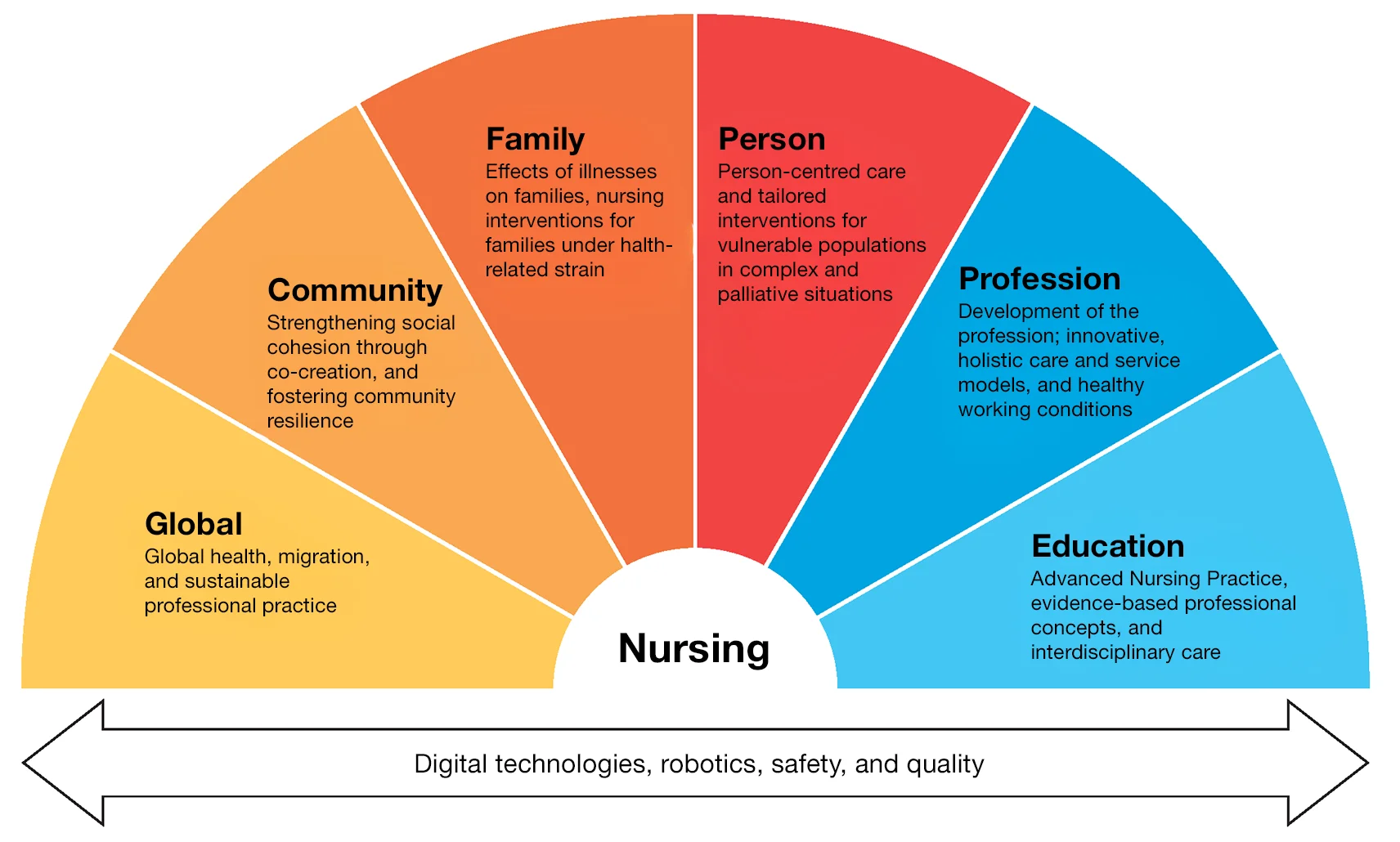
The research team at the Institute of Nursing strengthens clinical nursing practice by conducting applied research in six key areas: Global, Community, Family, Person, Profession and Education
Global
Our research topic Global explores how local health initiatives intersect with international developments. We analyse how innovative practices and empirical knowledge strengthen global health policy and the Sustainable Development Goals (SDGs).
We cover a wide range of topics, including mental health, health-related quality of life and burnout, child health and women's health. Here, we focus particularly on challenges related to menstruation and menopause.
Our work emphasises health promotion and healthcare delivery in conflict and disaster situations, aiming to make individuals, communities and health systems more resilient.
Moreover, we examine how international strategies are implemented locally to reduce inequalities in access to healthcare services and promote equitable health opportunities for all. Our goal is to gain global insights from local solutions and contribute to a fairer, more sustainable health world.
Community
Our research topic Community focuses on developing, implementing and evaluating care models tailored to people's daily realities. The goal is to achieve an integrated, socially embedded healthcare system based on person-centred approach, proximity, trust and empowerment.
We emphasise connecting health and social services while strengthening both individual and collective health resources. A key approach is Co-Creation, whereby citizens, professionals and local stakeholders collaborate equally to develop solutions for better healthcare. This approach fosters social cohesion and community resilience.
Among other things, we investigate how individuals can be best supported in stressful life situations and how neighbourhood care can be organized effectively. Professional roles, such as Advanced Practice Nurses, are crucial in supporting this approach.
Our projects use qualitative, quantitative and participatory research methods to address challenges like loneliness, language barriers, restricted mobility and limited access to public areas.
Project examples: Community
- Einsamkeit und soziale Isolation bei älteren Menschen – gemeindebasierte Intervention für nachhaltige Unterstützung und verbesserte Lebensqualität (in German)
- Decision-making processes for assessing the stability of living situations in residencies for the elderly – Development of a decision-making tool (StAWo)
- GeHör – Forschungsprogramm für hörbare Gesundheit, Resilienz und Community Health (in German)
Family
The research topic Family examines how illness, accident-related consequences, disabilities and life-changing events – like birth or death of a loved one – affect families and their individual members.
We also explore how nurses can support families in their daily lives. Our aim is to alleviate suffering and strengthen family resilience and well-being. In this context, family includes everyone people consider emotionally close, regardless of biological or social ties.
A distinctive element of our research is work in a real-world laboratory. There, nursing experts offer therapeutic conversations for families and individuals under stress (facing difficulties). With participants’ consent, we observe and record these conversations to gain practice-based insights.
Project examples: Family
Person
Our research topic Person focuses on person-centred care and support, with particular attention paid to vulnerable population groups. These groups include children and young people, individuals facing age-related limitations, frailty, dementia, and individuals with rare diseases.
Our research addresses complex and palliative situations across inpatient acute, long-term as and community care settings. A holistic, needs-based approach to the individual is instrumental to our research.
We develop person-centred outcome measures that capture symptoms, concerns, outcomes and healthcare needs through innovative research methods. These measures form the basis for targeted and personalised interventions. In addition, we develop, implement and evaluate evidence-based concepts and approaches in person-centred care. The guiding principle of our work is honouring the uniqueness of every individual and their specific life situation.
Project examples: Person
- Care for patients with neuromuscular disorders in Switzerland (Care-NMD-CH)
- End-of-life fasting
- Electronic PerSon-cENtred care and Specialized Palliative Care for people with dementla: lmproving the quality of life with Outcome guided Recognition and assessment of relevant Symptoms, neeDs and care issues (eSENIORS) (in German)
- Organisational capacity building on person-centred dementia care – Development of a toolbox for nursing homes (PromPCdC)
- SENIORS-D
Profession
The research topic Profession focuses on advancing the academisation and professionalisation of nursing. A key focus is the development of new nursing roles, particularly in Advanced Nursing Practice.
Our research strengthens nursing practice through innovative, holistic nursing care and health service models.
Additionally, we examine how to improve the attractiveness of the nursing profession and increase the retention rates. This includes providing a safe and healthy work environment, ensuring adequate nursing staffing levels and delivering an appropriate quality of nursing care.
Furthermore, we develop, implement and evaluate targeted interventions to prevent potentially adverse events. These include patient risks such as delirium and workplace challenges such as emotional exhaustion or sexual harassment.
Education
Our research topic Education focuses on evaluating Advanced Nursing Practice (ANP) and the associated Advanced Practice Nurses (APN) roles. We focus on developing necessary advanced clinical skills in students enrolled in the Master of Science programme, which are required for the implementation of APN roles.
Through interprofessional and interdisciplinary research projects, we generate evidence-based professional and interprofessional concepts, as well as interdisciplinary healthcare for high-quality and sustainable healthcare.
Project examples: Education
What we offer
We advise, guide, and support practice partners, clients, and institutions in:
- Research projects in institutions
- Development, implementation, and evaluation of care and service solutions
- Monitoring and evaluation of quality development projects
- Development, implementation, and evaluation of evidence-based concepts and action-guiding documents
- Moderation, coaching, and counselling in communication processes
- Further and continuing education programmes
- Teaching assignments and individual courses
- Development, implementation, and evaluation of advanced nursing roles and services (Advanced Nursing Practice)
Projects and publications
All research projects and publications of the Institute of Nursing are listed in ZHAW project and publication databases, organized by start date or publication date.
Clients and research partners
We develop solutions tailored to the needs and problems of our practice partners and clients. For this purpose, we use a wide range of quantitative and qualitative research methods and other tools.
We offer modern infrastructure and a wide range of skills. In addition, we are able to draw on an interdisciplinary network within ZHAW as well as our close ties with international experts in various subject areas. We collaborate with research teams in Occupational Therapy, Midwifery, Physiotherapy and Public Health.
Our research team
The Research and Development team at the Institute of Nursing employs professionals with a doctorate in nursing science as well as research associates and assistants with practical and research experience in Switzerland and abroad.