What influence does mobility have on community participation and health of persons with disabilities?
This project investigates the meaning of mobility in relation to community participation and health of persons with disabilities in Switzerland and compares the situation with that of persons without disabilities. The findings serve as a basis for policy options.
Situation
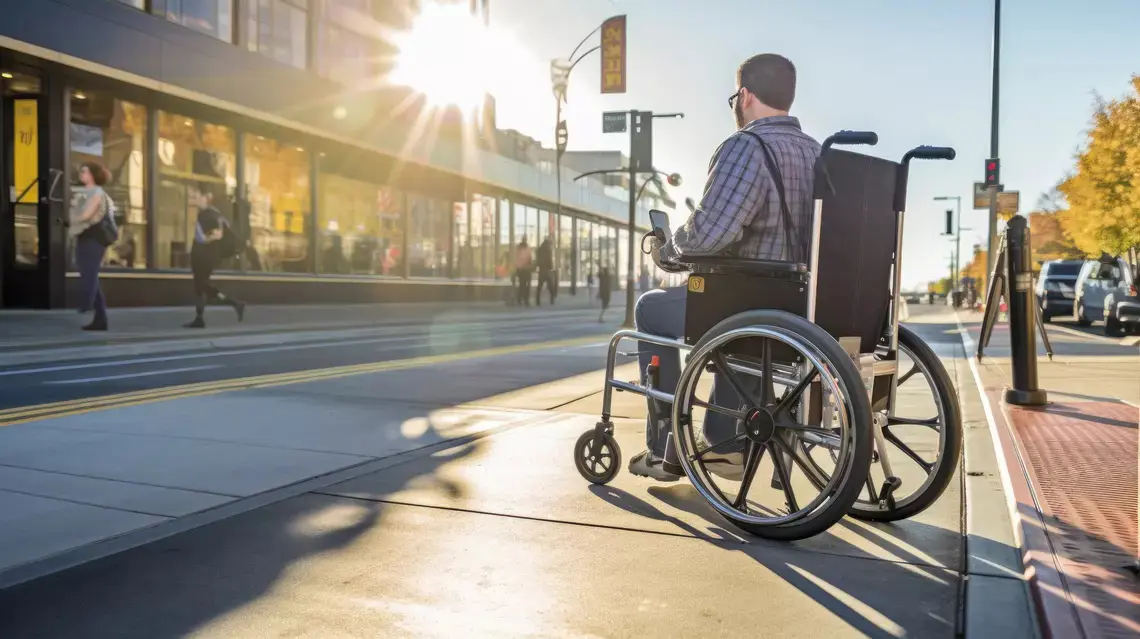
Persons with disabilities face inequalities due to barriers that restrict their participation in community activities and access to places. Mobility is an important prerequisite of community participation and health of persons with and without disabilities.
In Switzerland, political aims to make public transport accessible by the end of 2023 were not met. A study led by the Research Unit of Occupational Therapy also showed that public transport services are not available or accessible to all those affected in Switzerland and that their activities in the community are restricted.
There are no studies that examine the community participation of persons with disabilities in relation to mobility, health, and satisfaction, especially in comparison to those without disabilities.
Objective
The research objective is to provide evidence and policy options regarding mobility, community participation, and health of persons with and without disabilities in Switzerland.
The specific aims are:
- Assess differences between persons with and without disabilities in terms of visiting frequencies to important places, variety of transportation modes, level of community participation, satisfaction and quality of life.
- Examine how the frequency of visiting important places and the use of different transportation modes correlate with self-rated community participation and satisfaction for persons with and without disabilities
- Identify factors that hinder or support community participation and mobility for persons with disabilities, including personal perspectives on transportation needs.
- Develop and validate policy options and tailor them to the Swiss federal context to increase persons with disabilities community participation in relation to their needs.
Method and approach
We employ a mixed method-design, implementing qualitative and quantitative studies across all parts of Switzerland, using research methods such as narrative interviews, photovoice and nationwide surveys. Participants for the studies include persons 18 years of age and above with disabilities and/or chronic conditions.
The online survey is currently underway – take part!
Results
Qualitative Interviews
Over a one-year period, 25 persons with different disabilities and/or chronic conditions were interviewed about their mobility and community participation—both at home and while on the move.
Initial analysis results indicate that persons with disabilities and/or chronic conditions experience multiple forms of dependency in relation to their mobility and participation. For example, they often rely on support and understanding from others, as well as on the availability of accessible infrastructure. The full results are currently being compiled into a publication and will be submitted for publication in summer 2026.
Narrative Analysis
For three of the 25 interviews, the researchers additionally conducted an in-depth narrative analysis. Using the same method, three persons in South Africa were also interviewed. The researchers examined the experiences of persons with disabilities and/or chronic conditions while moving through their environments in two different contexts. An article presenting the results has been submitted to the Journal of Occupational Science.
Photovoice Study
From autumn 2026 to spring 2027, persons with disabilities and/or chronic conditions will document their mobility and community participation through photography in two regions of Switzerland. During group meetings, they will discuss their photographs, develop narratives, and jointly plan a public photo exhibition.
Initial findings show how complex and multifaceted the mobility experiences of persons with disabilities and/or chronic conditions are. At the same time, the study provides valuable insights into the implementation of the Photovoice method, which the researchers continue to analyze further.
Reports and news
- Umfrage zu Mobilität und gesellschaftlicher Teilhabe – jetzt mitmachen Web news, January 2026 (in German)
- Der lange Weg zur Barrierefreiheit article Vitamin G 1-2025 (in German)
- «Mehr Teilhabe im öffentlichen Raum» article ZHAW Impact 2-2024 (in German)
- Menschen mit Mobilitätseinschränkungen für Studie gesucht Web news, June 2024 (in German)
ZHAW Publikationendatenbank
-
Gantschnig, Brigitte,
2025.
In:
PhD Programm Santé, Médecine et Société, Université de Neuchatel, Switzerland, 10 November 2025.
Project organisation
- Project lead
Prof. Dr. phil. Brigitte Gantschnig, Leiterin Forschung und Entwicklung Institut für Ergotherapie ZHAW
Prof. Dr. Isabel Margot-Cattin, Professor Haute école de travail social et de la santé HES-SO - Projekt period
2024 - 2028 - Project team
Prof. Dr. Staffan Josephsson, Docent Karolinska Institutet
Prof. Dr. Ann-Helen Patomella, Senior Lecturer Karolinska Institutet
Dr. Sarah Mantwill, Research Manager Swiss Learning Health System (SLHS)
Sara Frey, Ergotherapeutin MSc, Doktorandin
Clémence Orain, Ergotherapeutin MSc, Doktorandin
Dr. Selina Egger, Ergotherapeutin MSc - Projekt partners
Haute École Spécialisée de Suisse Occidentale HES-SO
Karolinska Institutet
Schweizerische Bundesbahnen SBB
Pro Infirmis
Fussverkehr Schweiz
BETAX Genossenschaft
Association Transport Handicap Vaud
Sensability
Swiss Learning Health System SLHS, Universität Luzern
Eidgenössisches Büro für die Gleichstellung von Menschen mit Behinderungen EBGB - Funding
Schweizerischer Nationalfonds SNF (Project Nr. 220493) - Project status
ongoing