ZHAW CAI Launches Its First Humanoid Robot Innosuisse Project
The ZHAW Centre for Artificial Intelligence (CAI) has launched the first Innosuisse project at ZHAW built around humanoid robots. With a budget of over CHF 1.1 million, the project brings AI-driven humanoid automation to hospital sterilization departments, a demanding and understaffed environment. It is led by Dr. Jorge Peña Queralta, Head of the Embodied Mobile Agents group.
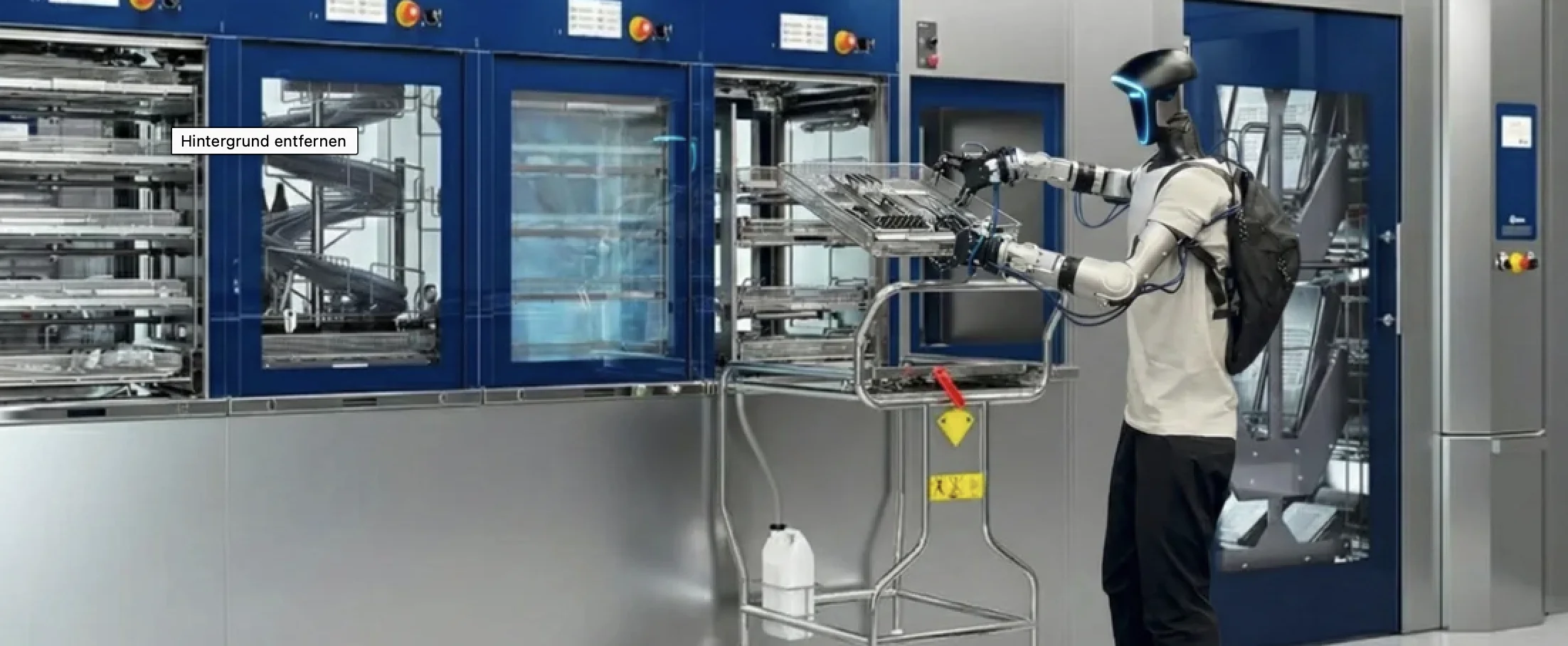
The ZHAW Centre for Artificial Intelligence (CAI) has launched its first Innosuisse Innovation Project centred on humanoid robots, the first project of its kind at ZHAW. Started in May 2026 with a total budget of over CHF 1.1 million (CHF 1’140’809), it is led by Dr. Jorge Peña Queralta, Head of the Embodied Mobile Agents research group , together with Dr. Giovanni Toffetti from the Institute of Computer Science (InIT).
The project targets one of the least visible but most demanding corners of a modern hospital: the Central Sterile Supply Department (CSSD). This is where every reusable surgical instrument is collected after an operation, decontaminated, inspected, reassembled into trays, and sterilized before it returns to the operating room. A single hospital processes thousands of instruments every day, and the work is split between an “unclean” side, where contaminated containers arrive, and a “clean” side, where sterile trays are assembled. The two sides are kept strictly separate to prevent cross-contamination.
These tasks are repetitive, physically heavy, and carried out in a warm, contamination-prone setting. This is exactly the kind of work hit hardest by Europe’s shortage of more than a million healthcare workers. Conventional automation such as conveyors and automated guided vehicles cannot manage the fine, varied handling these workflows demand. Humanoid robots are a natural fit here, because the department was designed around the human body and human tools in the first place.
Together with industry partner Steelco Belimed, the team will bring AI-powered humanoid robots into this environment and teach them to autonomously handle surgical instruments and sterile containers across two concrete use cases: moving and handling containers on the unclean side, and assembling instrument trays on the clean side. Rather than hard-coding every movement, the project combines modern robotic foundation models with agentic AI, so the robot can perceive its surroundings and adapt on the fly. The approach will be validated through pilots in real hospital environments.
This milestone underlines the CAI’s ambition to turn Physical AI into tangible, real-world impact, and it complements the group’s broader engagement in initiatives such as the Davos Tech Summit.