Global warming: regional networks strengthen resilience and future viability
A study undertaken by the School of Architecture, Design and Civil Engineering together with the architectural practices HILDEBRAND and ITER uses three Swiss case studies to demonstrate how timber can bring together economic value creation, ecology and building culture.
This year’s summer has made the impact of global warming very tangible. Adaptation and the consistent reduction of CO₂ emissions are urgently needed. The construction sector and buildings are responsible for around 37% of global CO₂ emissions and thus represent a key lever for achieving Switzerland’s net-zero target by 2050. However, the necessary transformation will not be achieved through a single product, technology or building. It will emerge where people, landscapes, resources, companies, knowledge and infrastructure interact and form viable systems.
Holz als gemeinsames Kapital
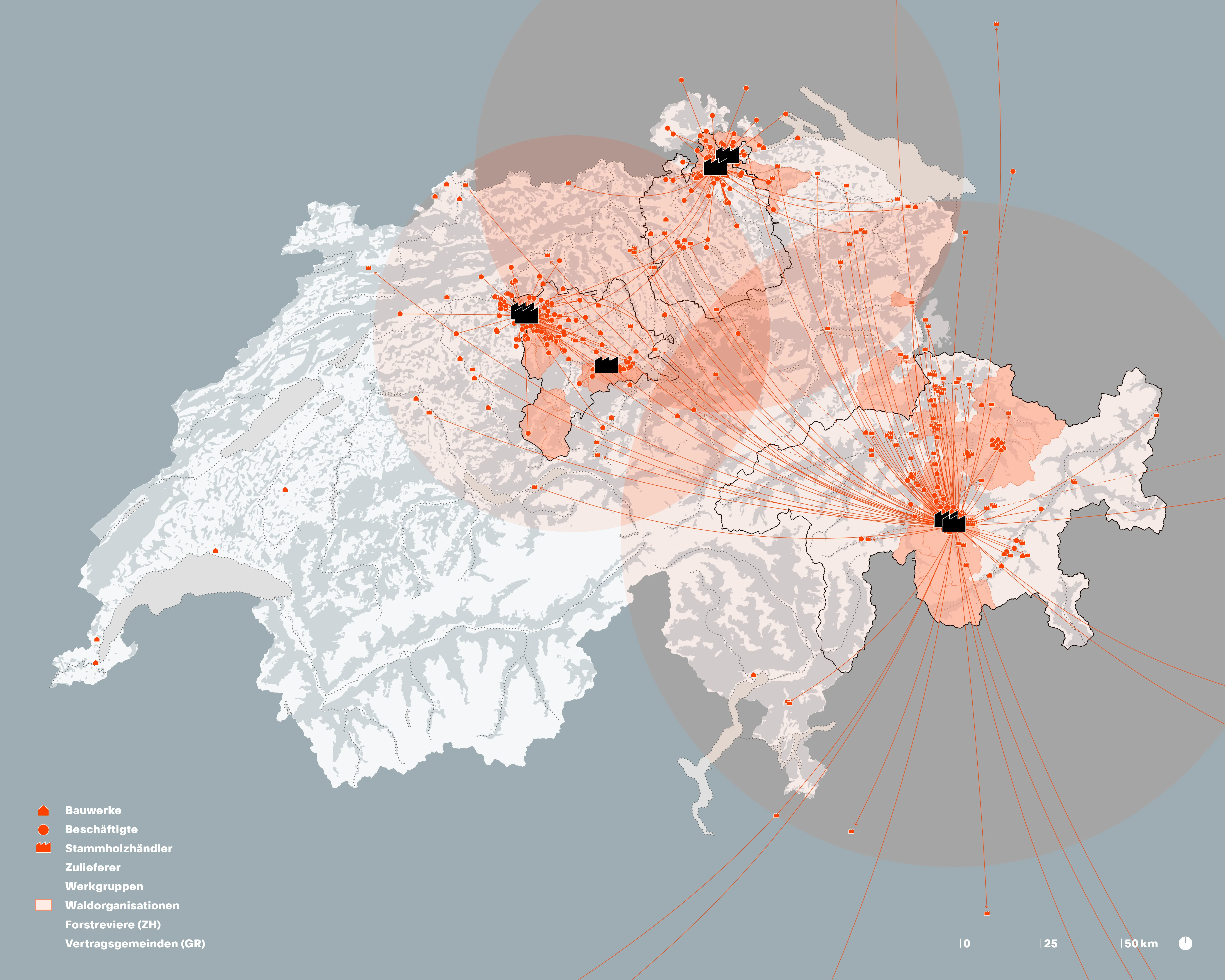
The “MEHRwert HOLZ – value creation in the timber industry” study, supported by the Wood Action Plan of the Federal Office for the Environment (FOEN), investigates how such relationships already function in three Swiss regions and what potential they hold for the future. The study focuses on schaerholzbau ag in the canton of Lucerne, Robert Schaub AG in the canton of Zurich and Uffer Holz AG in the canton of Graubünden. Following timber from the forest to the completed building, it shines a light on the wide range of relationships along this value chain.
Good solutions for all stakeholders emerge when we understand interconnections, recognise needs and develop a clear narrative on this basis. A project is like a game of chess: think strategically, maintain an overview and remain flexible at the same time.” Enrico Uffer, UFFER GROUP, Savognin GR
Five visions for the economy and the landscape
Five visions for the economy and the landscape
Drawing on existing strategies and relationships, the study identifies five visions. They illustrate how economies and regions can be transformed when resources, production, landscape and society interact.
1 Timber as a shared asset – Regional networks combine raw materials, processing, knowledge and employment. A large proportion of the projects, employees, raw materials and partners of the companies studied are located within a radius of around 10 to 25 kilometres, while some relationships extend beyond 50 kilometres. In this way, timber becomes a connecting element between the landscape, economy and society.
2 Linking nature, production and living environments – Uffer Holz AG demonstrates how forests, forestry enterprises, municipalities, processing and utilisation can be connected. By collaborating with Resurses SA, the associated sawmill, and the establishment of long-term supply agreements, the company strengthens regional processing capacities. A significant share of value creation remains within the region.
3 Valorisation creates new circular systems – Residual products from forests and processing are converted into energy, biochar or new materials. Since 1984, the woodchip heating plant operated by Robert Schaub AG in Andelfingen has supplied a growing district heating system with residual timber from the company and woodchips sourced from local forestry operations. In this way, valorisation generates regional value creation.
4 Building culture as part of the regional network – A building does not begin on the construction site. It forms part of a network comprising forests, people, companies, materials, energy, infrastructure and cultural context. Architects can act as intermediaries between stakeholders, connect resources and bring building materials together. Architecture makes regional relationships visible and enhances existing potential.
5 Sharing knowledge as a resource – Resilient systems arise from the ability to connect knowledge and apply it collectively. schaerholzbau ag exemplifies this as a pioneer in digital innovation. Working together with research and planning partners, the company combines traditional craftsmanship with technologies such as business information modelling and mixed reality and continuously develops its planning and production processes.
Regional networks as a model for the future
The five visions point towards greater economic, ecological, social and cultural sustainability. Timber building culture becomes a connecting force between people, resources, knowledge and production, creating space for innovation. Strong networks and collective action can thus provide the foundation for resilient systems that are fit for the future.
Contact
- Tibor Joanelly, Head of Communication, ZHAW School of Architecture, Design and Civil Engineering, +41 58 934 67 19, tibor.joanelly@zhaw.ch
- Thomas Hildebrand, lecturer at the School of Architecture, Design and Civil Engineering, Partner at HILDEBRAND, Wasserwerkstrasse 129, 8037 Zurich, +41 44 350 24 32, thomas@hildebrand.ch