AIT Nepal 2026/27: Target-aware de novo design of anti-cancer peptides via multi-objective guided flow matching
Meet Anup Dhakal, one of the ten participants in the 2026/27 edition of the Academia-Industry Training Nepal program.
Interview with Anup Dhakal
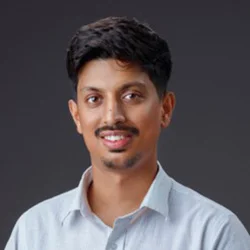
“My work uses artificial intelligence to design novel and more effective anti-cancer peptides, allowing researchers to identify promising drug candidates much faster and at a significantly lower cost before they enter the laboratory.”
What problem does your startup solve, and why is it important to you personally?
My research addresses one of the biggest challenges in cancer treatment: the slow, expensive, and inefficient process of discovering new drugs. Current approaches often rely on multi-million-dollar, years of trial-and-error laboratory testing, while existing treatments can cause severe side effects by damaging healthy cells along with cancer cells. My work uses artificial intelligence to design novel and more effective anti-cancer peptides, allowing researchers to identify promising drug candidates much faster and at a significantly lower cost before they enter the laboratory.
What inspired you to become a sciencepreneur, and what has been your biggest “aha!” moment so far?
What inspired me to become a sciencepreneur was the belief that research should not end with a publication, it should create real impact. As an engineer, I saw how powerful technology can be when applied to real-world problems. At the same time, I witnessed how diseases like cancer continue to claim lives because developing new treatments is slow, expensive, and inaccessible for many people. I wanted to build solutions that move beyond the laboratory and reach patients who need them the most. I found out that artificial intelligence could do more than analyze medical data, it could help create entirely new drug candidates such that we could replace much of the costly trial-and-error process with intelligent computational design.
What unique perspective does your academic background bring to your startup?
My academic background in Artificial Intelligence and Computer Engineering allows me to combine AI with computational biology to solve complex healthcare problems. It allows me to design anti-cancer peptides using AI instead of relying only on slow, expensive laboratory experiments. This unique perspective enables our project to develop faster, safer, and more affordable solutions for future cancer therapies.
What’s one surprising lesson you’ve learned since launching your startup?
It was realizing that the real bottleneck isn't the lack of good ideas, it’s turning those ideas into solutions that people can actually use. A breakthrough only matters if it reaches the people who need it.
If you could host a dinner with three innovators (past or present), who would they be and why?
I would invite David Baker, Demis Hassabis, and Andrej Karpathy. Baker is redefining protein design, Hassabis is proving that AI can transform scientific discovery, and Karpathy inspires by making AI simple, practical, and accessible. I would love to explore how AI and biology can work together to solve humanity’s toughest healthcare challenges and learn how to turn ambitious ideas into technologies that improve millions of lives.