AIT Nepal 2026/27: Eagleshot
Meet Noel Frey, one of the ten participants in the 2026/27 edition of the Academia-Industry Training Nepal program.
Interview with Noel Frey
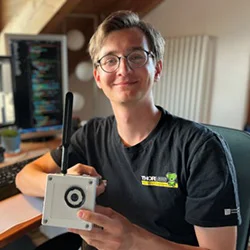
“Climate change is making natural hazards in mountain regions more frequent and more destructive. Yet most threatened sites are never monitored, because monitoring systems are too expensive to be deployed widely. With Eagleshot, we want to close that gap: affordable, reliable monitoring for every site that needs it – not just the few that can afford it.”
What problem does your startup solve, and why is it important to you personally?
Climate change is making natural hazards in mountain regions more frequent and more destructive. Yet most threatened sites are never monitored, because monitoring systems are too expensive to be deployed widely. This became real for me when a rockslide hit a mountain road shortly after I had driven through it. With Eagleshot, we want to close that gap: affordable, reliable monitoring for every site that needs it – not just the few that can afford it.
What inspired you to become a sciencepreneur, and what has been your biggest “aha!” moment so far?
I grew up in the Engadin, watching the Morteratsch glacier retreat. When glaciologists from ETH Zurich needed new glacier-monitoring cameras, I took it on as my bachelor thesis – my passion for photography and nature made it a perfect fit. Realizing no comparable system existed, I decided to start Eagleshot. My “aha!” moment came from our own data: I knew glaciers were melting fast – but seeing how fast, with images from your own sensor, is shocking.
What unique perspective does your academic background bring to your startup?
My background is in photonics – the science of light – a field between physics, electronics, and engineering. Working across these disciplines taught me to think in whole systems: from the image sensor to hardware that survives extreme cold and software that runs unattended for months, all while staying affordable. What photonics didn’t teach me, my previous startup experience did: good products come from understanding your users – so we develop hand in hand with the scientists using our systems.
What’s one surprising lesson you’ve learned since launching your startup?
Building a first prototype was relatively easy – making it survive months alone on a glacier was hard, especially while staying affordable. You can’t just hike up to fix things; one failure means months of lost data. So we spent countless hours testing and refining the design. Today, ten cameras have run for over two years through snow, rain, and cold – one was even hit by an avalanche and kept sending images like nothing happened.
If you could host a dinner with three innovators (past or present), who would they be and why?
There are too many I’d love to meet, but if I had to pick three: Demis Hassabis, who shows how science and entrepreneurship can reinforce each other at the highest level; Nikola Tesla, a genius who struggled to commercialize his inventions; and Isaac Newton, one of the greatest scientific minds of all time – whose experiments on light laid the foundations of my field. I’d ask how they brought their ideas to life – and what they’d do differently today.