AIT India 2026/27: SIMORGH Sarl
Meet Seyyedmaalek Momeni, one of the ten Switzerland-based participants in the 2026/27 edition of the Academia-Industry Training India program.
Interview with Seyyedmaalek Momeni
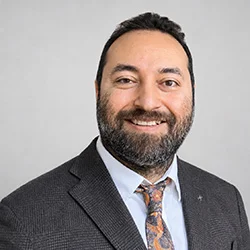
“Critical infrastructure rarely fails without precursors, yet conventional monitoring often misses weak early signals or cannot detect and localize them fast and precisely enough. SIMORGH turns crack- and damage-related signals into near-real-time, actionable insights, helping operators identify where damage starts, how it evolves, and what drives it.”
What problem does your startup solve, and why is it important to you personally?
Critical infrastructure rarely fails without precursors, yet conventional monitoring often misses weak early signals or cannot detect and localize them fast and precisely enough. SIMORGH turns crack- and damage-related signals into near-real-time, actionable insights, helping operators identify where damage starts, how it evolves, and what drives it. This is personally important to me because I have spent over 17 years in microseismic monitoring and want to translate that scientific expertise into technology that can help prevent infrastructure failures.
What inspired you to become a sciencepreneur, and what has been your biggest “aha!” moment so far?
What inspired me was seeing that years of scientific research could create much greater impact when translated into a technology used in the field. My biggest “aha!” moment was realizing that the same core technology we developed for precise microseismic monitoring could address problems far beyond our original research applications – from mines and dams to bridges and landslides. That realization transformed SIMORGH from a research outcome into a scalable platform for monitoring critical infrastructure.
What unique perspective does your academic background bring to your startup?
My academic background in seismology and more than 17 years of experience in microseismic monitoring gives me a deep understanding of both the physics behind damage signals and the limitations of existing monitoring methods. Working at the intersection of research and field applications taught me to approach infrastructure monitoring from first principles. This perspective helped us develop technology that combines scientific rigor with the speed, automation, and scalability required for real-world deployment.
What’s one surprising lesson you’ve learned since launching your startup?
One surprising lesson has been that building great technology is only part of building a successful deep-tech startup. Since launching SIMORGH, I have learned how important it is to understand each customer’s specific operational problem and demonstrate value through focused pilots. The technology may be applicable across many sectors, but adoption starts with solving one concrete problem for one customer. This has shaped our strategy: start with pilots, prove value, then scale toward long-term portfolio monitoring.
If you could host a dinner with three innovators (past or present), who would they be and why?
I would choose Leonardo da Vinci, Richard Feynman, and Steve Jobs. Da Vinci for his extraordinary ability to connect science, engineering, and imagination; Feynman for his way of reducing complex problems to their fundamental principles; and Jobs for understanding how sophisticated technology can become a simple, compelling product. I would be fascinated to discuss how they each moved between deep understanding, creativity, and practical impact – exactly the intersection that motivates me as a sciencepreneur.