AIT India 2026/27: PanTELL platform by Arcuria
Meet Denis Cmunt, one of the ten Switzerland-based participants in the 2026/27 edition of the Academia-Industry Training India program.
Interview with Denis Cmunt
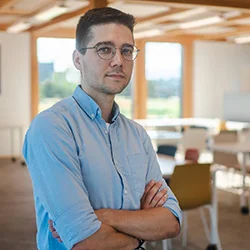
“PanTELL develops cancer therapies that can work for a wider range of genetic backgrounds. By building safety testing into the discovery process from the start, we aim to create treatments faster and reduce the risk of harmful effects.”
What problem does your startup solve, and why is it important to you personally?
One promising type of cancer immunotherapy is designed for one common genetic type, leaving most people worldwide without access to these treatments. PanTELL develops cancer therapies that can work for a wider range of genetic backgrounds. By building safety testing into the discovery process from the start, we aim to create treatments faster and reduce the risk of harmful effects. This matters to me because cancer breakthroughs should benefit all patients, not only those whose genetics fit today’s narrow pipeline.
What inspired you to become a sciencepreneur, and what has been your biggest “aha!” moment so far?
From the beginning of my scientific journey 15 years ago, I wanted my work to have a real-world impact and help people. When my PhD project showed clear potential to translate into patient benefit, it inspired me to pursue entrepreneurship. My biggest “aha!” moment came when I realized we could explain our complex science without jargon by focusing on its human impact: making advanced cancer immunotherapies accessible to patients from a wider range of genetic backgrounds.
What unique perspective does your academic background bring to your startup?
Our technology comes directly from my PhD work, so my academic background is at the heart of PanTELL. I learned to see a therapeutic challenge as more than a scientific puzzle. It must also be safe, practical to develop, and meaningful for patients. Research trained me to work carefully with uncertainty, question assumptions and turn complex problems into testable steps. This mindset helps us develop rigorous science while keeping our goal clear: safer cancer therapies for more people.
What’s one surprising lesson you’ve learned since launching your startup?
A key lesson has been that there is no single “right” path to build, finance, or scale a startup, especially in biotech. Companies reach the same destination through very different combinations of grants, partnerships, venture capital, licensing, and organic growth. It is important to learn from these examples and speak with people who have navigated them, without prematurely committing to one model. The real skill is staying informed and adaptable, then recognizing the right opportunity when it appears.
If you could host a dinner with three innovators (past or present), who would they be and why?
I would invite Katalin Karikó, Alan Turing and Jane Goodall. Beyond their achievements, I imagine they could make very good dinner company: curious, thoughtful and hopefully funny. Karikó for her persistence with an unfashionable idea; Turing for his imagination and because his life is a reminder that innovation needs an inclusive society; and Goodall for her stories from the wild. I would hope for an evening of sharp questions, surprising stories and smart jokes.