Research findings of CAI staff have potential to impact cancer diagnosis globally
The result of the BSc Thesis "Deep-learning-based Cell Segmentation for Rapid Optical Cytopathology of Thyroid Cancer" by Martin Oswald and Tenzin Langdun has been accepted as a paper in Nature's Scientific Reports
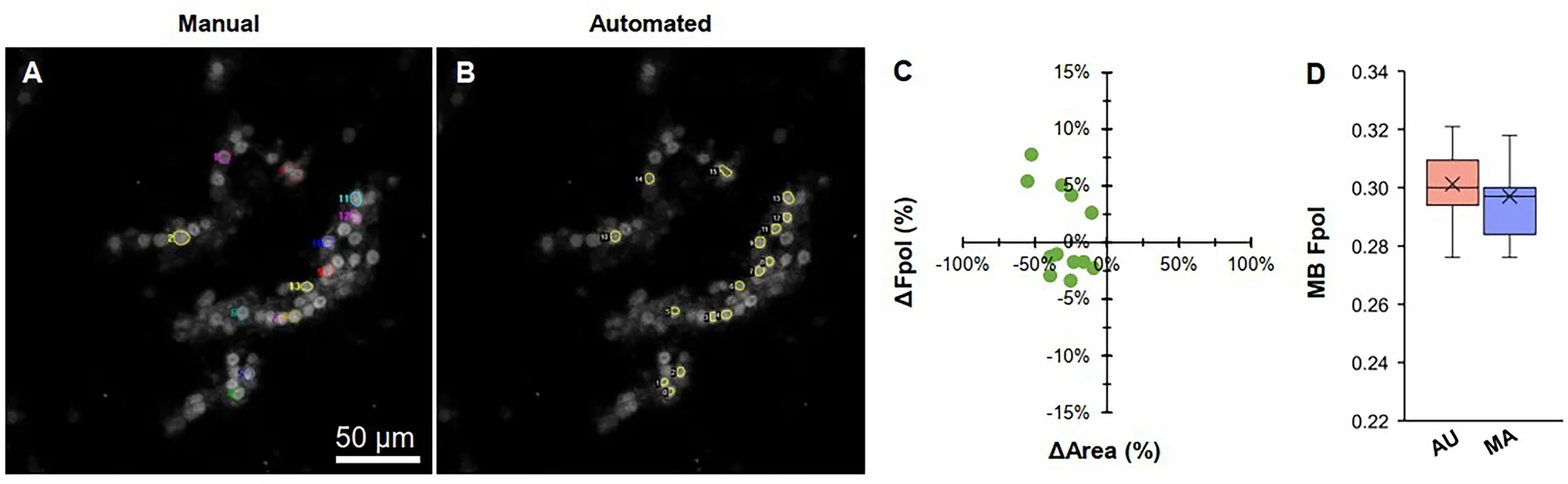
To put the possible impact into perspective: When Dr. Ahmed Abdulkadir was giving a talk on the topic at a recent medical conference in the US, a professor from Harvard came and told him, "This has the potential to change medical practice around the globe on how we diagnose cancer - in every doctor's practice".
The abstract reads as follows: "Fluorescence polarization (Fpol) imaging of methylene blue (MB) is a promising quantitative approach to thyroid cancer detection. Clinical translation of MB Fpol technology requires reduction of the data analysis time that can be achieved via deep learning-based automated cell segmentation with a 2D U-Net convolutional neural network. The model was trained and validated using images of pathologically diverse human thyroid cells and evaluated by comparing the number of cells selected, segmented areas, and Fpol values obtained using automated (AU) and manual (MA) data processing methods. Overall, the model segmented 15.4% more cells than the human operator. Differences in AU and MA segmented cell areas varied between -55.2% and +31.0%, whereas differences in Fpol values varied from -20.7% and +10.7%. No statistically significant differences between AU and MA derived Fpol data were observed. The largest differences in Fpol values correlated with greatest discrepancies in AU versus MA segmented cell areas. Time required for auto-processing was reduced to ~10 seconds versus one hour required for MA data processing. Implementation of the automated cell analysis makes quantitative fluorescence polarization-based diagnosis clinically feasible."
Congratulation not only on a fantastic paper but changing the medical world for the better!