Towards quieter and cleaner skies: unravelling spray-flame-accoustic coupling in aircraft engines operated on sustainable aviation fuels (SPARC)
Sustainable aviation fuels can significantly reduce the climate impact of aviation. This project is investigating how these fuels affect the stability and safety of aircraft engines.
Description
Human activities such as energy production, transport and industry have greatly increased the amount of carbon dioxide (CO₂) in the atmosphere since the industrial revolution. This contributes to climate change, including rising temperatures, extreme weather events, melting glaciers and rising sea levels. Aviation is particularly difficult to de-carbonize because long-distance flights require fuels with very high energy density. Electrification and hydrogen-powered aircraft are unlikely to provide a practical solution for large long-haul aircraft in the near future.
Sustainable aviation fuels (SAFs) offer an important solution for reducing the climate impact of aviation in the coming decades. SAFs can be produced from renewable biological resources or through synthetic processes and can significantly reduce greenhouse-gas emissions over their life cycle. However, SAFs can differ from conventional jet fuel in their physical and chemical properties, which may affect how they burn in aircraft engines.
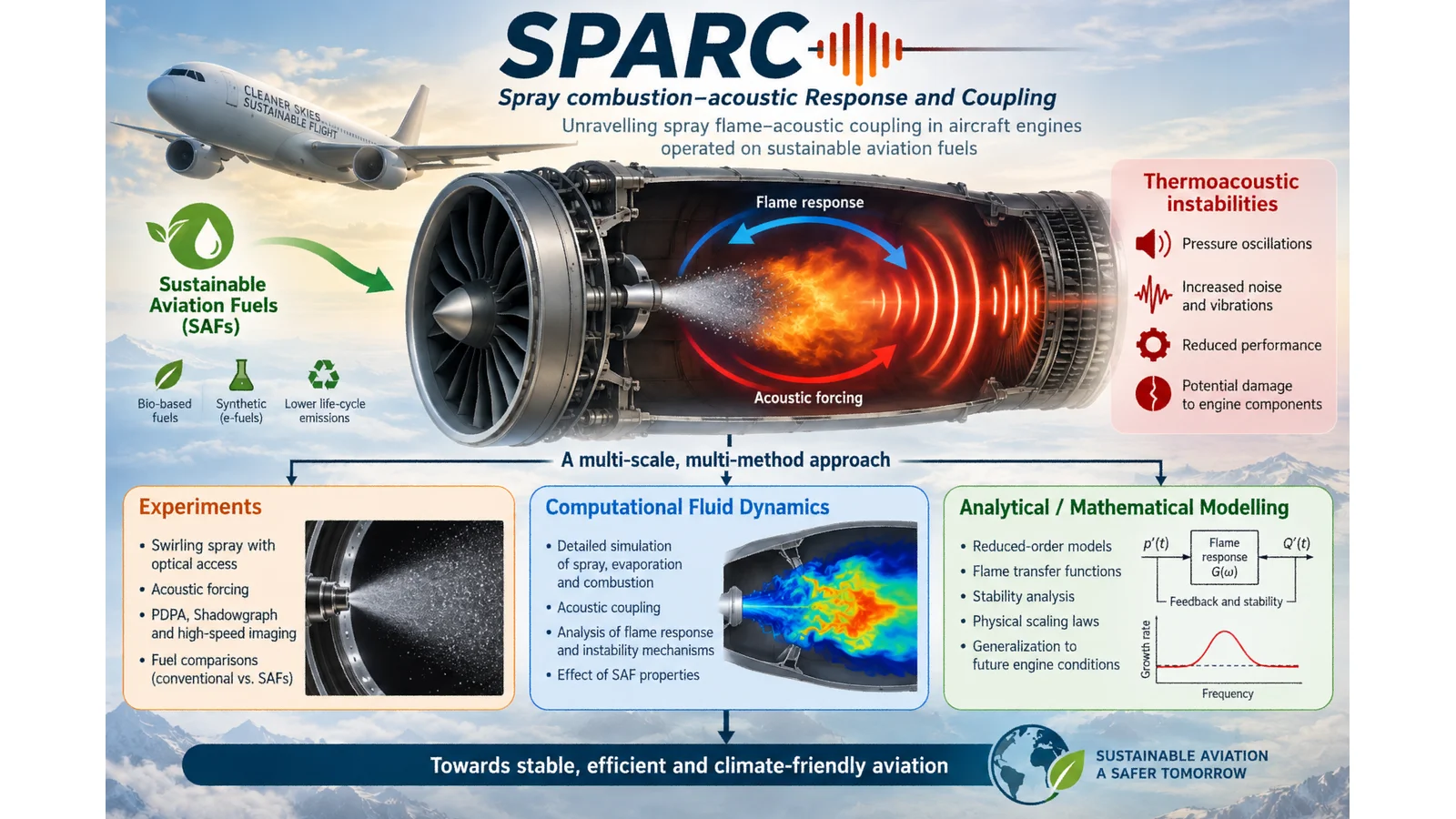
This project will investigate how SAFs influence the stability and performance of aircraft-engine combustion systems. Particular attention will be given to thermoacoustic instabilities, in which fluctuations of the flame interact with sound waves inside the engine. Under certain conditions, this interaction can amplify pressure oscillations, leading to noise, vibrations, reduced performance and, in severe cases, damage to engine components.
The project will combine laboratory experiments, computer simulations and mathematical models to understand how SAF sprays and flames respond to acoustic disturbances. The results will provide new knowledge for the reliable use of sustainable fuels in future aircraft engines and help identify operating conditions that avoid combustion instabilities.
Key data
Projectlead
Deputy Projectlead
Project team
Project status
Start imminent, 12/2026
Institute/Centre
Institute of Energy Systems and Fluid Engineering (IEFE)
Funding partner
SNF Ambizione
Project budget
748'100 CHF
Further documents and links

School of Engineering
Technikumstrasse 9
8400 Winterthur